| | | THE LATEST PROGRAMME | | | |
| | Jonathan Freedland looks for the past behind the present. Each week, The Long View, recorded on location throughout the British Isles, takes an issue from the current affairs agenda and finds a parallel in our past.
Have you got a good subject for a future programme? Click here to make your suggestion. | | | 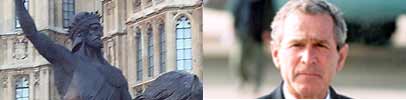
Statue of King Richard 1 of England and President George Bush. |
 Sources used for readings in the programme Sources used for readings in the programme
The leader of the West talks about a crusade to the Middle East. George Bush recently used the word in relation to Saddam Hussein and Iraq. It's traditional context goes back to the Middle Ages when Western Europe's Christian powers attempted to re-capture Jerusalem from the new Islamic regional Power.
What are the parallels between these two attempts to lead crusades (and maintain coalitions) into the Middle East?
In 1095 Pope Urban received an appeal from the Emperor of Byzantium, asking for aid against the Turks who had captured Asia Minor from the Byzantine Empire. Pope Urban, in the same year, made a famous call to arms. A crusade from Western Europe ensured and was successful with the capture of Jerusalem in 1099.
The election of Godfrey of Bouillon as defender of the Holy Sepulchre marked the beginning of the Latin Kingdom of Jerusalem. A Latin patriarch was elected. Other fiefs, theoretically dependent on Jerusalem, were created as the crusade’s leaders moved to expand their domains.
| | | On Location | | 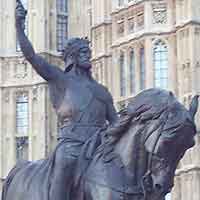 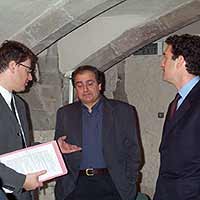 | | Left-hand picture:Statue of Richard 1 outside the Houses of Parliament
Right-hand picture:Jonathan Friedland, Youssef Choueiri and James Rubin.
| | 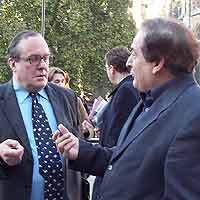  | | Left-hand picture:Michael Ancram with Youssef Choueiri
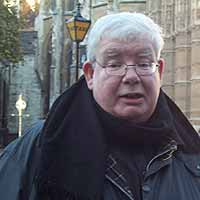
Right-hand picture:The actor Richard Griffiths
| | 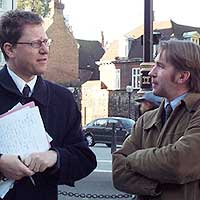  | | Left-hand picture:Jonathan Freedland with Jonathan Phillips
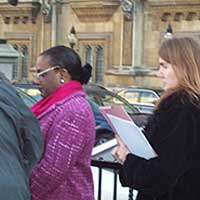
Right-hand picture:Diane Abbott and Sarah Johnson, programme producer, during recording outside House of Lords
| | This new Latin kingdom came under attack from the Ottoman leader, Saladin. The Third Crusade, 1189–92, followed on the capture (1187) of Jerusalem by Saladin. The crusade was preached by Pope Gregory VIII but was directed by its leaders—Richard I of England, Philip II of France, and Holy Roman Emperor Frederick I.
The crusade was a complex coalition of Western Powers. In fact it did not hold together and the crusade ultimately failed in its major of objective of taking Jerusalem. How clear a strategy did the Crusaders have, and how clear is America's? What does America want from intervention in Iraq? What does the UN want? And how realistic is America's plan for Iraq after the downfall of Saddam Hussein?
Contributors
Jonathan Phillips - historian of the crusdaes,
Richard Griffiths - actor,
Youssef Choueiri - reader in modern Arab and Islamic history,
Michael Ancram MP - Conservative,
Dianne Abbott MP - Labour,
James Rubin - former US Assistant Secretary of State.
|
| | |






 Listen to introduction