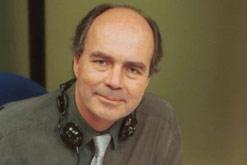
Nick Clarke's widow examines how society deals with bereavement.
8.00 - 8.30pm
12 May 2008
Just over a year after the death of the broadcaster Nick Clarke, his widow, Barbara Want, investigates the way we as a society deal – or fail to deal - with bereavement.
When Nick Clarke died, leading politicians and journalists paid tribute and the BBC Radio 4 website hosted some 3,000 pages of acknowledgment, accolade and condolence - a public outpouring. But Barbara’s personal experience was a marked contrast.
In this programme Barbara tries to understand what lies behind a common experience: that our society is unable openly to talk about death. She tells her story of how those around her, both close and more distant, have found it almost impossible to address her loss. When words are spoken they are nearly always the same: ‘I don’t know what to say…’
In 1961 C S Lewis wrote in A Grief Observed:
“I’m aware of being an embarrassment to everyone I meet. At work, at the club, in the street, I see people, as they approach me, trying to make up their minds whether they’ll say something about it or not.”
Barbara describes similar experiences, and during the programme she challenges people in her local community about her feelings of isolation since Nick’s death and mirrors her journey with an investigation into the British psyche, trying to find out what it is about our culture that makes us so uncomfortable with bereavement when other cultures have specialised rituals to support and allow the pain, sorrow and sometimes madness of grief, and to discuss mortality.
“This country, just over a century ago was gripped by a ‘cult of death’ - it has an openness about the subject and rituals for the bereaved and those around them. It lasted until the death of Queen Victoria. Yet now we seem unable to talk about it at all,” she says.
Useful Information
Cruse Bereavement Care: Provides support and offers information, advice, education and training services. Web: www.crusebereavementcare.org.uk/ Helpline: 0844 477 9400
The WAY Foundation: Supports those who are bereaved and young. They run social groups across the UK. Tel: 0870 011 3450 Email: info@wayfoundation.org.uk
The Compassionate Friends: Provide support and friendship for bereaved parents and their families Tel: 08451 23 23 24 Web: www.tcf.org.uk/
Jewish Bereavement Counselling Service Tel: 020 8385 1874 Email: jbcs@jvisit.org.uk
Child Death Helpline: A helpline for all, including children, affected by the death of a child. 0800 282 986 Web: www.childdeathhelpline.org.uk/
Winston’s Wish: Help for grieving children and their families. Tel: 0845 20 30 405 Web: www.winstonswish.org.uk/
The National Association of Bereavement Services: For information about your nearest, most appropriate source of support.2nd Floor, 4 Pinchin Street, London E1 1SA . Tel: 020 7247 1080
Dr Colin Murray Parkes: Honorary Consultant Psychiatrist to St Christopher's Hospice, Sydenham and St Joseph's Hospice, Hackney. Now retired from private clinical practice and unable to accept referrals from outside these hospices. Dr Colin Murray Parkes' research and career