British shipping companies first started employing Chinese sailors during the Napoleonic wars to replace the British sailors who had been called up to the navy. They soon discovered that they were cheaper, didn’t get drunk and were easier to command.
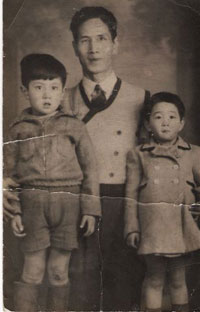
Conditions aboard ship appalled Lee Cheong when he visited his father’s quarters:
"The smell … I remember the smell and the incredibly cramped conditions. I remember going down below, rows and rows of bunks, knapsacks and all sorts of junk stuffed in every nook and cranny ... lots and lots of people milling around. I couldn’t think of anything worse than those sorts of conditions."
Lee Cheong as a child with his sister and their seaman father Photo courtesy of Lee Cheong
With the advent of steam in the 1860s, the recruitment of Chinese seamen increased on the trading routes from the Far East. Former Blue Funnel sailor Cheun Ng describes why a job on these ships was such a sought after ambition for Chinese men and why Liverpool, then the hub of the Empire’s sea trading, soon had a thriving Chinatown.
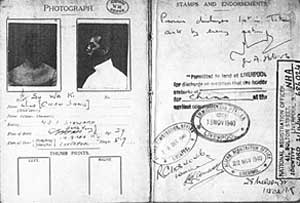
During both world wars more Chinese seamen were recruited and many hundreds were killed and injured aboard British ships. Graham Chan’s father and uncle were both on ships torpedoed by German submarines.
Seaman Chan Sang and his seaman’s identity document
The document shows that his ship was “sunk by enemy action”. Photos courtesy of Graham Chan
A Chinese seaman called Poon Lim set the world record for survival on a raft after his ship was sunk by a German submarine in 1942. Despite such risks, Chinese seamen were treated shabbily, with less pay and rights than their British counterparts.
During the World War II, the Chinese Seamen’s Union led strikes to demand the War Risk Bonus - which they eventually won.
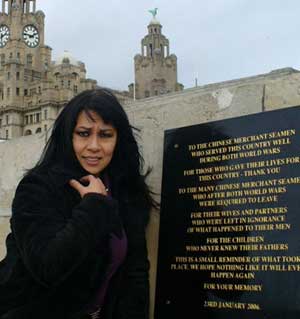
But after the war was over, the Government and the shipping companies colluded to repatriate thousands of Chinese seamen, many of whom left behind wives and children they would never see again.Yvonne Foley’s father was among those repatriated and has spent many years trying to uncover what exactly happened to him and other Chinese seamen at that time.
Yvonne Foley has set up Half and Half, a network for families of Chinese seamen who were repatriated after the second world war.
Sole Survivor: A Story of Record Endurance at Sea, Ruthanne Lum McCunn (Scholastic NY 1996) The fictionalised account of the Chinese seaman Poon Lim, whose British merchant ship was torpedoed by German submarines in 1942. His 133 days of survival on a wooden raft is still the longest recorded survival story in modern history.
Chinese Liverpudlians: A history of the Chinese Community in Liverpool, by Maria Lin Wong. Liver Press, 1989.