

16:30 - 17:30
Sean Rafferty presents a selection of music and guests from the arts world.
Musical Instruments |  | |
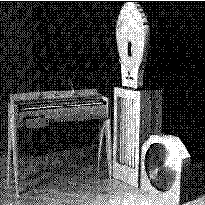 Electronic instruments Although the power of electricity was recognised as early as the eighteenth century, the first musical instruments to harness it in any viable form were not invented until the 1890s in the USA, and even these were short-lived experiments. Only in the 1920s, and in Russia, was an instrument created that had a career of any significance. This was the theremin , named after its inventor, Lev Termen . In its original form, the player's hands moved in front of two antennae, one of which controlled pitch, the other volume: later versions employed a keyboard. A concerto-like piece was written for the theremin by Andrey Paschenko in the form of his Symphonic Mystery in 1924, but it was heard by a much wider audience when the Hungarian-born Hollywood composer Miklós Rózsa made a feature of it in his score for the Alfred Hitchcock psychological thriller Spellbound in 1945. Edgard Varèse incorporated two theremins in his Equatorial (1934), though replaced them in the revised version with ondes martenots . The latter was far more successful, not least because it became a favourite instrument of a major composer: Olivier Messiaen . Invented by Maurice Martenot (a fully trained musician) in 1928, the ondes martenot relied on a principle similar to that of the theremin but quickly acquired a keyboard. It made its debut in a piece called Poème symphonique by Dimitrios Levidis. Among other composers who exploited it early on were such prominent figures as Darius Milhaud , Jacques Ibert , Arthur Honegger , Florent Schmitt , Charles Koechlin and André Jolivet . Varèse listed it as an alternative option in two compositions. But it was the advocacy of Messiaen, starting with his Fêtes des belles eaux in 1937, that eventually made it known worldwide. It occurs also in his Trois petites liturgies de la présence divine (1944) and the Turangalîla-symphonie (1948), and his own sister-in-law Jeanne Loriod became its most distinguished exponent. Early on in his career Pierre Boulez also wrote an ondes martenot quartet. Less successful, though far from negligible, was the trautonium , first exhibited in Berlin in 1930 by its inventor, Friedrich Trautwein : among the composers who succumbed to its charms were Paul Hindemith (who inevitably wrote a Konzertstück for it), Werner Egk and even Richard Strauss . More widely distributed, and having an impact upon a huge variety of music making, was the invention of the electronic organ : various forms were created, but it was the patenting of the Hammond Organ in 1934 that led to this innovation really taking off: well over 2 million such instruments have subsequently been sold. Its repertoire is not, however, unique to it -- music written in any style for any kind of organ can and has been played on it. Another old acoustic instrument given a new impetus by amplification was the electric guitar , which in its wired-up form (first marketed in 1931) went on to become the defining instrument of rock music, and to be almost as strongly represented in other mass media genres. It has also been heard occasionally in 'classical' contexts, such as Michael Tippett 's 1960s opera The Knot Garden . After the Second World War, the lead in the creation of electronic instruments passed to Japan, where new and increasingly compact circuitry revolutionised the electronic organ and led to the creation of the synthesiser , which has gone on to find a place in almost all popular or commercial forms of music making as well as providing an inspirational tool to avant-garde musicians working in the contemporary classical field. The analogue synthesiser first appeared in 1964, followed within seven years by its digital equivalent: such instruments have become ever more sophisticated, and now have the capacity to generate a staggering range of sounds. Later models, in effect, are modified computers specially adapted to the requirements of sound generation, and covering all conceivable sonic parameters. In terms of the computer proper, an increasing number of composers has made use of them: one of the most notable is the Paris-based Modernist Iannis Xenakis , much of whose work has a complex mathematical basis, the calculations for which can far more quickly be arrived at by a computer than by a mere composer. In terms of electronic music itself, thousands of works have been created using tape since the first experiments made by Pierre Schaeffer in a radio studio in Paris back in 1948, but since compositions for tape alone always remain the same the use of the word 'instrument' is at the very least debatable. During the 1950s composers working in the Cologne Radio Studios utilised oscillators, filters and modulators, but here again the finished compositions existed only as completed objects on tape. Throughout that decade and the 1960s special studios were created all over the world for experimentation into electronic music, but it is only when the results are employed in live performance (as in certain works by Karlheinz Stockhausen , John Cage , Pierre Boulez and others) that instruments become involved. This mixed genre is known as electroacoustic music, and the brilliance and originality with which live orchestral sounds are transformed and manipulated in a work such as Boulez's Répons (1980) are beyond question. The indefatigable French composer/conductor/administrator himself set up the most important institution for creative research into relationships between live performers, electronics and computers in Paris in 1969. The work of the Institut de Recherche et de Coordination Acoustique/Musique has been highly influential in stimulating new compositions, and many important creative figures have developed their works there, two of the most notable from this side of the Channel being Jonathan Harvey and George Benjamin . | | Music Genres Instrumental Chamber Orchestral Vocal Choral Opera Music Timeline Medieval Renaissance Baroque Classical Romantic Modernism Musical Instruments Strings Woodwind Brass Percussion Electronic Related Links on radio 3 on bbc.co.uk Essential Guide to Classical Music What's On Classical TV and Radio Classical Reviews Guide to the Orchestra on the web The BBC is not responsible for the content of external websites. |
| | |

BBC iD
BBC iDBBC navigation
BBC links

BBC © 2014The BBC is not responsible for the content of external sites. Read more.
This page is best viewed in an up-to-date web browser with style sheets (CSS) enabled. While you will be able to view the content of this page in your current browser, you will not be able to get the full visual experience. Please consider upgrading your browser software or enabling style sheets (CSS) if you are able to do so.
