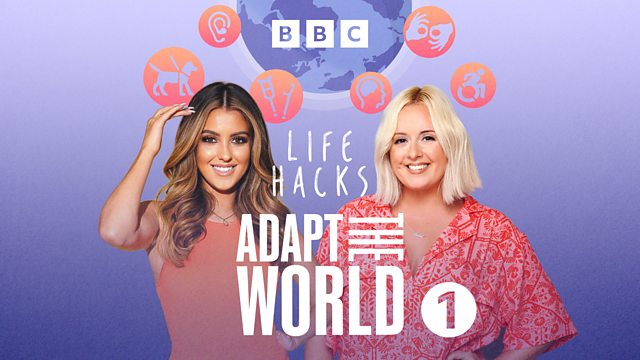
Adapt the World with Niall Aslam
Former Love Island contestant Niall Aslam joins Katie Thistleton and India Sasha with three things he'd change about the world to make life fairer and easier for disabled people.
Life Hacks’ Katie Thistleton and influencer and disability rights activist India Sasha ask if the world was re-built tomorrow 'what would you change to make life fairer and easier for disabled people?'
In this episode they are joined by Niall Aslam, a content creator and former Love Island contestant with Asperger's Syndrome. They discuss everything from masking your disability to disability and mental health.
Last on
More episodes
Transcript
Katie: Hello and welcome to the Adapt the World Podcast. This is the place where we want to find out the three things you'd like to change about the world to make it a better place for disabled people. I'm Katie Thistleton from Radio 1’s Life Acts, and I'm joined by my amazing co host, India Sasha. We'll also be joined very shortly by today's guest, Niall Aslam. He's an ambassador for the National Artistic Society and he has autism himself and you'll probably know him from his time on Love Island too back in 2018. But first India, can you tell us a little bit about you?
India: So I create content on TikTok, kind of trying to normalise disability and just to show people that no matter what kind of situation that you just happen to be in it doesn't have to stop you. I try and communicate that to the people that watch my content and also give them a bit of a giggle along the way because not everything about disabilities and stuff has to be so negative. Like I genuinely enjoy being different and I just like to tell my story through my videos and my content.
Katie: And you do it very well. Your videos are excellent, and someone else who does that sort of thing is Niall and he joins us right now. Thank you so much for coming on the podcast Niall. Can you tell us about your experience being diagnosed with autism?
Niall: I was diagnosed at eight. Because I was so young, probably my mom would know more about that time in my life.
Katie: Yeah, of course, can't remember the exact details!
Niall: The process of actually getting a diagnosis takes quite a long time. I feel like it takes longer now than it did years ago when I was that age. But, I think I started the diagnosis process at seven and got my diagnosis at eight. They don't actually give the diagnosis of Asperger's anymore when it comes to autism. Now people get diagnosed with autism. They don’t use that anymore. I had to learn myself when I started to talk publicly about autism, like the definitions of things have changed.
Katie: Yeah. It can be quite complicated, it can be confusing. Can you remember how that felt at that time? Like you say you were very young.
Niall: Yeah, so it was strange cause I just kinda got taken out of classes. Because I was always in CAMS, the Child and Adolescent Mental Health Services. So I was always in CAMS. They'd be like, “what does this blob symbolise to you?, what does my tone of voice sound like?” And then I'd be like in a group and people would be bouncing around like on these settees and things and asking questions. I didn't really know what was going on to be honest. But then it was only later in life… I don't remember a specific moment when I was like, “oh yeah, this is how I felt when I got diagnosed with autism”. Because I was so young it’s just kind of like all I knew growing up from like 10.
I've started to become more aware of it more as I'd say I got to like 10 or 11 years old. Especially in secondary school because I'd hear negative stereotypes a lot from people and like people saying like words about it and making fun of people and things like that.
And I'd be like, “Oh I'm diagnosed with that” and I'd feel quite ashamed of myself. So I didn't want anyone to know about it. When I was in secondary school it was on a need to know basis between professionals. I wouldn't go around telling people like, “oh, I'm autistic”. I'd be in learning support a lot, but I'd tell people it's because I'm naughty I've got sent out of class. I’d make up excuses, sometimes I do something naughty just…
India: To fit the description?
Niall: Yeah
Katie: Isn’t that funny how we'd sort of rather have the label of naughty than, than the label of having autism? It sort of says a lot, doesn't it, about how we treat people?
Niall: It was at that time when I'd hear how people would talk about things and I just didn't want people to like, you know, you know how kids can be. Especially like in the 13-15 range. I don't want people knowing that about me when I've seen how people can be, so I ended trying to keep it on the low.
India: So how has your experience with autism been for you? Like what is your kind of day to day like and just the things that you kind of as an individual would experience?
Niall: For me when it comes to autism, I've picked up a lot when it comes to masking, but like I can struggle a lot and people wouldn't pick up that I struggle with like social situations, but like growing up I really did. But eventually I kind of learned to kind of, I guess act my way through it, if that makes sense. I used to struggle with things like eye contact and things like that, but as I got older, I learned to kinda put on more of an act. But I still struggle with these things and I have a very special interests when it comes to things like my food, it has to be very specific and plain. I've learned to mask a lot when it comes to being autistic.
Katie: Let's get into the three things that you would change if you were to rebuild the world tomorrow and make it better for people with disabilities in general. What's the first thing you'd like to change?
Niall: Well, the first thing I'd like to change is that there just needs to be more education around adjustments to people with disabilities. Because I feel like a lot of the time there's only like small things that make a very big difference. I think people just having a better understanding around the importance of small adjustments and big adjustments and just understanding around that. I think it's a really big thing for people with disabilities.
Katie: So people just stop having that empathy and not judging you and thinking he's just being difficult or being fussy, actually that's something that's really, really important to you and, and a need that people need to meet.
India: Yeah. And what about your second thing? What other thing would you change if you could?
Niall: I think there needs to be more understanding and more education around non-visible disabilities and because I think sometimes, I've often got like, “oh, you know, you don't look autistic” and things like this.
But I think people, there's such a lack of, and I think it is slightly getting better. I'm not old, but I've been diagnosed with autism for a very long time. So I have seen a lot of changes around it. But I still think there's a lot of, when it comes to non-visible disabilities, a lot of education that still needs to be done because you'll get like, “oh, you know, you don't look autistic” or things like that or “you're not typical with how you present” and things like that. But I think it's just a lack of education around it and I think if people are educated more then I think it would be helpful for everyone really in understanding each other.
Katie: You don't know what's going on for someone, do you? You don't know if they've got a non-visible disability. You don't know if they're struggling with their mental health. And it goes back to that sort of compassion and empathy, doesn't it? Because we probably do it where we'll sort of judge someone, we'll think they're behaving in a certain way and you'll think, why are they being weird? Or why they're being moody, you know? And you judge them and then actually if you found out what was going on for them, you'd be like, “oh, okay”.
Niall: Yeah, I remember like. I did like a placement. It was like an advocacy service for children in care, you’d be an advocate and you’d represent them, this was before the show (Love Island). It was like a placement and I'd represent their wishes and feelings at different meetings around their care. And then one day on placement, I got taken to a mental health facility by the supervisor at the time. And there were like people there that were on such heavy medication and it really kind of shook me up. I was like, wow. How do you people get like that, not in a bad way. I was like, wow… I remember going home and being like, wow, that shook me up that people can get, from their mental health, to that kind of like that state, you know? And then fast forward, like literally less than a year I was in that literal situation. Where I was like that. And you realise that you don't know you are in that way. I was on so much medication when I was in like hospital that like, you know, I couldn't get my words out for a long period of time. I'd be kind of like speaking not very well, but in my head, I didn't realise that. So it just makes you realise not to judge people because like it could be you, you know what I mean?
Katie: Of course!
Niall: You don’t know that you're not gonna be on Love Island and then end up in a psychiatric unit within that period of time.
Katie: No one's immune from these things happening to them. Exactly. It could happen to everybody. So you’ve got to have that compassion for people and not judge. What's the third thing that you would change about the world now?
I’d like just a more broad coverage around disabilities and things with all aspects kind. I feel like often people always want that kind of “I had this and now I've ran a hundred marathons and I've conquered Everest and that”, which you know, people do do inspiring things like that, and it's great to see, but I feel like also talking about how some of the but it was hard with this, and this is the challenges that people face with disabilities, just so people can understand when people are overcoming these things and the challenges that people face on top of everything as well. Because I feel like people might get someone like, oh yeah, but then this was great. People don't wanna hear what people have to go through to get to that point or just covering people that might just be struggling in general because it's not a bright headline, but I feel like it's still, sometimes a reality that people face, you know?
Katie: It's a really good point, so don't shy away from the serious stuff and the negative sides of it as well. And like you say, we do a lot of things like,“oh wow, look at what this disabled person has done. Aren't they amazing? They've overcome the odds. They're so inspiring”. Actually, maybe we need to go, “this is really hard”. Do you sometimes think India we have all these kind of inspiring stories, but actually sometimes don't shy away from saying life is harder for me.
India: Yeah…
Katie: It's a balance between we've talked a lot on these podcasts about obviously you wanna be treated like you are capable like everybody else, but at the same time…
India: It’s almost like they're like, it's, it's romanticising the things that you do to be, “wow, look at you doing all these things”, but by saying “wow, look at you doing all these things”. It's kind of like you're, first of all, assuming that I couldn't have done all these things. And yes, I'm doing them but to get there it was very, very hard. And even though my disability is physical and I wouldn't genuinely change a thing. I like being different. I like having my hand. It's kind of part of me, but it doesn't mean that I struggle a lot of the time to carry bags and through schooling and PE and face discrimination and all that stuff that kind of comes along with that, and I think it's really, really important to be completely honest, because other people out there that might have a similar disability and you're talking so positively about it.
Katie: That's a good point. They're like, why are they coping and I'm not. Yeah, they're, they're coping. They've climbed Everest, like you say, and they’re like I'm really struggling with this.
Niall: Yeah. So I know people like that have had psychosis and similar issues to me that's like they might have like repeat episodes and things like that. And I can't, they can't talk about like, the same things as me. So I'm not trying to put a message out there that it's easy. It's not an easy to talk about because I don't wanna create some false things for other people and pretend life's breezy with that, it can get hard.
Katie: Of course, and no two experiences are gonna be the same, are they? Well, thank you so much Niall for chatting to us today and sharing your story and being so honest.
Niall: It's been great. I really enjoyed it.
Katie: It's been amazing. Thank you, and thank you so much to everyone who's listened to this episode. If you liked this, then there's more episodes just like this one that you can listen to right now. All you need to do is head over to the BBC Sounds app and search for ‘Adapt the World’. See you later!
Broadcast
- Thu 12 Jan 202302:45BBC Radio 1
Podcast
![]()
Adapt the World
Katie Thistleton and India Sasha explore what the world is like with a disability.