Stephen Hawking
History biography page about Stephen Hawking
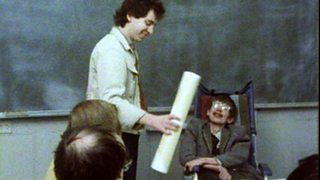
A new way of thinking about the world—Horizon, 2005-2006, The Hawking Paradox
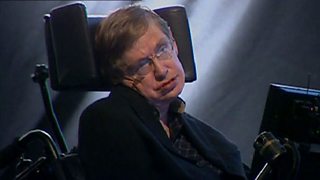
Hawking’s Motor Neurone Disease gradually robbed him of the use of his body. However, he managed to turn his disability into an advantage, by training his mind to work in a unique way.
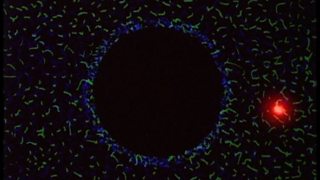
Black holes shine with Hawking radiation—Horizon, 1983-84, Professor Hawking's Universe
Hawking realised he had to combine theories from different areas of physics.
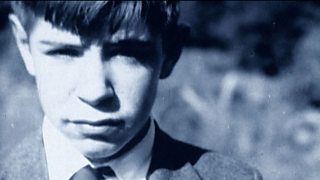
“No child prodigy”—Profile, Stephen Hawking
Hawking was a bright but unremarkable schoolboy, who was brought up to be curious about the world around him. However, in his early twenties he received a diagnosis that changed his life.
The Big Bang and black holes—Profile, Stephen Hawking
Hawking began working on black holes with Roger Penrose. He took a radical new approach, suggesting that the science of black holes could be adapted to explain on how the Universe was created.
A brief history of “A Brief History of Time”—Profile, Stephen Hawking
Hawking decided to try and communicate his ideas to a general audience. However, when his deteriorating condition robbed him of the power of speech, he had to find a new way to get his message across. The result was one of the best-selling books of all time.
The Information Paradox—Horizon, 2005-2006, The Hawking Paradox
In 2004, Hawking made a dramatic announcement.
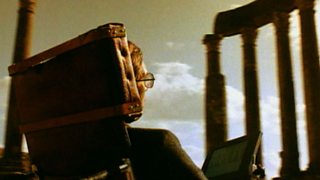
Playing the role of a priest—Profile, Stephen Hawking
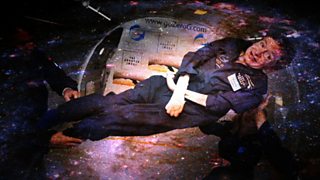
Hawking's fame transcended the scientific community, and led him to become one of the most recognisable figures on the planet. Why has he captured the public imagination in this way?
“I’m not retiring!”—Newsnight, 30/09/2009
Hawking became Lucasian Professor of Mathematics, a post once held by Isaac Newton. When he reached the age of 67, Cambridge University tradition held that he had to stand down. Stephen used the occasion to compose an audio essay for the BBC’s Newsnight, in which he explained why he wasn’t retiring.