Whirling wings
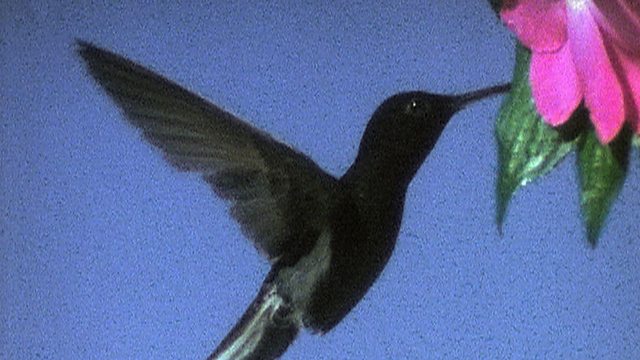
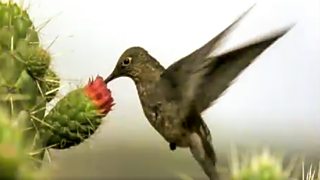
Slow motion shows the extraordinary figure of eight beat of hummingbird wings.
Only hummingbirds can hover for any length of time without the help of a headwind. Their wings work in a unique way. They routinely beat 25 times a second, making the humming sound that gives them their name. Hummingbird wings work by producing down-drafts. Their wings beat by making a figure of eight, and flick over on the backstroke. Unlike the wings of other birds, they are symmetrical in cross-section, so work equally well to propel the bird in any direction, depending on the steer of its tail. This flight takes a lot of energy so they have to refuel very frequently. But flowers close at night, so what then? This is a particular problem in the Andes where the nights can be very cold indeed. As evening approaches, the Andean hillstar hummingbird heads to a cave to roost and goes into a state of torpor at night to save energy. Its heart - which beats at 1000 times a minute in flight - now slows to almost nothing. Its body temperature falls dramatically and its breathing seems to stop altogether. Basically it is doing what a hedgehog does every winter, but a hummingbird has to do this every evening of the year. The following morning it will start up all its motors once more.
Duration:
This clip is from
Featured in...
![]()
High Speed - Life slowed down
A collection of clips showing the best in slow motion nature films.
![]()
BBC Nature
Be captivated, informed and inspired by the world's wildlife.

More clips from The Mastery of Flight
![]()
Light fantastic
Duration: 01:48
![]()
Landing craft
Duration: 02:22
![]()
Air display
Duration: 01:28
![]()
Stationary view
Duration: 01:19
More clips from The Life of Birds
![]()
Weka Territory—To Fly or Not to Fly?
Duration: 01:08
![]()
Feet on the ground—To Fly or Not to Fly?
Duration: 00:51
![]()
Thirst quencher—The Limits of Endurance
Duration: 03:10
![]()
Food on the run—Meat-Eaters
Duration: 02:12