Heading Back To Work; "Blindness" At London's Donmar Warehouse
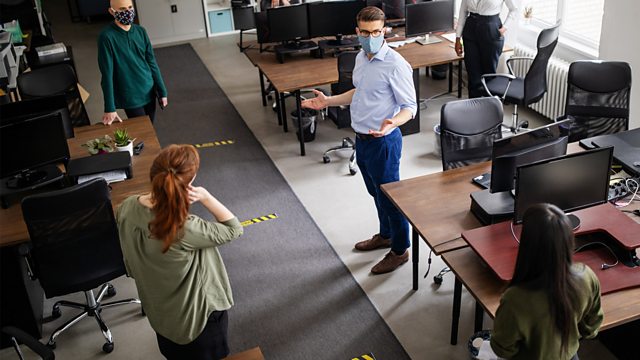
Lots of workplaces are very different now with social distancing. So how easy is to to return to work when you're blind?
We review "Blindness" at London's Donmar Warehouse.
We look at the challenges facing people who are blind or visually impaired when they return to work for the first time since lockdown. We'll get advice from Maria Shinn. She's from ACAS which gives employees and employers free, impartial advice on workplace rights, rules and best practice.
And our reporter Fern Lulham heads to London's Donmar Warehouse to check out a sound installation based on the novel "Blindness" by the Portuguese author José Saramago. Playwright Simon Stephens has adapted the book and Juliet Stevenson stars in the production which focuses on the the rise of a global pandemic.
Presenter: Peter White.
Producer: Mike Young.
Last on

In Touch transcript: 18/08/20
Downloaded from www.bbc.co.uk/radio4
THE ATTACHED TRANSCRIPT WAS TYPED FROM A RECORDING AND NOT COPIED FROM AN ORIGINAL SCRIPT. BECAUSE OF THE RISK OF MISHEARING AND THE DIFFICULTY IN SOME CASES OF IDENTIFYING INDIVIDUAL SPEAKERS, THE BBC CANNOT VOUCH FOR ITS COMPLETE ACCURACY.
IN TOUCH – Heading Back To Work; "Blindness" At London's Donmar Warehouse
TX: 18.08.20 2040-2100
PRESENTER: PETER WHITE
PRODUCER: MIKE YOUNG
White
Good evening. Home versus workplace – tonight, some of the current dilemmas facing visually impaired people who want to go on doing their job. And an epidemic of blindness in Covent Garden.
Clip
You can’t see anything around you, it’s pitched black, there are sudden loud flashes and loud bangs. It’s just a performance, you’re in a safe place and actually everything is fine but there were moments in the production where it was genuinely scary.
White
Don’t panic, it is only fiction but what effect do such poor trails have on people’s perceptions of blindness?
But first, a hot topic at the moment is what’s going to happen to work and where we do it? Has homeworking been such a success that it may become the norm or will people gradually go back to the creative buzz and companionship that working together, with your colleagues, can provide?
From the start of this month employers have been encouraged by the government to bring staff back to the workplace if it’s deemed safe to do so. But there are potential challenges for visually impaired people when it comes to things like social distancing and confidently navigating a workplace that may have significantly changed its layout since the last time you were there. Well we wanted to start looking, tonight, at how this might affect the admittedly too small number of visually impaired people who have a job, concentrating on what your rights are, whether you stay at home or go back to the office, or, in Hannah Smith’s case, the shop. We heard Hannah last week talking about how lockdown had been for her but she also talked about going back to the British Heart Foundation charity shop, where she’s worked for the past 10 years and which had been a big part of her life.
Smith
It felt really strange actually because the last day we shut I worked up until the Saturday and was due to go on holiday. I then discovered we weren’t going on holiday and before we’d all gone into lockdown I said to my boss – look, I’ve got nothing really planned next week, so, if you want me to come in for an emergency afternoon then let me know. But I then received a phone call on the Tuesday, going – don’t worry Han, I’m locking up anyway, we’ve gone into lockdown, I will let you know when we’re reopening.
White
So, you lost your holiday and you lost your job?
Smith
Yeah along those lines.
White
But now you’re back, because I’m interested in this – how, for visually impaired people, going back into the workplace because the worry always is that you’ll have lost some confidence over this…
Smith
Yeah.
White
What’s happened to you?
Smith
Work have been very good actually. We’ve had a new layout of the shop and my manager very kindly walked around the shop with me to show me where everything was. Prior to that we all had an online training session to deal with wearing masks, having screens and all of that. Some of it was quite visual but there was lots of speaking, so, even if I couldn’t see the images I could hear. And after the training I was able to sit down with my manager and have a conversation, which boosted my confidence in case I missed something on the video clips.
White
So, now you are feeling – I mean were you worried about the loss of confidence and how is it working out…
Smith
Yeah, I think the first day I was a bit nervous because I’d literally finished in March, two and a half weeks ago I went back…
White
So, really you’d lost about four months.
Smith
Four months – I, you know, I hadn’t done anything and I walked back in and I was like – ooh, okay, we’re back open but things are slightly different.
White
So, on the whole good marks really for Hannah’s employers. But what rights do visually impaired people have so that they can make the decision of home versus workplace on equal terms with their sighted colleagues?
Well, there are a number of places from where you can get advice. Maria Shinn is from ACAS, now they aim to give employees and employers free impartial advice on workplace rights, rules and best practice.
Maria, what should an employer be doing to make sure that someone who’s blind or has partial sight can actually be confident coming back to work, what are the main things they should do?
Shinn
Well, the employer needs to do a risk assessment for anyone returning to their workplace, so, they would need to be mindful of particular changes that have happened that may affect a blind person. And it could be the things that you talked about, perhaps, where there are new walkways, there are different ways of entering and exiting the building. So, those sorts of things need to be discussed with the employee before they return and that communication is really important.
White
Can you give us some examples of the kind of things that a blind or partially sighted person might have the right to ask for but maybe other people wouldn’t think about?
Shinn
They may ask for a colleague to be there to perhaps guide them around to start with, so they can familiarise themselves with the changes within the building. So, it’s about thinking about when are other people going to be working in that workspace and who’s going to be available to help that blind person once they go back and particularly at the initial stages.
White
We’ve heard a lot of people complaining in shops about the fact that there are visual signs about where you can stand and so forth. I mean things like colour contrast, for example, that surely would be something people might not think about.
Shinn
No and that can be really important to a blind person that that is thought about. There’s also a requirement for the employee to be really open about what they need from the employer, what needs to be taken into consideration because not all employers will feel confident in considering the needs of a blind person. So, that needs to be very much a two-way discussion.
White
Some people might be a bit worried about, you know, I don’t want to appear too special but you do have rights to reasonable adjustments, don’t you?
Shinn
Absolutely. A blind person would be covered by the Equality Act. So, if somebody has a disability then they do have the right for reasonable adjustments to be considered by the employer to ensure that they are safe in the workplace and they’re able to carry out their role effectively. And actually, for the visually impaired person, perhaps once they first go back into the workplace, they may identify things themselves that they’re having difficulty with. So, it may be a really good risk assessment is done before they return but actually there are other factors that perhaps hadn’t been considered or haven’t been thought about and then they become apparent once they’re there.
White
We’ve talked so far about returning to the workplace, but what rights does an employee have who either wants to continue working from home or who’s being told that at the moment this is their only option?
Shinn
So, there may be circumstances where somebody feels that they need to continue to work from home, they could be shielding or been living with somebody else who needs to shield and they may have anxieties and fears about that, so, it’s important to raise those with your employer if that is the case. But the right to work from home, it’s possibly a variation on their contract, so it’s something that they would have to discuss with their employer about what the long-term plan is and how that’s managed.
White
It strikes me that some employers, with the best intentions, might make the assumption that because it means no travelling, no refamiliarisation with the workplace, if you come in, that visually impaired people would prefer to work from home and that might be true for some but for some the companionship, the informal help you get from workmates, that may be sorely missed.
Shinn
Yes absolutely. For some employees, yes they may be very happy to continue to work from home because it may be easier than using public transport and various other things but for very many people it may be that part of their social interaction is going into work, be with different people and it’s good for their mental wellbeing as well.
White
So, the message seems to be keep talking on both sides.
Shinn
Absolutely.
White
Maria Shinn from ACAS thank you very much indeed. And I’d love to hear people’s work experiences, whether as a stay at home worker or perhaps someone who’s ventured back to the workplace – intouch@bbc.co.uk, is our email address.
And thanks for all your emails that responded to other programmes that we’ve been doing over the past few weeks. When it comes to the challenges of wearing or not wearing a face mask Sight for Surrey and Open Sight Hampshire have both been in touch with us, they’ve designed exemption cards to wear which explain why you might not be masked up. And last week the RNIB backed the government’s official badge that’s been released to help people social distance, the Please Give Me Space visual indicator can be downloaded or printed from the gov.uk website and there’s a link to that on our own In Touch site.
There’s also reaction to our item on robot guide dogs. Christie Ward says: “I’d be happy to pay £600 or £50 a month for this potential brilliant invention if it would enable me to get out more and feel safer.” Christie goes on to say: “Symbol canes and guide dogs are not for me,” she adds: “Let’s be more positive as younger visually impaired and blind people want these essential and needed inventions.” Whereas Philip Partridge has emailed from North Devon, he says: “Robotic guide dogs will never replace the real thing, anyone who’s ever had one of these wonderful life-changing animals will tell you that technology can never replace the enormous emotional support that they provide to their owners.”
Now there’s not been much live theatre to go and see recently but one production that is on right now at London’s Donmar Warehouse is called “Blindness” and it’s all very timely as it tells the story of a mysterious pandemic, though this time the main symptom is people going blind.
Clip – Blindness
In the first 24 hours he said there were hundreds of cases of blindness, they were all alike, they all shared the same symptoms, the same whiteness. Nobody felt pain. On the second day the government announced that the situation would soon be under control. They used what they called a curve of resolution to prove that there were clear signs that the epidemic was on the wane. They were wrong.
White
Well, we’ve heard some of that before. That was Juliet Stephenson performing in Blindness. The performance is described as a socially distanced sound installation. It’s based on a novel by the Portuguese author – José Saramago. Twenty years ago, Saramago received the Nobel Prize for Literature for works including Blindness but a subsequent filmed version of Blindness caused something of a stir, especially amongst some blind people for its treatment of the subject.
Time, we thought, to send our reporter – Fern Lulham – along to the Donmar to check out the soundscape version and engage its effect on the audience.
So, Fern, first of all, the event itself – how did it feel to be back in the theatre again?
Lulham
It felt good but as with so much else at the moment I was very aware of it being a tentative step back into normality rather than normality itself. I should say that as the name suggests the Donmar Warehouse isn’t a traditional theatre, so it’s more of a big open space and when I went into it, it was more like a nightclub – so very dark with just some different coloured strip lights on the ceiling – so a very different feel to usually when you go to a theatre. Naturally queueing was involved, social distancing and seating involved splitting the audience into small socially distanced groups, so the numbers attending were much lower than they usually would be as well.
White
So, tell us a bit more about the performance and the plot. I mean it was a 400-page novel originally, so keep it short.
Lulham
Yeah, it’s quite hard to tell you, to sum it up Peter but I will start by saying that as you mentioned earlier it was a sound installation and that means that the whole story was told through headphones and as you got a little snippet there, the whole design of the sound is made to feel like you’re right in the middle of the action, so you feel very intimate and very involved. There’s no stage and no actors present, except from obviously the voice of Juliet Stephenson and the sound is supplemented in some places by lighting, so flashing, different colours, a lot of it is done in pitch blackness and that definitely helps to amplify the mood created by an already dramatic story. We follow the story of a group of people made blind by the pandemic and the wife of one of that group who mysteriously retains her sight but who pretends to have lost it, so that she can join her husband when in quarantine in an asylum set up by the authorities in response to the pandemic. Now order within the asylum breaks down very quickly as basics like hygiene and food, the supplies worsen, and violent attacks start to occur. Now I won’t tell you the end, just in case you want to go and see it, but suffice to say it’s a very dark story, both physically and figuratively.
White
And from what you say it’s not exactly giving one a positive view of blindness, which is presumably why some people objected to it when it was filmed.
Lulham
Yes, the film came out in 2008 and there was a lot of controversy around it, there were protestors and picketing of some cinemas in America. Blind people were saying that the blind people in the story were portrayed as monsters. But Saramago did bite back against this, he said that his story depicts a blindness of rationality and went on to say that stupidity doesn’t choose between the blind and the non-blind. So, in other words, this is about humanity rather than targeting blind people.
White
Right, so it’s how people might react in that situation.
Lulham
Yeah and very extreme.
White
What about what I’m sure was a predominantly sighted audience, what did they make of it?
Lulham
I was interested to talk to the audience because I felt that it really did play on that fear in sighted people that blindness might be the worst thing that could ever happen to you, including death. So, I was really intrigued to put this to a sighted audience and to see whether they agreed with my point of view.
Vox pops
First Voice
I definitely think it plays on those fears of being blind. I think that it very much taps into that sense of vulnerability that you have, almost claustrophobic, you don’t know your surroundings. I think it, for me, slightly exacerbated that feeling of fear around losing sight.
Second Voice
I think what it really made me realise is how unset up to support and help blind people the world is, so, like the concept of making everybody blind all at the same time, it’s about the way people behave in that panic that was the scary thing, rather than the blindness itself. I think it’s really brilliant to have something that really forces you to think about that, to make you realise how much would need to change about our world to be able to live in it without sight.
Lulham
As a fully sighted person how was that being thrust into a world of darkness all of a sudden?
Third Voice
The importance of sound, I think the encapsulation was the intonation of voice, echo and I was closing my eyes a lot, I don’t know why I was doing that but I was closing my eyes a lot. And then the sudden flashing lights. So, it was a great [indistinct word] of being powerless and not being able to fight your way and feeling unsafe.
Fourth Voice
You can’t see anything around you, it’s pitch black, there are sudden loud flashes and loud bangs. There were times when I would have to remind yourself – it’s just a performance, you’re in a safe space and actually everything is fine. But there were moments in the production where it was genuinely scary.
Lulham
Do you think if the pandemic, instead of the potential – it being that you might die, if it was instead that you would lose your sight, do you think that might change people’s attitudes to it and how people respond, do you think maybe they’d take it more seriously or less seriously, how do you think it would impact them?
Fourth Voice
I think people would be more scared of the virus, definitely. I think people would take it a lot more seriously. I dunno, there’s something about suddenly losing your sight that people are very – would be very scared of.
Fifth Voice
Blindness would be completely indiscriminate, like everybody would be taking that as seriously as the next person, I don’t think anyone would kind of be cavalier about it, whereas at the moment there’s certainly a sense that some people can take Covid-19 more seriously than other people because they think that probably they’re not going to be affected by it.
Lulham
I think a couple of things really struck me about those comments. So, the first was that it really does seem to confirm the terror that sighted people feel about being blind, particularly following this production. And the other one is that what came out of it was clearly an appreciation for just how inaccessible the world can be to blind people. What did you think of those comments Peter?
White
They didn’t surprise me, those comments but would you have gone if we hadn’t made you?
Lulham
I – do you know, I think I would actually, it was very interesting to me, very fascinating to see both sides of it. And, like I say, I can definitely see why people were offended but at the same time it is set in a very different world – it’s just pandemonium, everyone is losing their sight all at once, all at the same time. So, it’s a very extreme scenario. Double tickets cost £45, single tickets cost £22.50; circle tickets cost £17.50 and if you can’t make it the audio of the show is available, a digital captioned download, but it is at a cost of £12.00.
White
Fern Lulham, thank you very much indeed.
And that’s it for tonight. Do let us have your comments on anything that struck you in the programme. If you’ve read the book of Blindness you might like to tell us about that. You can email intouch@bbc.co.uk or go to our website bbc.co.uk/intouch from where you can download tonight’s and previous editions of the programme.
From me, Peter White, producer Mike Young and today’s studio managers Celia Hutchinson and Chris Hardnam, goodbye.
Broadcast
- Tue 18 Aug 202020:40BBC Radio 4
Download this programme
Listen anytime or anywhere. Subscribe to this programme or download individual episodes.
Podcast
![]()
In Touch
News, views and information for people who are blind or partially sighted