Virtual pubs, robot guide dogs and face masks
The charity Sense says government should do more to publicise face mask exemptions. Could a robotic guide dog replace the real thing? And, fancy a night out by staying in?
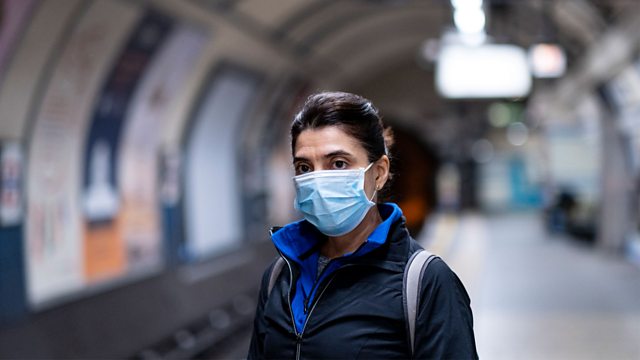
There are now more places where you have to wear a face mask but there are exemptions if you have a disability. The national charity Sense says the government should do more to raise awareness of exemptions as they report a rise in the number of abuse cases related to the wearing of masks.
Could a robotic guide dog ever replace the real thing? We talk to Anthony Camu, a student who has designed a prototype of a new device that leads the user as a guide dog would, and Angela Wood, chair of Hab Vi UK, about the pros and cons.
And if you're still not sure about going out to a real pub, how about The Staying Inn, a virtual pub, especially welcoming to blind and visually impaired people, where the pub quiz doesn't have a picture round.
Last on

In Touch Transcript - 04.08.2020
Downloaded from www.bbc.co.uk/radio4
THE ATTACHED TRANSCRIPT WAS TYPED FROM A RECORDING AND NOT COPIED FROM AN ORIGINAL SCRIPT. BECAUSE OF THE RISK OF MISHEARING AND THE DIFFICULTY IN SOME CASES OF IDENTIFYING INDIVIDUAL SPEAKERS, THE BBC CANNOT VOUCH FOR ITS COMPLETE ACCURACY.
IN TOUCH – Virtual pubs, robot guide dogs and face masks
TX: 04.08.20 2040-2100
PRESENTER: PETER WHITE
PRODUCER: LOUISE CLARKE-ROWBOTHAM
White
Good evening. Tonight, we meet the guide dog that doesn’t bark and we visit the pub where you don’t have to pay for a pint. More details later.
But first, amongst the new regulations brought in over the weekend to try to halt the feared resurgence of coronavirus, are more places where you’ll be required to wear facemasks, including museums and art galleries. There are exemptions to wearing them, including for people with reduced vision or who need to be able to lip read. But Sense, the organisation which represents people with more complex disabilities, including the dual disabilities of deafness and blindness, is calling on the government to be much clearer about the reasons for these exemptions to prevent potentially distressing incidents like this one:
Voices
I’m sat here, I’ve watched you wipe out your mask, you’ve got to wear the mask – yeah?
[Talking over]
Excuse me.
She’s just told me you’re deaf/blind but you’re talking to me.
I’m here because you’re shouting.
Can you please just do what Usher’s Syndrome is, have some awareness and Google it.
White
Well that was happening on a train recently. Sarah White is Head of Public Policy and Campaigns for Sense. Sarah, first of all, I mean, just explain – because obviously it’s slightly confusing what we’re hearing – what was actually happening there?
Sarah White
So, what you’re listening to there is two individuals who were on a train and one of the individuals has Usher’s Syndrome, which is a common cause of deaf blindness and they were communicating on the train and as per the guidance her sister had lowered her mask in order for her to be able to lip read her, to communicate, and a member of the public, who was sat opposite, viewed that as somebody not following the rules about wearing masks, that there was an excuse not to wear a mask and that the couple were pretending that they had a reason not to wear the mask. And so, what then happened is an argument about whether or not these individuals should be wearing masks on the train and just generally shows a lack of understanding of the needs of people to communicate.
White
And just to be clear, Usher’s Syndrome means that you may have partial deafness and partial blindness, it doesn’t necessarily mean that you are fully deafblind.
Sarah White
Exactly and the word deafblind doesn’t necessarily mean that someone has no sight or no hearing, it’s a combination of sight and hearing impairment which varies depending on who you are. Some people can hear a little bit, some people can’t hear at all and different people will communicate differently depending on their needs.
White
So just explain, in this particular case why did the lady we heard have to raise her mask?
Sarah White
So, the lady who she was communicating with has a hearing loss and relies on lip reading to be able to understand what someone is saying to her. So, she hears some things but also uses lip reading to add that additional bit of information. So, the person she was traveling with had lowered her mask so that her companion could read her lips and was about to raise it again but it was that ambiguity that is what confused the member of the public on the train because you’re saying, on the one hand you’re deaf but on the other hand you can lip read and it got very complicated.
White
And heated, as you can understand.
How common do you think this kind of thing is?
Sarah White
We know that public understanding and awareness of deaf blindness is low anyway but we’re really concerned as we move forward into this time where face coverings are going to be used more that we’re just going to see this sort of incident increase. We know other charities have also reported increasing reports of people being challenged in public and we also know of other people who we’ve spoken to who are really anxious about going out and about in case they’re challenged.
White
So, what exactly is Sense asking the government to do about this?
Sarah White
So, what we’re asking for them to do is to be really clear about the mask and face covering rules. We’re actually really pleased to see that the guidance is very clear and says that individuals who may struggle to wear a face covering don’t need to but we need to see that communicated more clearly.
White
I mean we’ve heard from the cabinet office; they say: “Our guidance clearly states that some people, including disabled people and those who have invisible impairments or conditions such as mental illness, do not need to wear face coverings if they feel unable to do so.” And they go on to say: “We’ve also collaborated with a number of disabled people’s organisations to create an example exemption card for those who feel more comfortable being able to show them. We will continue to work with Sense to better understand the concerns of disabled people and ensure our guidance is as inclusive as possible.” Haven’t they actually done as much as you could expect them to do?
Sarah White
What they’ve done there is absolutely fantastic and we agree and it’s been really great working with them. I think, as ever, the guidance is there it’s about how we get the public awareness and understanding of that. And I think it’s when you see scenarios like the government press conferences where actually throughout coronavirus disabled people haven’t been referenced or mentioned and on Friday the Prime Minister announced that this week the guidance will be changing again. It would be fantastic to see some leadership at that level, which calls out and says please bear in mind that some people won’t be able to wear masks. But it’s also about how we get that information down to ground level, so how can we be working with supermarkets and shops and settings where face coverings might be needed to be worn that makes people feel that they won’t be challenged or feel comfortable to go out.
White
I mean would an exemption card really have made much difference in this case; would that angry lady have known what one was?
Sarah White
Sadly, I don’t think it would, I think if people want to and feel comfortable carrying exemption cards I think that’s great but I think in that situation it just highlights that actually they were presenting that woman with all the information they needed to but it still wasn’t getting through and I think that highlights a wider issue.
White
She probably didn’t go home and Google it.
What do you fear will be the effects on people who are both deaf and blind if incidents like this continue?
Sarah White
We’re really concerned that we’re going to see that many deafblind people will feel anxious about leaving the house. We’ve all had our lives impacted in one way or another by coronavirus and we know that many deafblind people have been very anxious to leave the house for various reasons, your normal routines have been changed, normal everyday activities such as shopping have not been as straightforward or easy as possible and we’re worried that just at the point people were beginning to get their confidence up and feel able to go out and about and do those tasks again that confidence is going to be knocked and that we’re going to see people frightened to leave their homes.
White
Sarah White, thank you very much indeed.
And if you’ve got views on exemption cards, we’d like to hear them.
Now, meanwhile, the challenges of finding your way around when you’re visually impaired continue. But one Loughborough University student has set his mind to trying to come up with a solution. It’s been dubbed a robot guide dog by the newspapers but, as we’ll see, that’s a bit of an oversimplification.
Anthony Camu is an industrial design and technology student and his prototype is a portable handheld device, which he hopes will guide users through outdoor environments and large indoor spaces with very little user input. But is it something that blind people will use instead of a cane or an actual guide dog?
Well we’ll talk a bit more about that in a moment but first, Anthony, just explain how does it work?
Camu
Yeah, the best way to describe it is it is a guide dog sort of in your hand, it’s a handheld device. And it’s a device that sort of moves your hand around to try and communicate what’s in front of you. But it doesn’t just communicate what’s in front of you, it leads you as well, so, it’s making critical walking decisions for you, real time, as you’re walking along pavements, for example. This was critical in reducing the amount of time the visually impaired or blind person has to think about what they’re doing. This essentially allows them to walk at the same pace as or even faster than ordinary pedestrians.
White
And what’s actually driving it because it’s not like some of the equipment that’s gone before, like GPS or like a Sat Nav, is it, can you just explain how it can direct you?
Camu
First of all, you have the sensor system, so these are a set of cameras and radar, so those are for building up a three-dimensional picture of the surroundings, if you like. And then this information is then processed by artificial intelligence and deep learning and these basically assign attributes to what is going on in the data and then basically from this information they try to figure out paths for you to get to your final destination. So, that includes everything from point A to point B and anything that could happen in between to any potential hazards or obstacles that come along. And then from this information, from all this data, it’s fed through to a force feedback system which effectively simulates the feeling of holding a guide dog’s brace, it was that sort of key interaction of communicating what these algorithms were trying to say to the user and this is done through a talk motor. Essentially it is providing the resistance and pull you get from a dog’s leash, so it’s moving around in your hand, literally leading you along.
White
Well, listening to that is Angela Wood, Angela is Chair of Hab Vi UK, that’s an organisation that supports those who teach mobility and daily living skills.
Angela, first of all, I mean, there have been a lot of devices available to blind and partially sighted people for many decades now, yet none of them have ever really taken off or indeed replaced the cane or the dog, why do you think that is?
Wood
I think there are a number of factors why electronic mobility aids haven’t taken off. I think cost is a major factor. If an electronic aid retails around £600, that’s a lot of money for one person, it’s a considered purchase. And a local authority could provide 13 ultralight graphite long canes to the equivalent of one cane. So, that makes the standard long cane much more affordable. Long canes, in themselves, rely on that haptic, that touch feedback, to locate obstacles and it gives those obstacles definition, so you can identify a metal A-frame outside of a shop, you can identify a wooden fence, a brick wall and that helps with your orientation and navigation. You can identify the ground surface – tarmac, paving slabs – it gives you a lot of information which is useful for travelling. Electronic mobility aids can often be quite vague in the information that you receive. They will help someone to know that they’re approaching an obstacle, it won’t give you that feedback, that definition of what the obstacle is.
White
Yeah, because one of the things which is often said by blind people is that the problem with a lot of these gizmos is that the information they give you can actually distract from your natural orientation given to you by the use of your ears plus a cane, as you’re saying. But it sounds as if Anthony’s prototype may be getting round that because it’s something you hold in your hand, you’re not wearing anything, so – and it’s very early days but it might – he might be finding a way round that – it is steering you as a dog would.
Wood
Yes, and it sounds very, very interesting and I think habilitation specialists are always looking out for new devices that we can trial and we can use to build up a profile of a range of mobility aids that can be used by different people for different journeys. And it’s that toolkit of resources really. I mean I work with young people from nought to 25 and there’s no other stage in a person’s life where we undergo so many changes, so the needs of young people change quite rapidly. And so, over time, within education, they build up a toolkit of resources.
White
But are the dog and the cane likely to disappear any time soon?
Wood
I don’t think so. In all honesty, the guide dog is not just a mobility aid, it’s a very efficient mobility aid but it is also a companion and I think the positive impact that a guide dog can have on a person’s mental health is something very difficult to replace using an electronic mobility aid.
White
Angela Wood, Anthony Camu – thank you very much indeed.
And we’d like your comments please.
Now, some pubs have reopened at last but if you’re put off returning to them by talk of signing in with your personal details, one-way systems to walk round, sanitisers on the bar instead of snacks, you might like to sample Dr Amy Kavanagh’s online pub, especially as visually impaired customers are among those who are particularly welcome. It’s called The Staying Inn – I n n – get it? And Amy, the visually impaired landlady, can tell us a bit more about it.
So, how did you come up with this idea?
Kavanagh
Well it started as a bit of fun really. Everyone was doing Zoom calls and video conferencing and I’m already part of a nice online community, on social media and as the calls got bigger and we joked that we were going to the pub, I said, well why not make it something more formal and open to everyone.
White
So, who’s particularly welcome?
Kavanagh
Well, it is run by disabled people for disabled people but we do welcome anyone that is maybe feeling a bit isolated, people who were shielding and maybe continuing to shield, anyone who needs a friendly online accessible space.
White
I’ve heard of a few people who’ve tried to recreate the pub atmosphere online, so how does yours differ because you still say you welcome anyone, so how does it differ, particularly say, for visually impaired people from the others?
Kavanagh
So, we really make a big effort to be as accessible as possible to everyone and we always take on feedback about how we can improve that experience. People are encouraged to audio describe things, maybe if they’ve got a background up. We have a British Sign Language interpreter and live captions at all of our events. We keep it quite interactive; people can engage however they want – they can have their camera on or they can just type in the chat box or just listen along – whatever suits them best.
White
I know, for example, you have pub quizzes and of course, what happens in bricks and mortar pubs is you have a picture round and we all groan. How do you get round that?
Kavanagh
We don’t have one.
White
Simple as that?
Kavanagh
Yeah.
White
And what are some of the other things that you’re offering as far as events?
Kavanagh
Ah well, just anything and everything. What’s great is that our regulars, they offer their skills, so it’s not just an opportunity for fun, we’ve had disability advocacy sessions, we’ve had a British Sign Language lesson, we have a craft club, we’re doing interviews – we’re interviewing Haben Girma, the amazing deafblind lawyer and activist, next week. We’ve got a book club. You name it, if we can make it work online, we’ll do it.
White
Well, Jurgen Donaldson [phon.] is now a regular at the Staying Inn, Jurgen how did you find it and what make you stay?
Donaldson
I first came across it through Amy’s Twitter, like she said, from the wider social media kind of community. For me, I mean the pub quiz was fantastic because I guess it was the first time in a long time I’d gone to a pub quiz where I didn’t feel like an afterthought. I lost my sight 12 months ago, the idea of getting back to the pub and kind of returning to normal seems pretty far off right now, so being able to recreate it from the safety of my sofa has been fantastic.
White
I take it you have to provide your own booze?
Donaldson
I do, but thankfully I’ve got a good stock of tins of gin and tonic in the fridge, for all eventualities.
White
But you are finding that you can sort of take part in everything that goes on?
Donaldson
Completely, absolutely, it’s – everything that’s kind of all of the events you can definitely take part in.
White
Amy, what’s the response been like generally?
Kavanagh
It’s been really, really positive, especially in the early stages of the lockdown, because we started in March. There were people coming on saying we were the only voices they’d heard all week that weren’t on the telly or the radio. And it’s become such a positive, supportive growing community. We have over 600 people on our newsletter now and we regularly have events of around 40, 50 people.
White
So, will this carry on when the restrictions on real pubs, if I can call them that, are lifted, if that ever happens?
Kavanagh
Well we will keep going as long as we have the money to do so. It’s expensive to provide all these access costs and rely on fundraising through a Go Fund Me and I want it to keep going, there are lots of pubs that are inaccessible anyway, this turns out to be a great space for disabled people and why not keep it going.
White
Might drop in myself. Dr Amy Kavanagh, Jurgen Donaldson – thank you both very much indeed.
You can email intouch@bbc.co.uk or go to our website bbc.co.uk/intouch, from where you can download tonight’s and many other editions of the programme.
From me, Peter White, producer Louise Clarke-Rowbotham and studio manager, this week, Mike Smith. Goodbye.
Broadcast
- Tue 4 Aug 202020:40BBC Radio 4 FM
Download this programme
Listen anytime or anywhere. Subscribe to this programme or download individual episodes.
Podcast
![]()
In Touch
News, views and information for people who are blind or partially sighted