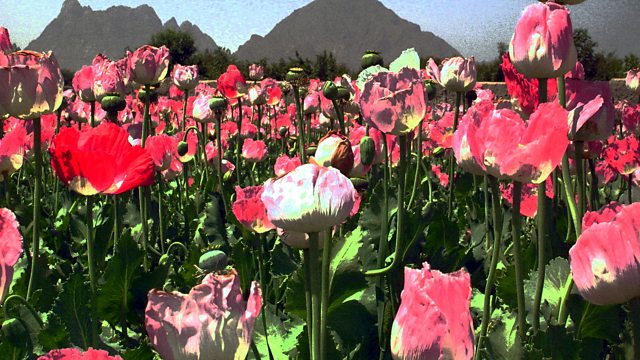
Milk of Paradise by Lucy Inglis (Omnibus)
Historian Lucy Inglis’s book explores man’s long and complex relationship with the juice of the opium poppy.
Derived from the juice of the poppy, it relieves our pain and cures our insomnia. It may even inspire great art.
It also causes addiction, misery and death.
Historian Lucy Inglis’s book explores man’s long and complex relationship with opium.
“In mankind’s search for temporary oblivion,” writes Inglis, “opiates possess a special allure. Since Neolithic times, opium has made life seem, if not perfect, then tolerable for millions. However unlikely it seems at this moment, many of us will end our lives dependent on it.”
In 17th Century England the invention of laudanum – an easy-to-swallow opium tincture – led to “a new age in drug-taking.”
A century later, laudanum became popular with writers of the Romantic movement such as Samuel Taylor Coleridge, whose great poem Kubla Khan was famously inspired by a drug-induced dream when he was a young man of 25. (He died aged 61, a housebound addict.)
In the American Civil War morphine was used extensively to relieve the pain of wounded soldiers. After the war, drug addiction among former soldiers was so common it became known as “the army disease.”
But it was the Vietnam War a century later that brought the idea of the “junkie soldier” into popular culture.
Today, heroin addiction remains a global problem:
“Where opiates and opioids are available,” says the author, “people will consume them.”
Omnibus of five parts abridged by Anna Magnusson.
Read by Anita Vettesse.
Producer: David Jackson Young.
First broadcast on BBC Radio 4 in August 2018
Last on

Broadcasts
- Sun 19 Aug 201809:00BBC Radio 4 Extra
- Sun 19 Aug 201820:00BBC Radio 4 Extra
- Sat 25 Feb 202307:30BBC Radio 4 Extra
- Sat 25 Feb 202312:30BBC Radio 4 Extra
- Sat 25 Feb 202318:30BBC Radio 4 Extra
- Sun 26 Feb 202302:30BBC Radio 4 Extra
