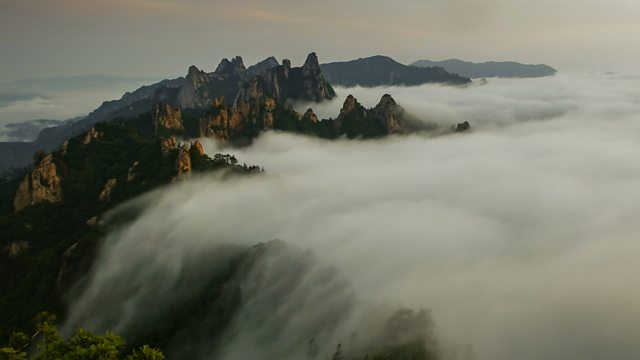
South Korea: Earth's Hidden Wilderness
Beyond the bustling cities of South Korea, pockets of untouched wilderness provide a home to remarkable species of wildlife such as the raccoon dog and the fishing spider.
Once a mountain kingdom of ancient palaces and emperors, Korea in the 21st century is largely known for its modern cities and decades of conflict. Tensions between North and South may be what defines it to outsiders but beyond the battle scars there is another side. In the south are large pockets of untouched wilderness where extraordinary animals flourish and Koreans continue to practise age-old traditions in tandem with the seasons and with nature. It is in these connections, rather than in division, that we see the true Korea.
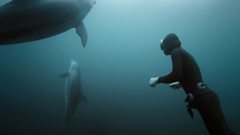
At the southernmost tip of the peninsular we follow a pod of bottlenose dolphins through the volcanic islands of Jeju. They click at each other as they encounter a human in their midst, but the dolphins know this diver - they have shared the ocean with the Haenyeo, or sea women, for thousands of years. We travel to the isolated island of Marado, where three generations of sea women are preparing for a dive. Today is the start of the conch season, and they work whatever the weather to maximise their catch.
In the grounds of an ancient palace on the mainland, a raccoon dog family takes advantage of a rare event. Once every five years, hundreds of cicadas emerge providing a feast for the raccoon. Those that escape make for the safety of the trees, where they metamorphosise into their flying form.
On the mud flats of Suncheon Bay we find a habitat that is neither land nor sea. Only recently has the ecological value of mudflats been recognised. A staggering 50 per cent of the earth's oxygen is produced by phytoplankton - microscopic algae that are found here in abundance. That is why the mudflats are known locally as the lungs of the earth. Plankton is far from the only life here - the mud of the bay is rich in nutrients and supports one of the most diverse ecosystems on the peninsula. We follow the story of a young mudskipper who has emerged for his first mating season.
Last on

Clip
![]()
Bottlenose dolphins encounter a Haenyeo diver
Duration: 03:06
Credits
| Role | Contributor |
|---|---|
| Expert | Yong Soon Park |
| Expert | Jeon Hye Min |
| Expert | Haw Ok Ra |
| Expert | Kim Hwa Ja |
| Expert | Soon Kim |
| Expert | Jae Yeom Kim |
| Expert | Soon Ja Park |
| Expert | Choon Geom Kim |
| Expert | Wal Soo Ra |
| Director | James Reed |
| Executive Producer | Caroline Hawkins |
| Production Manager | Jennie Baker |
| Producer | Philip Jones |
| Composer | William Goodchild & The Insects |
| Editor | Bobby Sheikh |
| Executive Producer | Claire Birks |
| Camera Operator | Benjamin Sadd |
| Writer | Anne Sommerfield |
| Writer | Matt Houghton |
| Writer | Hazel Marshall |
| Narrator | Arthur Lee |
| Director of photography | Wanho Lim |
| Camera Operator | Graham MacFarlane |
| Photographer | Dong Sik Kim |
| Photographer | Mark Payne-Gill |
| Photographer | Ki Soo Sung |
| Colourist | Blair Wallace |
| Camera Assistant | Sung Hyun Kim |
| Camera Assistant | Yong Soo Shin |
| Re-recording mixer | Ben Peace |
| On-line editing | James Beynon |
| Executive Producer | Chang Soo Lee |
| Location Manager | Sang Sup Yeom |
| Technical Director | Dae Geun Park |
| Production Manager | Cecillia Park |
| Assistant Producer | Steve Do |
| Assistant Producer | Harry Bang |
| Executive Producer | Jae Hyuk Lee |
| Producer | Ji Yun Lee |
| Producer | Kye Young Kim |
| Assistant Producer | Keun Uk Cho |
| Executive Producer | Martin Meszaros |
| Executive Producer | Sabine Holzer |
| Line Producer | Wolfgang Knopfler |
| Unit Manager | Dinah Czezik-Muller |
| Production Manager | Sarah Norenberg |
| Production Company | Oxford Scientific Films |
