10. Toil and Trouble
Neil MacGregor explains how a model ship hung in a church, reveals differences between Scottish and English witches. From 2012.
The differences between Scottish and English witches are revealed by a model ship, made to be hung in a church.
Object-based history series presented by Neil MacGregor, former Director of the British Museum.
Taking artefacts from William Shakespeare's time, he explores how Elizabethan and Jacobean playgoers made sense of the unstable and rapidly changing world in which they lived.
With old certainties shifting around them, in a time of political and religious unrest and economic expansion, Neil asks what the plays would have meant to the public when they were first performed.
He uses carefully selected objects to explore the great issues of the day that preoccupied the public and helped shape the works, and he considers what they can reveal about the concerns and beliefs of Shakespearean England.
Producer: Paul Kobrak
First broadcast on BBC Radio 4 in April 2012.
Last on

More episodes
Previous
Model of a Bewitched Ship
Date: c.1589, possibly the 1590s
Size: H:650mm, L:645mm
Made in: Denmark
Made by: Unknown
Material: Wood, Paint
Although it may look like a toy, this ship model was actually intended as an offering to God. It was made to give thanks for survival at sea and for delivering the ship’s royal passengers and cargo from the clutches of tempest-brewing witches.
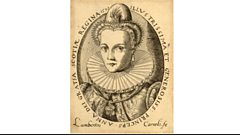
On board the real ship in the spring of 1590, King James VI of Scotland and his new bride, Princess Anne of Denmark, had been at the mercy of the powerful storms in the North Sea. The Danish and Scottish rulers concluded this could only be the work of disturbed spirits conjured by witches and a string of trials and executions followed.
Witches would continue to be associated with James VI, through the vastly popular publication about the trials, News from Scotland, and most famously in Macbeth, the Scottish play that features three ‘black and midnight hags’ at the centre of the action.
This object is from the National Museum Scotland
British Museum Blog: Toil and Trouble by Keith Thomas, Historian
Quotations
But in a sieve, I'll thither sail, And, like a rat without a tail, I'll do, I'll do, and I'll do.'
Macbeth, Act 1 Scene 3
'Double, double toil and trouble;/Fire burn, and cauldron bubble./Cool it with a baboon's blood,/Then the charm is firm and good.'
Macbeth, Act 4 Scene 1
Background
- This ship model was probably made to celebrate the marriage and safe return to Scotland of James VI and his bride, Anna of Denmark, in 1590
- Terrible storms had prevented the couple meeting and marrying earlier. The Danish Admiral Munk attributed the storms to the work of Danish witches
- Six women were tried in Denmark in May 1590 and executed for their alleged part in this plot
- At least 20 of Shakespeare's plays have overt references to witches or witchcraft, without counting the general references to bewitchment, sorcery or magic
- James I's interest in witchcraft was well known in England, not least through his book Daemonologie published in 1597 and reprinted in London in 1604
More from Radio 4: The mechanical galleon
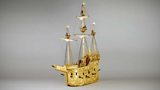
Neil MacGregor's world history explores the impact of the great age of European discovery between 1450 and 1600. Today he is with a magnificent clockwork galleon.
More from Radio 4: Witchcraft
Melvyn Bragg discusses witchcraft in Reformation Europe; misogynism or a sustained attempt by the Christian Church to root out the last of an ancient religion of Europe?
Broadcasts
 Fri 27 Apr 201213:45BBC Radio 4
- Fri 27 Apr 201219:45BBC Radio 4
- Fri 19 Oct 201214:15BBC Radio 4 Extra
- Fri 20 Mar 201514:15BBC Radio 4 Extra
- Sat 21 Mar 201500:15BBC Radio 4 Extra
- Thu 23 Jun 201613:45BBC Radio 4
- Fri 27 Apr 201814:15BBC Radio 4 Extra
- Sat 28 Apr 201802:15BBC Radio 4 Extra
- Fri 27 Oct 202307:15BBC Radio 4 Extra
- Fri 27 Oct 202312:15BBC Radio 4 Extra
- Fri 27 Oct 202317:15BBC Radio 4 Extra
- Sat 28 Oct 202303:15BBC Radio 4 Extra
Podcast
![]()
Shakespeare's Restless World
Neil MacGregor uncovers the stories 20 objects tell us about Shakespeare's world.