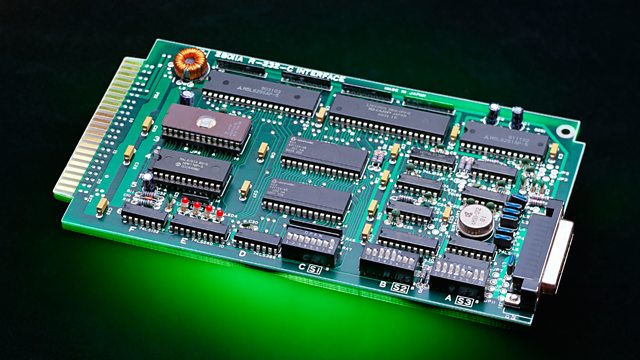
Conductors and Semiconductors
Melvyn Bragg and his guests discuss the physics of electricity: why some materials conduct it and others do not, and how these properties can be usefully exploited.
Melvyn Bragg and his guests discuss the physics of electrical conduction. Although electricity has been known for several hundred years, it was only in the early twentieth century that physicists first satisfactorily explained the phenomenon. Electric current is the passage of charged particles through a medium - but a material will only conduct electricity if its atomic structure enables it to do so. In investigating electrical conduction scientists discovered two new classes of material. Semiconductors, first exploited commercially in the 1950s, have given us the transistor, the solar cell and the silicon chip, and have revolutionised telecommunications. And superconductors, remarkable materials first observed in 1911, are used in medical imaging and at the Large Hadron Collider in Geneva. With:Frank CloseProfessor of Physics at the University of OxfordJenny NelsonProfessor of Physics at Imperial College LondonLesley CohenProfessor of Solid State Physics at Imperial College LondonProducer: Thomas Morris.
Last on

Broadcasts
- Thu 23 Feb 201209:00BBC Radio 4
- Thu 23 Feb 201221:30BBC Radio 4
Featured in...
![]()
Science—In Our Time
Scientific principles, theory, and the role of key figures in the advancement of science.
In Our Time podcasts
Download programmes from the huge In Our Time archive.
The In Our Time Listeners' Top 10

If you’re new to In Our Time, this is a good place to start.
Podcast
![]()
In Our Time
Misha Glenny and guests discuss the ideas, people and events that have shaped our world.