The Making of MusicSeries 1Episodes Episode guide
- All
- Available now (0)
- Next on (0)
Back up to: The Making of Music
![]()
Albertopolis
30/30The Royal Albert Hall opened in 1871 with a prince championing culture.
![]()
Grand Opera
29/30In the first half of the 19th century, Italy consummated its love affair with opera.
![]()
Virtuosi
28/30In the 1820s and 30s, audiences craved virtuosi performances.
![]()
Weber and German Romanticism
27/30Weber gave German audiences what they wanted - storms and disasters.
![]()
Schubert and the Piano
26/30Schubert used improving piano quality to make it an instrument for the voice.
![]()
Beethoven's Eroica
25/30The composer allegedly removed his original dedication to Napoleon from the manuscript.
![]()
Beethoven
24/30The great German composer worked at a time of seismic change in Europe.
![]()
The French Revolution
23/30La Marseillaise became a national anthem, and music inspired by revolution was everywhere.
![]()
Mozart's The Marriage of Figaro
22/30The play on which Mozart's opera was based was banned in its original form by Louis XVI.
![]()
Mozart
21/30In the middle of the 18th century composers needed patrons, but this was soon to change.
![]()
Haydn and the Esterhazys
20/30Joseph Haydn lived mainly in his patrons' isolated palace and produced music on demand.
![]()
Music and Society
19/30By the late 1700s, music was becoming part of the social fabric.
![]()
Rameau and the Philosophes
18/30Paris during the 1750s was the centre of a clash of cultural ideas.
![]()
Handel
17/30German-born composer George Frideric made English music great.
![]()
Bach's St Matthew Passion
16/30Johann Sebastian's recurring choral theme had a profound effect on the history of music.
![]()
Bach in Leipzig
15/30Johann Sebastian Bach produced some of the most sublime church music ever written.
![]()
The Restoration
14/30The return of Charles II from exile heralded a revival in English music.
![]()
The Puritans
13/30Oliver Cromwell not only appreciated music but also employed former royal composers.
![]()
The Violin
12/30The design of the violin was perfected in Cremona around 1700.
![]()
The Sun King
11/30How English composer John Dunstable's music travelled to the Burgundy court.
![]()
The Birth of Opera
10/30The idea of telling a story in music proved immediately successful across Italy.
![]()
Elizabeth I
9/30In the Elizabethan age, composers Byrd and Tallis revealed the religious divide.
![]()
Venice
8/30Uncle and nephew Andrea and Giovanni Gabrieli wrote music that filled St Mark's Basilica.
![]()
The Counter Reformation
7/30The composer Palestrina became accidentally embroiled in the politics of the high church.
![]()
The Reformation
6/30During the Reformation, Martin Luther harnessed secular songs for religious music.
![]()
The Renaissance
5/30Music and the arts were beginning to celebrate man as well as God.
![]()
Burgundy
4/30The Burgundy Court was influenced by the musical style of England's John Dunstable.
![]()
Troubadours
3/30In courts and great houses, the troubadours wrote secular songs of love and jealousy.
![]()
Notre Dame
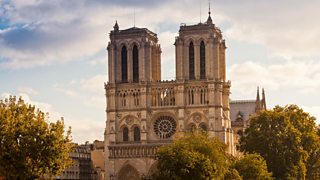
2/30As Notre Dame was built, composers Perotin and Leonin wrote music to fill it.
![]()
Origins
1/30James Naughtie looks at classical music origins in churches and monasteries.