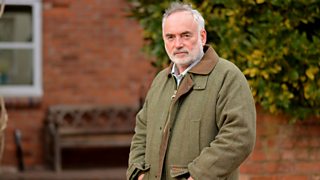
True stories: Stephen Watkins: Farmer from Worcester
We farm a range of about 17 different crops, and a lot of that land is on the flood plain – the river Severn and also the river Avon.
Farming on the flood plain we’re certainly used to getting lots of flood water, which we cannot really anticipate. We have a short period of time when we can see whether the water is going to come over the flood defences. These flood defences were installed in the 1960s, to protect the farm about seven years out of ten. But more recently, largely due to the building of lots of houses and more infrastructure, we’re finding it’s only protecting us for half the time, so every other year we’re getting flooded. In the Summer of 2007, we had a particularly bad flood. And then in the Winter of 2012-2013 we had lots of flooding, and it really is getting quite difficult.
Winter cropping’s at risk, as we tend to get flooding over the Winter period. But we also have some diversifications, like a riding school. It’s very important not to rely totally on conventional farming when you’re farming on the flood plain. The flood we had last winter cost us just over £70,000 in damage, and it cost us about the same in crop loss.
In terms of damage – after a flood we get a lot of debris. A really bad flood, like the previous winter brings all sorts of things (telegraph poles, trees, gas bottles from caravan parks, the steps that people use to get into a caravan) - and it amounts to a lot of time and effort to pick it up. Because it’s not on public property it’s my job to fund that collection. Fortunately, this time, I managed to get a number of people who were on community service to help, but unfortunately the numbers and the speed of picking up meant that we had to do quite a bit ourselves with the farm staff - and it’s a pretty demoralising thing to send the farm staff out picking up plastic bottles and everybody else’s rubbish – it’s bad enough looking after your own rubbish.
In the gateways or corners where the wind blows the rubbish, it takes a fork lift truck and farm tractor and trailer to heap it up. And the heap of rubbish we collect off a farm like this would be probably fifty-five, sixty feet round and about fifteen feet tall, so about the size of a semi-detached or a small detached house. Most of that has to be picked up by hand, which is not easy. We also get damage to fencing, particularly if it happens to freeze. If the flood water comes over and freezes, it snaps the barbed wire and every single post, because of the weight of the ice as it goes down. So it’s a total re-fencing job.
We were fortunate in the last flood, because of the flooding in the Somerset levels - the Government did come up with some funding. It was to a maximum of £35,000 per holding - we were fortunate to get the maximum, but it would be nice if they coughed up every time we got a bad flood!
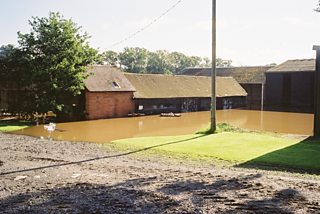
Thinking about the damage to winter crops - if I see water on the field for a consecutive 21 days, I don’t really worry about it. But between 21 and 28, the crop will be killed. So we have areas that are slightly lower on the farm and they are more vulnerable. But we do just take this balance that if it comes through we get a very good yield, and if it doesn’t we don’t, so it averages out at the end of the day. It’s important that, we have really good soil structure, which I’m very paranoid about, which allows the water to get away as quickly as possible. And that allows it to dry out so that if we have to patch up in the spring, we can get on and we can still get a reasonable crop.
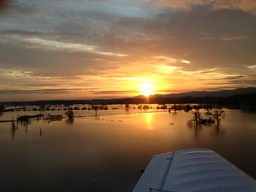
When we have a serious flooding incident, we usually have indications from the Environment Agency, but a lot of it is personal knowledge – knowing whether we’re in for a high tide, the wind direction, the amount of rain in Wales, the amount of rain locally. And then we can generally move livestock. Just occasionally it comes super quick – and we did have an incident where we had to cut a few fences to let some horses onto some slightly higher ground. Although, horses are quite good at swimming, and we have swum them out in the past.
I enjoy my life and I think that’s the key thing - you learn to live with the environment you’ve got and manage the environment the best you can, to get the best results.
It’s frustrating when individuals come in who haven’t got experience and haven’t got an understanding, saying that dredging does not have an effect – it does have an effect, as has been seen on the Somerset levels. The river capacity has not been changed – all these banks here, this four miles here, were re-profiled in ’95 and ’96. And since that (so a relatively short period of time) – there’s been enough deposition along the edge of the bank to allow the stock to walk over the fences completely. A lot of deposition of material has got to affect the polymetric capacity, and that’s got to reduce its carrying capacity – which basically means more flooding for the towns and villages. So you’ve just got to keep building the fences higher and higher unless you clean out the main drain. They won’t clean out the main drain, so it’ll get worse and worse.
The flood we had last winter cost us just over £70,000 in damage, and it cost us about the same in crop loss.
You can see that the medieval abbey of Tewkesbury was on high ground, because they knew where it flooded. Severn Stoke church now floods, but wouldn’t have in the past because they never would have put a structure like that in an area that was going to flood. It’s only more recently that it’s started to flood. So it’s quite clear that Man is having a big impact in the building of the houses and all the infrastructure – not maintaining channels, and blocking channels and putting weirs in, and locks etc. We are having a big impact on the environment, and people are not looking strategically and not looking ahead enough to know what we should be doing to maintain what we’ve got. It’s a real shame. For example, in Upton they wouldn’t need all those barriers if they kept the river clean.
Stephen Watkins: Sheepcote Farm - Severn Stoke, Worcester.
![]()
True stories: Oliver Surman
Read how one friday in July 2007 turned into a fight to save his dairy herd and farm for Oliver Surman in Worcester.
![]()
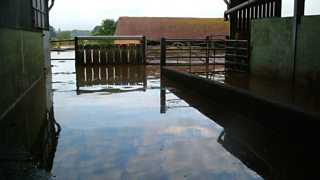
Flood Timeline
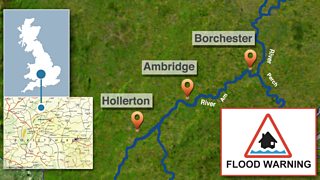
Visit the rolling news account of the Ambridge floods including weather reports, maps and tweets from Ambridge residents affected by the recent weather events.
![]()
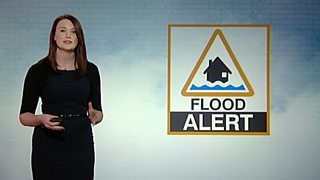
BBC Midlands Today Weather Report
Watch the latest weather forecast for Ambridge and the wider Borsetshire area, as reported by BBC Midlands Today.
![]()
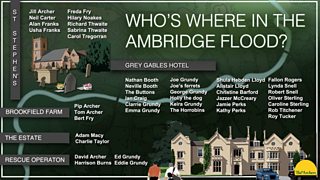
Who's Where In Ambridge
Many Ambridge residents have been forced to leave their homes and take alternative refuge because of the floods. Here's your guide to who's where.
![]()
True stories: Stephen Watkins: Farmer from Worcester
Stephen Watkins talks about his arable farm on the flood plain of the river Severn and also the river Avon.
![]()
True stories: Peter Fryar: Publican in Severn Stoke, Worcestershire
Landlord of the Rose and Crown in Severn Stoke, Peter Fryar talks about how the local pub has become a place of refuge for some during the floods.
![]()
True stories: Steve Page, Sheep Farmer from Malvern
"In the past I’ve spent twelve hours in water rescuing sheep by driving the tractor through the flood water and loading them in to the trailer." Sheep Farmer Steve Page, tells his story.
![]()
Are you at risk of flooding?
Check if you’re at risk of flooding now and in the next few days with the Environment Agency's Live Flood Warning Map and 3 Day Flood Forecast.