GCHQ: Your questions about the spy agency answered

Jo Cavan is GCHQ’s director for strategy, policy and engagement – she joined 5 Live’s Nicky Campbell on his phone-in show to answer questions from listeners to the radio station.
Despite not being able to answer a number of questions that came through on air because of national security reasons, Jo was able to explain about their infamous puzzles, why they have the right to listen to private phone calls and why their car park is empty on weekends.
Are you a spy?

5 Live listener Darren wants to know if Jo is in any way like James Bond.
Jo says she doesn’t consider herself a spy, “I’d be a bit of a rubbish spy if I was here and you know my real name live on radio”.
A lot of people who work for GCHQ would consider themselves to be civil servants or might define themselves by the type of work they do, so lawyers, analysts, or computer scientists.
When asked about the difference between all the UK ‘spy’ agencies, Jo described MI5 as a domestic intelligence agency and MI6 as an international intelligence agency while GCHQ is “traditionally a foreign signals intelligence agency, we’re focussed on threats to the UK from foreign sources”.
But are any of them like we see in Bond films?
“There’s more depth to it than you see in James Bond”, she said. “I love a Bond film as much as anybody, but there’s not too much fact in it!
Why does GCHQ have the right to listen to everybody’s calls?

Eddie got in touch to ask why the organisation has the right to snoop on calls and Andrew had the more direct question: “Do you know who I am and do you track me through my phone?”
Jo says the organisation operates within a “stringent legislative framework”.
“It’s a common myth we’re reading everybody’s emails and listening to everybody’s phone calls,” she said. “We’re not listening to everybody’s calls, that would be physically impossible, and it would be morally wrong.
“We do have really significant powers to keep the UK safe… we do identify, analyse and collect communication but we are focussed on the threats that are harming the UK.
“We’re looking at serious organised criminals, people who are planning terrorist attacks and we’re doing work to support our military out in theatre to keep their communications secure as well as our national cyber securities work with government, industry, academics and the general public to keep them safe online.”
Are there no threats to national security at weekends?
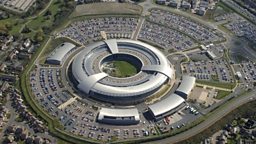
Dave, who passes the GCHQ base in Cheltenham each day, contacted 5 Live to ask why the car park is “virtually deserted” at weekends.
Jo says it’s a “great question” and that GCHQ obviously encourages their staff to cycle to work and not use their cars in order to care for the climate.
“We do have flexible working as an employer,” she said. “So everybody isn’t working 24 hours a day, but we do have fewer people working at the weekends.
“We have a 24/7 centre which monitors threats throughout the night and if we need to call people in, if something happens somewhere in the world that we need to help with, we’ll mobilise that.
“Also, Cheltenham isn’t our only office. We have offices in London and a new office in Manchester… and we’ve got other locations across the UK - some of which don’t have car parks at all, actually!”
How does GCHQ recruit?

Several listeners got in touch asking which degrees would lead to a job in the organisation, if there is a recruitment process at all or if shadowy figures in trench coats tap prospective employees on the shoulder at elite universities.
Jo says GCHQ is “passionate” about better representing the society they’re here to protect, with a broad range of roles available and a great careers website that talks about some of those roles.
“Yes we do still want university graduates, but each role is different and we take apprentices and people without degrees from a range of different disciplines – we want all sorts of different people.
“We have all sorts of jobs, language analysts, engineers, mathematicians, intelligence analysts, software developers but also as well as the technical roles, just as any big organisation, we need really good lawyers, HR people, strategy and policy folks.
“We’re also looking for people will all sorts of different languages, from Mandarin Chinese, Russian, Persian, Arabic, and if people come in with European languages, they have an opportunity to retrain in a rare language – our language analysts have over 40 languages between them, they’re a fantastic team.”
Do you have to be good at puzzles?

Nicky Campbell says he’s been looking at the organisation’s quizzes and failing to be able to answer any, he asks if people have to be able to work out those puzzles to work for GCHQ.
Jo says she herself is “terrible” at the puzzles, so that isn’t a prerequisite of getting a job at GCHQ.
“Of course we are interested in people who can break codes and mathematicians and people who are good at solving problems,” she said. “But there are so many roles in GCHQ you can do, it’s not all about solving puzzles.
“We have a thriving neurodiverse community at GCHQ - often the more you think differently, the better you are at some of the roles like intelligence analyst roles, which are all about sifting through large amounts of data and trying to spot patterns or things that are out of place.
“Often people who have dyslexia have really good strengths because of the way they can see the bigger picture and see something out of place visually by looking at a screen, whereas people who are typical in a neurodiverse sense may not spot those patterns.”
How do you leave GCHQ and get another job?

Neil asks how people who want to leave the organisation explain to external employers what their job was without giving away state secrets.
Jo says it can be “challenging” to leave GCHQ for another job, but that the organisation can help.
“We talk to people when they leave and how they go about applying for roles,” she said. “We can talk about the type of work we were involved in, but not the specifics or maybe capabilities people have built.
“We have to hold a lot of secrets and we have to protect the UK’s secrets, that’s a big responsibility we’ve got and we’ll continue to work really hard to protect the UK’s secrets, but we’re not a secretive organisation.”