Tony's story: I was arrested in the Brixton riots
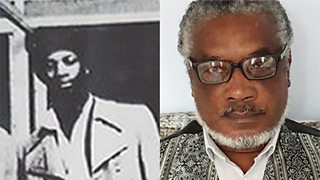
Back in the early 80s, Tony Cealy was a Brixton schoolboy whose passion was music and sound systems.
He is now a director, trainer and actor.
But on the morning of Saturday, April 11th, 1981, as the Brixton riots unfolded, he made a decision that changed the course of his life forever.
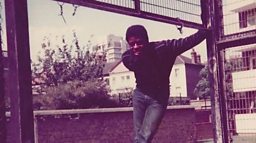
"Saturday was when I actually got involved in the riots.
"I got put in the van. Oh my God, I was petrified"Tony Cealy
I remember seeing lots and lots of people running around, kicking in windows. A woman with a pram was trying to walk down the road [with] a TV.
This guy ran into one of the department stores. He grabbed a handful of clothes. And I'm sure it was a pink shirt that he dropped. This shirt was in the middle of the road.
Looking left, you had police with their riot shields. On the right, there were other police with their riot shields. And in the middle was no man's land - where all the treasure was.
And I remember thinking, right, if I don't do it now, it's never going to happen. So I just darted out of the crowd.
Someone said, ‘What you doing?’ I didn't even listen. I just picked up the shirt.
I turned the corner and ran straight into the police. And one of them grabbed me by the shoulder and started yelling abuse at me.
I got put in the van. Oh my God, I was petrified. I was told to sit on the floor, and then one officer kicked me, which pushed me over. He had his feet on me and I was like, ‘Get off, man.’ And he was like, ‘Shut the hell up.’
When I got out of the van, I could see Brixton was on fire.
There were people walking up the steps of Brixton police station shouting abuse.
There were other officers coming out of the police station ready to get involved in the riots.
I remember being put into a cell. This was my reality now. Realising that this was my fault; what had I done? But in another sense, I was glad to be there.
My mum was in tears. She was pleading with the desk sergeant, apologising about my behaviour. And I'm like, Mum, don't apologise to them. And she's just telling me to shut up.
She slapped me around my face, and told me how I bring shame on my family. Then she said sorry to the desk sergeant.
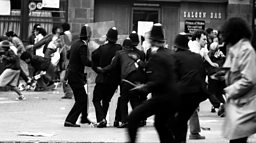
Getting these beatings from my mum in front of the police officers was humiliating.
She came from that West Indian tradition of the teacher’s right, the police are right. There's a whole heap of West Indian families who had that kind of view; that the oppressor was right.
I think it was only later that she realised the victimisation of people was actually real.
It was definitely a kind of coming of age"Tony Cealy
I felt really satisfied and proud that I'd been involved and took part. It was definitely a kind of coming of age. That was a highlight for me for days, months afterwards.
I was charged with two counts of theft. Both were heard at Lambeth East Juvenile Court. I was convicted of both charges, and fined 25 pounds. And my mum was absolutely livid.
One year, when I got a new CRB [Criminal Records Bureau] check, those two fines weren't there. I was really upset.
People were saying to me, you should be proud it's not there, so people don't know. I said, no; this is really important. I need the charges to be there so I can remind myself of that time. And so I rang up CRB and asked them to put the convictions back on.
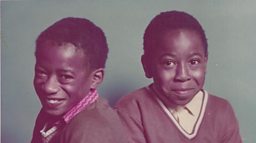
There was lots of talk on the street about why the uprising happened.
I think it happened because the black community had been victimised by a racist police force that were very brutal.
There’s only so much a community can take. There's going to be a tipping point, a boiling point.
Later, I got inspired by the whole world of performance and acting. I realised that I really wanted to become a performer. And I have spent the last 27 years working in community development, using theatre for social change.
Today, I'm working on the biggest project of my career, which is ‘81 acts of exuberant defiance’.
It’s a widespread community-led cultural programme that shines a light on the 1981 uprisings.
I want people to come to Brixton to see the actual legacy of the 1981 uprisings embedded in the community. So you'll never, ever, forget what happened here.
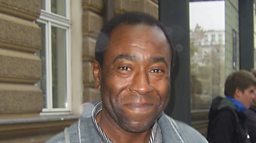
Brixton has completely changed, and everybody can tell you that. But the reality is the people on the ground are still suffering.
I'm just hoping that the whole Black Lives Matter movement can really spark a change. And I think the younger generation have definitely got their groove on.’
As told to Ben Robinson
In April 1981, Brixton suffered particularly high rates of unemployment, poor housing, and crime. Swamp 81, a plainclothes police operation to reduce crime in Brixton, was launched in the area ten days before the riots. Its use of stop and search raised tensions with the community, who felt young black men were being harassed.
The Metropolitan Police say that, over the years, the force has undergone enormous change, and it is a different force to the one it was 40 years ago. Their current commissioner says that racism will not be tolerated.
![]()
Podcast - Brixton: Flames on the Frontline
Big Narstie asks what caused violence to erupt in his home town of Brixton 40 years ago.
![]()
‘Policing Brixton riots was a battle for survival’
Former police officer Peter Bleksley remembers being sent to police the Brixton riot.