The 1940s
Once again, the world is gripped by the horror of war. Our soundscape now incorporates historic wartime broadcasts alongside BBC news reports from Dunkirk and Leningrad.
No part of society is untouched by the conflict, least of all music. But as Britain starts to rebuild, we hear familiar, more hopeful voices.
The music
Works that define the spirit of the 1940s
- Sergei Prokofiev: Symphony No 5 (1945)
- Benjamin Britten: Four Sea Interludes from Peter Grimes (1945)
- Ralph Vaughan Williams: Symphony No 5 (1943)
- Vera Lynn: When the Lights Go On Again (All Over the World) (1943)
- Dmitri Shostakovich: Symphony No 7, “Leningrad” (1942)
- Recording of singing from Belsen Concentration Camp after its liberation (1945)
- Olivier Messiaen: Quartet for the End of Time (1941)
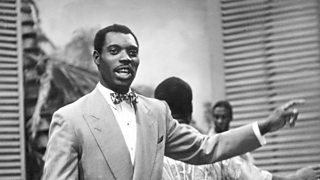
- Lord Kitchener: London Is the Place for Me (1948)
- Aaron Copland: Appalachian Spring (1944)
- Christoph Willibald Gluck: Che Faro senza Euridice from Ordeo ed Euridice (recorded by Kathleen Ferrier in 1946)
- Florence Price: Symphony No 4 (1945)
- Gerald Finzi: Farewell to Arms (1944)
Listen on Radio 3 and BBC Sounds
![]()
Radio 3's Soundscape of a Century
Press rewind on a century of the BBC with an epic, eight-hour soundscape. Listen on BBC Sounds now (UK only).

Events to listen out for
1940
May-June: Operation Dynamo
More than 338,000 British and French soldiers are evacuated from the French port of Dunkirk. JB Priestley, broadcasting on The Postscript, describes "the little holiday schooners that made an excursion to hell, and came back glorious".

June: The fall of France
In June, General Charles De Gaulle addresses citizens of occupied France from a BBC studio in London. The Free French are given five minutes every day in which to broadcast to France, rallying the resistance from afar.
September: The Blitz
From September, towns and cities across the UK are targeted by German air raids in a campaign lasting more than eight months. More than 40,000 civilians are killed, almost half in London. The BBC continued to broadcast under siege, despite being high on the list of enemy targets.
1941
December: Pearl Harbor
On 7 December, the Imperial Japanese Naval Air Service mount a surprise attack on the Hawaiian US naval base, prompting the USA’s formal entry into World War II
1942
January: Desert Island Discs
The first ever edition of Desert Island Discs is recorded in the bomb-damaged Maida Vale Studio on 27 January and broadcast two days later. The first guest asked to select the music, book and luxury item they would take to a lonely island was the comedian Vic Oliver, whose choices you can still find today on the DIDS website.
June: The European broadcast premiere of Shostakovich’s “Leningrad” Symphony
Written under occupation in 1941, the score of the symphony had been smuggled out of the Soviet Union on microfilm two months prior to its broadcast on the BBC. It is performed at the BBC Proms by the London Philharmonic Orchestra under Henry Wood a week later.
The siege is lifted by Soviet forces in January 1944 after nearly two and a half years.
1945
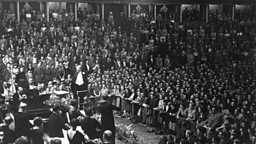
April: The liberation of Bergen-Belsen
British troops liberate the concentration camp and find 40,000 survivors in dire conditions. Over 70,000 people are thought to have died at Belsen, including at least 13,000 who died in the days after the liberation. BBC journalist Richard Dimbleby described the scenes of unimaginable horror that he witnessed: "I find it hard to describe adequately the horrible things that I’ve seen and heard but here, unadorned, are the facts."
May: Victory in Europe Day
Germany officially surrenders on 7 May 1945 and mass celebrations break out throughout Europe the following day, on what becomes known as VE Day. Find out more about how the BBC covered the day's mingled emotions with BBC 100.
1946
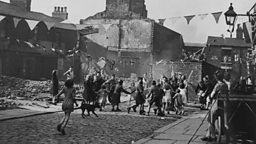
October: Woman’s Hour
First presented by Alan Ivimey, billed as an expert in writing for and talking to women, early editions of the programme tackled a diverse range of topics including childcare, equal pay and “putting your best face forward”. Find out more with BBC 100.
1947
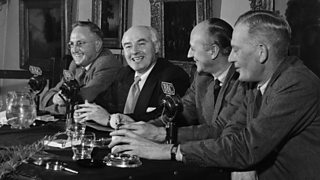
April: Gardeners' Question Time
The forerunner to Gardeners' Question Time is first broadcast on the BBC's Northern network, with a format that will seem familiar to modern listeners! The show meets with a large and appreciative audience of amateur gardeners, likely boosted by the wartime Dig For Victory campaign.
1948
June: The Empire Windrush
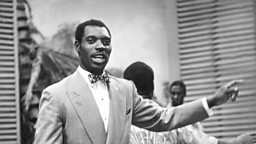
The former troopship docks at Tilbury, bringing hundreds of West Indian immigrants to a new life in the UK. Among them is "king of calypso", Lord Kitchener, who is interviewed by a BBC journalist as he disembarks. Find out more about how the BBC responded to a new age of multiculturalism with BBC 100.
July: Start of the NHS
The UK’s new National Health Service is formed, making healthcare free and accessible to all for the first time. Health minister Aneurin Bevan reflects on the first year of the NHS and stresses the "volume of need" that the service has revealed.