Is this the toughest animal on the planet?
Wildlife cameraman Max Hug Williams witnesses the endurance of caribou.
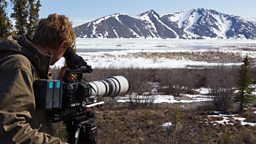
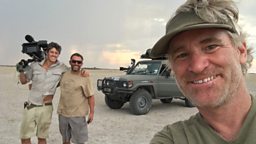
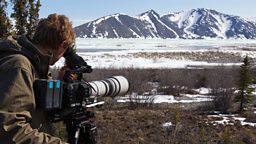
Working as a wildlife cameraman I feel very lucky to get up close to some of the world's most amazing creatures. People often ask me what is the most incredible spectacle I’ve seen in the natural world. Well, recently I met a new contender, one of the unsung heroes of the animal kingdom, and witnessed a feat of endurance like I’d never seen before.
For many caribou are simply the reindeer of North America, which conjures up an image of Rudolf and his sled, but as I discovered their epic adventures make delivering presents to the children of the world seem like a stroll in the park.
When we set off with the mission of trying to follow the porcupine caribou herd through the Yukon and Arctic refuge in Alaska, I knew it was going to be a challenge. But how hard could it possibly be to keep up with an animal that survives the winter eating little more than lichen? After all, we had packed snow shoes, lightweight camera kit and high energy ration packs to fuel us on our journey.
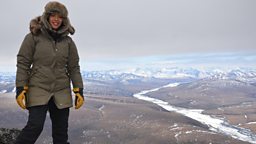
This part of the world is so remote, that more people visit Everest than Ivvavik National Park each year. Luckily I was joined by scientist Pete Sinkins and local legend Lee Jon Meyook, our Inuvialuit host, who knew the area like the back of his hand. As we set up our camp in the snow at -25°c little did I know that in just two months time I’d be searching for caribou again, only this time in +30°c wearing a mosquito head net.
Lee Jon pointed out some lines etched into an impossibly steep rock at the top of a mountain and told me that these were the lines left by caribou from previous years. He explained that they often traveled in single file with the one at the front blazing a trail through the snow. Lee Jon estimated that it would probably take a Caribou about thirty minutes to reach the summit from our camp. We knew from the GPS collar data that the herd was just 10km away so we decided we’d take a little trip to the top of the hill to see if we could spot them. Almost four hours later, still trudging through the snow and out of breath, I started to realize the enormity of the task that lay ahead for us trying to follow the caribou migration on foot.
As we waited and waited for the herd to arrive the park seemed eerily quiet, and the only signs of life we’d seen had been a ground squirrel, but all that was soon about to change. When the caribou finally crossed the border into the National park it was clear that we weren’t the only ones waiting for them. There were grizzly bears coming down from the hills in all directions and then suddenly a wolf heading straight towards the herd. I’d never seen anything like it. Within just ten minutes the herd had already lost one of it’s members and been chased by three different predators. Unbelievable, it was almost like we were watching the salmon run with grizzly bears appearing everywhere!
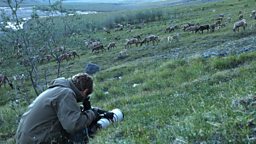
For the next few weeks we watched in amazement as the caribou traveled night and day with next to no food or sleep, summiting seemingly impossible mountain peaks, walking up to 30 miles per day through the snow, swimming across frozen rivers and somehow avoiding predators that were lying in wait around every bend. Needless to say, we soon realized there was no way we could possibly keep up on foot but with the help of the invaluable satellite GPS data, we were able to leapfrog ahead of the herd by air and get in position to film.
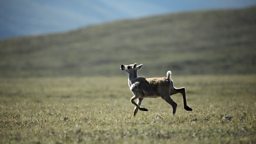
When we finally reached what we thought was the finish line of the coastal calving grounds there was barely a chance to catch our breath before the great race started all over again. From the day they are born caribou calves can outrun an Olympic sprinter and have to keep on the move to evade the golden eagles and bears. The youngsters must follow their mothers back down to the over wintering grounds in the south doing the same epic journey in reverse.
As summer fast approaches and the snow melts the whole herd comes together in mass aggregations. Bizarrely their main challenges now are avoiding the heat and swarms of blood sucking insects. Alaska is home to some 17 trillion mosquitoes and when they latch onto the herd it can get so bad that there are reports of caribou being asphyxiated if they don’t keep on the move. Moving as one herd makes it difficult for any predators to keep up and predict where the caribou might pass at any one time. This also in turn made it very difficult for us to pinpoint them on the ground, which explains why so few people have witnessed these mass aggregations. Armed with the latest GPS collar data we set off in a light aircraft and landed as close as we possibly could.
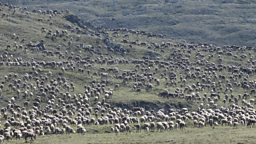
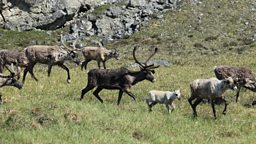
Glancing at a map and using some calculated guesswork about which valley we thought the herd would travel down, we hiked eight miles to get into position. By now it was 4am, but with 24 hour daylight it seemed like mid afternoon. I sat with my bug net on in a deserted landscape praying that the herd would come my way. Apart from the buzz of mosquitoes it was silent and I was convinced the caribou had given us the slip. Then, in the distance, I heard a rumbling noise and I saw a cloud of dust enveloping the hillside and the sheer numbers of caribou pouring into the valley were almost impossible for my eyes to compute. Moving like one organism the whole herd had come together and we were engulfed and completely surrounded by perhaps as many as 200,000 animals. For nearly thirty minutes a constant stream of caribou passed us by. Mothers, new calves and bulls sometimes almost too close to film, it was truly mesmerizing and something I will never forget.
As Lee Jon had told me caribou come and go like the wind. And he was right, as soon as the last one passed there was silence again as if it had all been a dream. Even the mosquitoes had decided to leave and followed the herd.
The caribou are the lifeblood of this ecosystem: the bears, the wolves, the eagles, the vegetation, the local people and even the mosquitoes depend on them. It’s incredible to think that the world's longest land mammal migration has gone on largely undisturbed for thousands of years. I just hope that the discovery of oil in this remote part of the Arctic doesn’t change all that.
The porcupine caribou are one of the few herds that have actually been increasing in numbers in recent years. Seeing first hand what the caribou are up against simply blew me away. They already have quite enough to contend with, so even the smallest change to the ecosystem could tip the balance. I couldn’t quite believe the relentless obstacles that seem to lie in wait around every corner of this epic journey. It’s easy to forget that not only is it the longest walk in the world, but many of the females leading the charge are so heavily pregnant that they could drop their calves at any moment.
I remember asking the caribou scientist in Canada if these animals ever actually got a break?
His reply summed it up perfectly – “they probably get their time to rest in the middle of winter, that’s what they are perfectly adapted for……when it’s -50°c, howling a gale and no predators are crazy enough to venture outside, the caribou probably wander out on a frozen lake, sit down and finally get to relax.
Quite simply caribou have to be up there with the toughest animals on the planet.