Timeless and elemental: Richter / Pärt at MIF
By William Cook | 10 July 2015
It sounds like a mad idea – an artist and a composer sharing the same space – but when you see (and hear) it, you realise it makes perfect sense. Here in Manchester one of the world’s great artists, Gerhard Richter, has teamed up with one of the world’s great composers, Arvo Pärt. The result is strange and wonderful, like stepping into a surreal film.
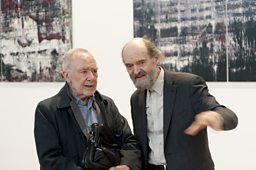
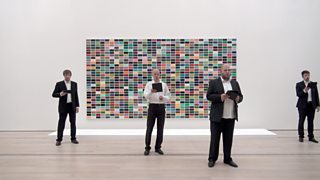
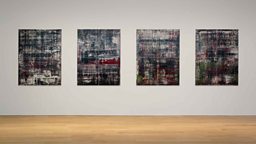
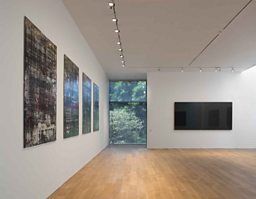
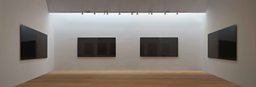
A large white room at The Whitworth (recently voted Museum of The Year) is hung with Richter’s arresting paintings. On one wall is Birkenau, an abstract series inspired by photographs taken by a prisoner at Auschwitz-Birkenau concentration camp.
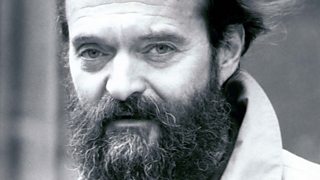
Ostracised by the Communist state, Pärt reached an impasse in his work. ‘I had lost my inner compass,’ he said. He doubted he’d ever be able to compose again.
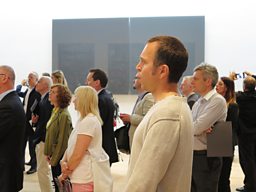
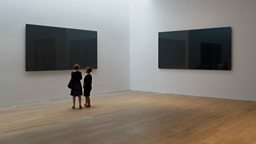
On the other three walls is Double Grey - four minimalist diptychs, shades of grey on enamelled glass. The viewers are reflected in the glass. This creates an awkward, self-conscious atmosphere. The room is silent. Then some of these viewers start to sing.
At first you don’t know what’s going on. You thought these singers were just spectators. They don’t look any different from you or me. But the sound they make is beautiful – simple, timeless, elemental.
This is Drei Hirtenkinder aus Fátima, an unaccompanied choral work by Arvo Pärt. Pärt and Richter have dedicated these parallel artworks to each other.
Drei Hirtenkinder aus Fatima has an interesting history. In 1917, three child shepherds in Portugal saw a vision of the Virgin Mary. The Madonna made several prophecies. She foresaw the Second World War.
This story was Pärt’s inspiration. The words are from the Eighth Psalm: "Out of the mouths of babes and sucklings has Thou ordained strength..."
Born in the 1930s, Pärt and Richter were both children during the War. They both spent their teens and twenties under Communism: Richter in his native Dresden, which became part of the East German ‘Democratic’ Republic; Pärt in his native Estonia, which was swallowed up by the USSR.
In 1961 Richter fled to West Germany, where he was able to work in freedom, but for Pärt the 1960s was a time of repression, not liberation.
His 1968 choral work, Credo, delighted Estonian audiences, but the Soviet authorities disapproved of its powerful Christian theme.
Ostracised by the Communist state, Pärt reached an impasse in his work. "I had lost my inner compass," he said. He doubted he’d ever be able to compose again.
Desperate for inspiration, he asked a street sweeper what a composer ought to do. "He should love every note," said the street sweeper. It’s a perfect definition of Pärt’s music. Out of that crisis came a purer style, inspired by Gregorian chant.
Living in the Bundesrepublik, rather than the Soviet Union, Richter’s career wasn’t affected by state censorship so much as fickle market forces. In the 1970s his work became unfashionable, as conceptual art eclipsed painting.
However Richter never wavered and today he’s the most expensive living painter on the planet. Private collectors like Frieder Burda, who bought his work in the 1970s, have been handsomely repaid for their support.
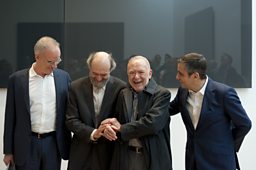
In the 1980s Pärt moved to Berlin, where he lived for 30 years. Yet though Richter admired his music, the two men never met until they were introduced by Hans-Ulrich Obrist and Alex Poots, the co-curators of this show.
In a way, you could say Pärt and Richter have pioneered a new artform.
Obrist and Poots got talking on a transatlantic flight and hatched the idea of asking Richter and Pärt if they’d like to work together.
"We were thinking about how we could bring art and music together," says Obrist. "Alex was telling me about his collaboration with Arvo - I was telling him about my collaboration with Gerhard."
A few weeks later, Obrist visited Richter in his studio. "What have you been listening to lately?" asked Obrist. Richter said, "Arvo Pärt." The German artist and the Estonian composer finally met in Dresden, at an exhibition of Richter’s work.
The two men saw Richter’s paintings together, and listened to Pärt’s music together. This collaboration is the culmination of that meeting.
Richter’s work has always had a close relationship with music, from John Cage to JS Bach. This show takes that relationship to a new level. However, for many visitors to the Manchester International Festival, it’s Arvo Pärt’s music which will be the biggest revelation.
In Estonia, singing isn’t just an artform – it’s an important part (perhaps the most important part) of Estonia’s national identity. The ‘Singing Revolution’ of the late 1980s was central to the peaceful protests which led directly to Estonian independence.
"I could never get Arvo Pärt’s music out of my mind," says Alex Poots, who’s also Artistic Director of the Manchester International Festival. "In its economy of language, it had such a complexity of emotion and metaphor."
Coupled with Richter’s paintings, it’s even more affecting. At the first performance, some members of this audience were moved to tears.
In a way, you could say Pärt and Richter have pioneered a new artform. Opera and ballet combine music and performance. This show unites art and music, and the results are just as thrilling.
I have a hunch this collaboration may be the first of many, and not only at the Whitworth.
As you leave this gallery, with Pärt’s haunting music still ringing in your ears, you can’t help thinking of all the other artists and composers who might work together. Georg Baselitz and Kraftwerk? Grayson Perry and The Pet Shop Boys? This idea could run and run...
Richter/Part is at The Whitworth, Manchester until 19 July.
Related Link