Snakes in the city
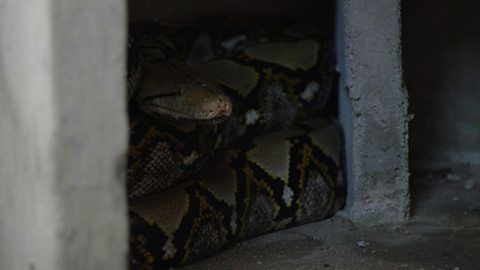
When you think of wildlife you may encounter in a city, you might think of pigeons, rodents or stray cats. But after spending a few days in Bangkok at one of the fire stations that responds to snake calls, it is evident that Bangkok is also home to thriving populations of snake species, in particular reticulated pythons. These pythons are the longest snakes in the world, but this doesn’t prevent them from remaining virtually undetected by many passersby.

This is one of the reasons my partner Max and I have chosen to conduct field research in the Sakaerat Biosphere Reserve, just a few hours north of Bangkok. I am studying the spatial ecology of native Burmese pythons as well as exploring human-python conflict and Max is researching the thermal ecology of king cobras. Together we provided scientific support for Cities: Nature's New Wild and helped to ensure that the snakes were handled in a manner that was safe for them and didn't cause them any unnecessary stress.
The fire station that Pinyo, the head “snake catcher”, works out of, has close to 200 reticulated pythons in bags, boxes and cages. All of them have been found in the city and removed by Pinyo and his team over the course of a few weeks. All of these snakes will soon be released to wild areas away from the city or used in education programmes. Within this number is an enormous reticulated python, that is over 5 metres long. It baffles me how a snake that large has gone its entire life up until this point without being noticed or seen by Bangkok’s residents.
Over the course of a year, Pinyo estimates that Bangkok firemen will respond to between 30,000-35,000 snake calls, and that about 70% of these calls will be for removing reticulated pythons and relocating them away from the city. The abundance of reticulated pythons in Bangkok is dramatically different to what Max and I find in the Sakaerat Biosphere Reserve.The difficult part of our job is actually finding snakes to include in our sample size, and we can spend several hours a day for several weeks actively searching for our species without finding anything. So, the opportunity to see and get hands on with so many pythons in such a short time is a real treat!

While it seems strange that reticulated pythons are thriving in Bangkok, it isn’t that surprising why they have survived so well there. Bangkok is built on a wetland, which is the perfect habitat for reticulated pythons, and when people changed the landscape, the pythons adapted well. Some of the buildings make perfect spots for pythons to ambush their prey, digest their meals or lay their eggs.
People also produce waste, which attracts rats and other scavengers, and rats make a good snack for reticulated pythons. Pythons are considered to be diet generalists, meaning that they will take a variety of mammals and birds. This flexibility in their diet gives them the upper hand over other species of snakes that may have more specific tastes. Additionally, their relatively sedentary lifestyle makes it easier for them to remain concealed. Usually people spot snakes when they are on the move, either crossing roads or pathways.
Pinyo shows us some other snakes he has captured during snake calls and, while pythons aren’t the only species he finds, they are the most common. This could be because reticulated pythons can grow to be huge, and maybe the thought of a large snake in your backyard is a little more unsettling than a small, 50cm pit viper (also commonly found in Bangkok), so perhaps people are more inclined to call in pythons.

What’s probably more likely is that certain snake species in Bangkok are very abundant but there is a lack of species richness, meaning that there are high densities of a handful of species, but overall there may only be a few species present. This phenomenon is not limited to reptiles though, and urbanisation often leads to biological homogenisation, which occurs when select species are able to adapt to urbanisation and become widespread compared to their less adaptable counterparts. So when judging the overall health of an ecosystem or environment, it's important to not only look at species abundance but species diversity as well.
Due to the abundance of reticulated pythons, it is fortunate that there are dedicated rescue teams that respond primarily to snake rescue calls amongst many other responsibilities in the bustling Bangkok environment. The presence of the firefighters reduces a large amount of human-snake conflict in the area. Generally, snakes are not popular with people - which can result in harm to the snake or to the humans that take it upon themselves to “deal” with them.
So these rescue teams really are invaluable to the survival of wild city snakes and without them many would probably be killed out of fear. With the rapid increase of urbanisation across the world, we are seeing similar situations involving other species of different taxa where there is a direct need for intervention between wildlife and humans. This underlines the importance of humans learning to live with and appreciate the wildlife that we now share space with and should also encourage efforts to preserve and protect what wild environments still remain.
By Samantha Smith, Research Biologist
Behind the scenes: Python catch
Members of the Fire Service rescue a three-metre-long python from a kitchen in Bangkok.