Are fake tanning products healthier than a natural tan?
In the depths of winter, many of us are reaching for the fake tan to add a touch more colour to our sun-starved skin.
Listener Julie uses tan from a bottle when she wants to get that sun-kissed look. But after much trial and error with foams, lotions and gels she got in touch with BBC Radio 4's Sliced Bread to ask what actually is in the fake tanning products that she uses? Can they really deliver a streak-free, long-lasting glow? And how much better for us are they than a natural suntan?
To find the answers, presenter Greg Foot and experts take a thorough look at the sunless tanning products on the market – including the nasal sprays and pills sometimes seen on social media. Here's what Julie needs to consider before deciding whether to slather on the tan or embrace the pale.

A tan is a sign of DNA damage
“Tanning, unfortunately, is a sign of DNA damage,” says consultant dermatologist and senior lecturer at the University of Manchester Dr Jean Ayer.
It’s caused by Ultraviolet B, a set of wavelengths of light that can penetrate through the top layer of our skin. “It can cause DNA damage and it stimulates the production of melanocytes, which then in turn produce melanin.” This is the pigment responsible for the colour of our skin.
But exposure to the sun is not all bad. “We synthesise vitamin D almost exclusively from UV radiation,” adds the scientist. “Like anything, there is a balance to be had.”
A tan might not protect your skin from the sun as much as you think
Melanin is, in theory, a form of protection from the sun – but it depends on your skin type, explains Jean.
If you usually burn, occasionally tan, you have a higher concentration of pheomelanin – responsible for a yellowy-red pigment. “Unfortunately, that type of melanin is less photostable,” says Jean. “It confers very little photoprotection.”
With a darker skin type you have a higher concentration of eumelanin, which is more abundant and more evenly distributed in the skin, and that type of melanin is much more photoprotective.
Almost all fake tans have the same main ingredient
The active ingredient in most fake tans is a compound called dihydroxyacetone (DHA).
It's important to remember that fake tan won't protect you from the sun, so you still need to apply sunscreen as normal.
“Fake tans react with the top dead layers of skin in a way similar to how bread browns in the oven,” explains cosmetic scientist and science communicator Dr Michelle Wong. This is called the Maillard reaction and it’s what gives fake tan its distinctive, biscuity smell.
A product will offer a light or dark tan, depending on the concentration of DHA and how long you leave it on for.
“Some of them are already brown when they come out of the bottle,” explains Michelle. “That sort of helps you see where you are putting the fake tan to begin with.”
Fake tanning is safe
Fake tan can make the skin tingle, but it’s not harmful at all, says Jean.
With the Maillard reaction in cooking, you have to have heat as well as a chemical reaction between the protein and the sugar. “There obviously is not a heat component with the skin,” states the scientist.
Secondly, the brown pigment is really confined to the stratum corneum. This is the topmost layer of the epidermis where all the cells are essentially dead. “There's no evidence to suggest that this would go into the blood stream or be absorbed anywhere else,” she states.
“From my perspective, there are no concerns about safety with these products.”
It’s important to remember though that fake tan won’t protect you from the sun, so you still need to apply sunscreen as normal.
Exfoliation helps with an even fake tan
How well the tan develops will depend partly on your skin hydration and how well exfoliated it is, says Michelle. Scrubbing off as much of your dead skin as possible before applying will help the tan go on evenly and last longer.
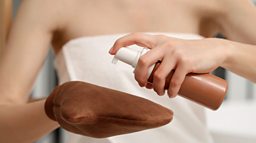
In areas with more dead skin, like knees and ankles, the DHA tends to react more. “You get more of a darker orange colour and that can look very unnatural,” says the cosmetics expert. The palm of your hand also has a lot of dead skin; applying your tan with a mitt can help avoid orange fingertips and brown calluses.
“How evenly your skin cells come off also depends on the moisture level,” says Michelle. Using a fake tan that’s a lotion, that moisturises your skin, can help.
Some sunless tanning products could irritate sensitive skin
Some fake tans contain preservatives. Some incorporate fragrances to mask that biscuity aroma.
Just like with anything else in skincare, the price doesn't always reflect the quality.Dr Michelle Wong
“The more chemicals within a product the more likely you can then develop an allergic reaction,” warns Jean. “The most common one that you might develop, if you were to constantly use these products, is a delayed hypersensitivity reaction or a contact allergy.”
“I think less is more,” she states. “If you have sensitive skin, avoid a product with the preservatives.”
More expensive isn't necessarily better
“Just like with anything else in skincare, the price doesn't always reflect the quality,” says Michelle. “I would look up reviews and really just with your own eyes see which one gives you the result that you like best.”
You don’t need to splash out extra on a special fake tan for the face. “Sometimes they might also have other face skincare ingredients in them,” says Michelle, “but really, the base ingredient is always DHA.”
You should exert caution when it comes to tanning pills
Some brands promise a glowing tan from simply popping a pill. Many list beta-carotene – the orange pigment in carrots – as the active ingredient in their supplements.
If you consume beta-carotene naturally in whole foods, that’s one thing, says Michelle, but supplements are often not tested rigorously. “They're a lot more dangerous than people give them credit for because you think it's natural. It seems like it's safe, but that's just not really the case.”
Beta-carotene does confer some photoprotective benefit and is sometimes used to treat intense photosensitivity, says Jean, but taking the right dose is crucial. “When you are going down the route of taking something orally, unless you are certain what it is that is in your product that you're taking and the dose, I would be cautious,” asserts the scientist.
The NHS advises not taking more than 7mg of beta-carotene supplements a day.
Tanning nasal sprays and injections can be dangerous
Some adverts on social media promote nasal sprays and injections promising to give a long-lasting tan.
These are likely to be analogues of melanocyte-stimulating hormones (MSH), which in theory help you naturally synthesise melanin, explains Jean. But many of these products don’t have details on the label.
“It is very common for end users who are using these nasal sprays to report lots of side effects,” she stresses. In some cases, young users are reporting serious, neurological problems.
“As a general rule of thumb, don't sniff anything or inject anything where you don't know what the ingredients are.”
The injections in particular are illegal to sell or distribute in the UK.
The experts are unanimous
Are fake tanning lotions, potions, creams and mousses the best thing since sliced bread or marketing BS?
“I'm inclined to say SB actually because if somebody wants to tan, they do so in a safe way,” says Jean. “I see no harm in using a product that will cause them no ill effects in the long run.”
“I'd say SB as well because it is much safer than a tan,” states Michelle. “As someone who's on social media a lot, seeing a lot of younger kids being on social media, I think it would be nice if we could all get more comfortable with our skin's natural colour. But until then, fake tan is much safer.”
To hear Greg's full fake tan test, and learn whether listener Julie will be reaching for the bottle again, listen to the full episode of Sliced Bread on BBC Sounds.
The information contained in this article was correct at time of broadcast on 23 October, 2025.
More articles from Sliced Bread
![]()
Can you insulate your home for less than £100?
Can these DIY insulation hacks really save us energy and money?
![]()
Are expensive face creams worth the money?
Greg Foot delves into the world of ointments and creams.
![]()
Can anti-ageing products help us to stay young?
Greg Foot investigates the pills that claim to help us to live longer and healthier lives.
![]()
Are expensive dishwasher tablets worth the money?
Sliced Bread looks at the range of washing products out there.