Newcastle’s special relationship with Shakespeare
For 40 years the Royal Shakespeare Company has enjoyed a special relationship with Newcastle upon Tyne and its theatres.
Annual visits to Newcastle started in 1977 and the city became the RSC’s northern home with a raft of productions from Stratford-upon-Avon featuring at the Theatre Royal and other smaller theatres in the city over the course of several weeks.
![]()
Much ado near me
Hear more Shakespeare stories on BBC Newcastle
![]()
Shakespeare Festival 2016
The BBC celebrates the genius of the bard


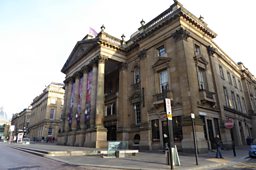
During its early years, the season also took in the Gulbenkian Studio, part of the Newcastle Playhouse complex. This provided a home for smaller scale non-Shakespeare productions as well as more specialist Shakespeare plays such as King John.
Many huge stars trod the boards at Newcastle Theatre Royal including Jeremy Irons, Charles Dance, Judi Dench, Dame Peggy Ashcroft, Derek Jacobi and Michael Gambon.
Many huge RSC stars of the stage trod the boards at Newcastle Theatre Royal in the Shakespeare shows including Jeremy Irons (Richard II and A Winter’s Tale), Charles Dance (Coriolanus), Judi Dench (Much Ado About Nothing), Dame Peggy Ashcroft, Derek Jacobi (Much Ado About Nothing) and Michael Gambon (King Lear).
Future acting stars such as Simon Russell-Beale appeared in smaller roles during the annual seasons.
When the Theatre Royal was being refurbished in 1987, the RSC moved venues temporarily, using the Tyne Theatre and the People’s Theatre (in the suburb of Heaton) as substitute spaces.
Notable productions included ‘Romeo and Juliet’ in modern dress with a very young Sean Bean at the Tyne Theatre in a white Armani-style suit.
During what locals now call “this golden age of theatre”, the Geordie people went to three-four RSC shows in a month, and the season generated huge interest in The Bard in a city where people didn’t always go to the theatre during the rest of the year.
The arrival of the RSC’s huge stars and productions made the city feel like a very special place to be. Famous actors were sometimes spotted in the Theatre Royal bar and several were seen using the Tyne and Wear Metro back to their digs in Whitley Bay.
For a month, Newcastle was transformed into Stratford upon Tyne.
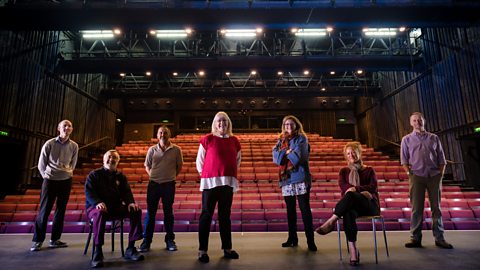
Amateur actors team up with the RSC Dream project in Newcastle at the People's Theatre (Image credit: RSC)
Erica Whyman, Deputy Artistic Director of the RSC, discusses this unique performance
‘Bloodiest’ Titus prompts faintings – writes the BBC’s Sue Wilkinson who was among the blood-splashed
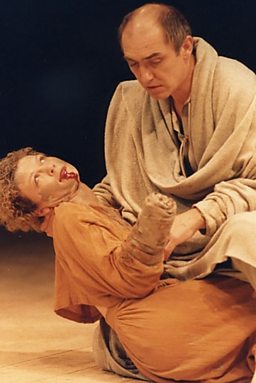
Particularly memorable during the 1987 RSC season was Titus Andronicus at the People’s Theatre starring Brian Cox in Deborah Warner’s ground breaking production.
The St John’s Ambulance team had to carry out at least three sensitive audience members
The theatre, normally used for amateur productions, including Shakespeare, was taken over by the RSC who transformed the 1930s playhouse into its own space.
Extra seating for Titus was placed close to the stage which meant that the audience was very much at the heart of the action in this particularly bloody production.
It was also a ground breaking moment for director Deborah Warner, one of the RSC’s first modern female directors.
At the time the RSC didn’t have a strong track record of using women directors and Warner was an interesting choice because she came from an alternative theatre background having founded the experimental Kick Theatre.
She refused to cut the text of Titus, something that had been done in previous RSC productions in the 1970s and 80s.
Described by director Bill Alexander as 'the biggest bloodbath in Shakespeare's canon', Warner’s production was to prove to be one of the goriest in the play’s history.
This was an incredibly visceral and super-realistic production with no softening of the play’s extreme violence.
In a key scene Sonia Ritter’s Lavinia is released by her abusers after being raped and brutally attacked, having her arms hacked off and tongue ripped out.
As she crawled around the stage dripping blood following her mutilation, the audience looked shocked and several people fainted every night of the show.
“Alas, a crimson river of warm blood,
Like to a bubbling fountain stirred with wind,
Doth rise and fall between thy ros'd lips,
Coming and going with thy honey breath.
But sure some Tereus hath deflowered thee,
And, lest thou should'st detect him, cut thy tongue”.
Even Shakespeare’s scene with Titus cutting off his own hand was played out not in a dark spot on stage but straight in front of the front row.
No surprises that on the night of my visit, the St John’s Ambulance team had to carry out at least three sensitive audience members. As for me, I barely missed being covered by fake blood in the splash zone close to the stage!
At the People’s and Swan theatres (it played at both venues) the play had a warning notice - 'This play contains scenes which some people may find disturbing,' and the local newspapers reported on the number of people who had passed out. The nightly tally of faintings became a news story in the press.
This critically acclaimed production is considered by critics to be one of the best ever Titus productions. Actor Brian Cox calls it 'the greatest stage performance I’ve ever given'.
The future?
Since the golden years, the number of RSC productions visiting the city of Newcastle has dropped.
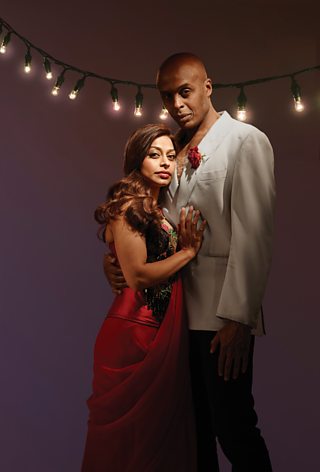
In 2011 the RSC failed to bring a major production to Newcastle due to funding cuts, but the company returned in 2012 and 2013 with a reduced season.
In recent years there has been a rethinking of the 'special relationship' between the RSC and Newcastle. The relationship is unlikely to return to its 'golden age', according to its deputy artistic director, Erica Whyman.
She has insisted, though, that it remains 'incredibly special'.
Whyman has said that the RSC’s relationship with Newcastle has changed over time: "We are in a constant state of evolution and a lot has changed since 1977. We just have to make sure that the kind of relationship we have is one that is fit for the 21st century environment."
One of those changes is the production of A Midsummer Night’s Dream with Northern Stage in Newcastle in 2016 to mark the 400th anniversary of Shakespeare’s death.
That production has a new twist with two local amateur actors playing Bottom and Puck alongside the RSC’s professional company. It is certainly a case of the RSC cementing its bonds with the local community in a very different way.
RSC’s Erica Whyman, once Northern Stage’s boss, is also looking to the future of Newcastle’s 'special relationship' with the RSC: "I’m really thrilled that we’re coming back to Northern Stage and delighted to be re-igniting that relationship with the theatre. I am confident that we’re going to do the same with Live Theatre over the next couple of years too."
Shakespeare on Tour
From the moment they were written through to the present day, Shakespeare’s plays have continued to enthral and inspire audiences. They’ve been performed in venues big and small – including inns, private houses and emerging provincial theatres.

BBC English Regions is building a digital picture which tracks some of the many iconic moments across the country as we follow the ‘explosion’ in the performance of The Bard’s plays, from his own lifetime to recent times.
Drawing on fascinating new research from Records of Early English Drama (REED), plus the British Library's extensive collection of playbills, as well as expertise from De Montfort University and the Arts and Humanities Research Council, Shakespeare on Tour is a unique timeline of iconic moments of those performances, starting with his own troupe of actors, to highlights from more recent times. Listen out for stories on Shakespeare’s legacy on your BBC Local Radio station from Monday 21 March, 2016.
You never know - you might find evidence of Shakespeare’s footsteps close to home…
Craig Henderson, BBC English Regions
![]()
Shakespeare Lives
The nation’s greatest performing arts institutions mark 400 years since the Bard's death

Related Links
Shakespeare on Tour: Around Newcastle
![]()
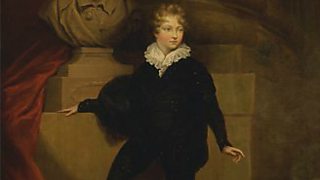
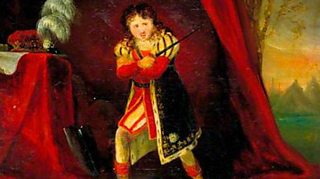
Child prodigy actor prepares to retire as he headlines in Newcastle
W.R. Grossmith says farewell to the stage at 11
![]()
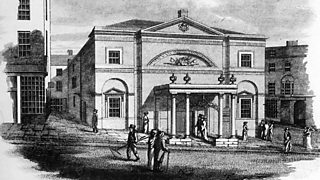
Heavyweight Shakespearean actor's huge influence on north east theatre
The legacy of Stephen Kemble, actor turned theatre manager
![]()
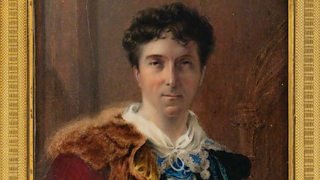
Upstart actor plays Hamlet
Charles Young plays in Newcastle
Shakespeare on Tour: Around the country
![]()
The 'Young Roscius' storms Manchester
Boy actor William Betty treads boards at ten
![]()
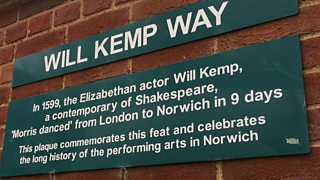
Will Kemp dances to Norwich
The journey of Shakespeare's former clown
![]()
Domestic Calamity postpones performance
Did the 'curse of Macbeth' strike?
![]()
Jonathan Miller and the Cambridge Footlights
Much ado about Jonathan Miller's Shakespeare