From giraffes to aerials on the Pyramids: nine unexpected WWI facts
Writer and director Jonathan Ruffle has been looking back a century to bring history to life and uncover new evidence that has challenged deep-seated beliefs about the First World War. His meticulous research of unit war diaries and eyewitness accounts bring us some fascinating facts about a war that defies modern expectation.
1. Giraffes sabotaged communications lines
An unexpected source of battlefield disruption, giraffes were known to walk through and destroy British signalling cable running from treetop to treetop in the African bush. On 8 June 1917 signalling Lt Col Hawtree reported from Lindi (in what is now Tanzania) that once again a successfully laid line had been brought down by giraffes. Someone must have disobeyed the 1916 order that cables be slung no less than 25 feet off the ground to avoid interference from the towering mammals.
When the British Army needed a big aerial for operations in Egypt, they anchored one end of it to the top of the Great Pyramid of Cheops.TOMMIES creator Jonathan Ruffle
2. Brits and Germans traded war materials
It doesn't sound possible, but the British munitions industry bought war materials from the Germans in the First World War, and vice versa. According to respected historian Guy Hartcup’s archival research, in August 1915 the British bought German binoculars, rangefinders and telescopic sights by the tens of thousands from the Germans in exchange for raw rubber, in trades that took place at the Swiss border. Opposing countries were selling equipment, which would be used to kill their own soldiers.
3. The first shot was fired by a Ghanaian
The first rifle shot fired by a soldier in British service in WWI wasn't fired on the Western Front. Instead, it was fired in what is now Togo, by Alhaji Grunshi of the Gold Coast Regiment. This was on 12 August 1914, though some sources put it as early as 7 August, just three days after war was declared. The war in Africa was to carry on past the end of the War in Europe, ending on 25 November 1918. In British East Africa alone the death toll was a crippling one-in-eight of the male population, and the fighting saw extensive ruination of farmland. The region is still recovering from this, one hundred years on.
4. The Germans used "drone" warfare
On 10 March 1917 the Germans attacked the Royal Navy on blockade duty in the North Sea using an early "drone". The Germans had packed an unmanned boat full of explosives and steered it from 12 miles away using a long wire trailed from the stern, with course corrections radioed to the controller by a German seaplane circling the scene. The drone exploded on the east pier of Nieuport harbour. No one knows why this technology wasn't exploited further after this promising start.
5. The Eiffel Tower and the Pyramids were used as aerials
The massive advances in signalling communications were integral to the way the First World War played out. Extraordinarily (yet perhaps logically) Allied signals communications were routed through the Eiffel Tower – it even generated the pips for the British Army's daily time signal. Also, when the British Army needed a big aerial for operations in Egypt, they anchored one end of it to the top of the Great Pyramid of Cheops.
6. British phones were tapped at the Somme
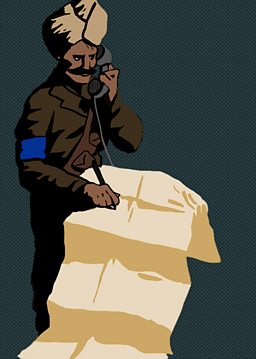
Early telephone technology was pretty simple: One phone was connected to the other by a long piece of wire. However, when two wires were placed side-by-side, sound could easily leak over. The Germans didn't permit any telephone lines a mile from their front lines on the Western Front for this very reason. Not so the British, who used millions of miles of wire up and down the line. The night before the first day of the Battle of the Somme, the Germans heard a British good luck message being read out down a phone, scuppering the chances of a surprise attack. The next day, 19,000 men were killed and a further 38,000 wounded.
7. Regent’s Park was the site of the biggest wooden building ever
Soldiers' moods can be dramatically affected by communications from home, and the British Army broke records in trying to keep Tommy in touch with his family. All post to and from the front went via a purpose-built mail sorting office in London's Regent’s Park – a vast wooden building called the ‘Home Depot’. Two-and-a-half-thousand people, many of who were women, sorted two billion letters and 140 million parcels. The sorting office is believed to be the largest wooden building in the world, ever. Eventually it covered five acres to cope with the demand.
8. Women fought on the front line
The First World War is full of accounts of women serving on the front line. British soldier Flora Sandes fought in hand-to-hand combat on the battlefields of Serbia, working as an ambulance driver before her resolve to fight saw her enrolled in the Serbian Army. Advancing to the rank of Sergeant, Sandes was gravely wounded by a grenade near Bitola in 1916 and was granted the highest decoration of the Serbian military. Other notable women on the front line included Italian-based American pilot Alice Sherman Hitchcock, and the frighteningly named Russian Women’s Battalion of Death.
9. Everyone fired the last shot of the war
It seems strange (and slightly morbid) that there should be a bit of competition on the last day of the War – 11 November 1918 – to be named the soldier who fired the last shot of the war. This desire was so great that men on both sides rigged long ropes, rather like you might use in a tug of war, but with one end tied to the trigger of a large artillery gun. As the last seconds ticked away up to 11 a.m., they all pulled, collectively becoming the 'last man to fire a gun in the war'.
More WWI from the BBC
![]()
World War One: The Cultural Front
Francine Stock explores how World War I changed the arts.
![]()
Seven significant facts about poppies
What do we really know about these beautiful flowers?
![]()
Voices of the First World War
Dan Snow uses archival recordings to tell the story of the First World War.
![]()
Home Front
The epic drama set in Great War Britain.