Main content
Seven significant facts about poppies
Millions of us wear poppies in November to remember those who gave their lives in war. But how much do we really know about these iconic red flowers?
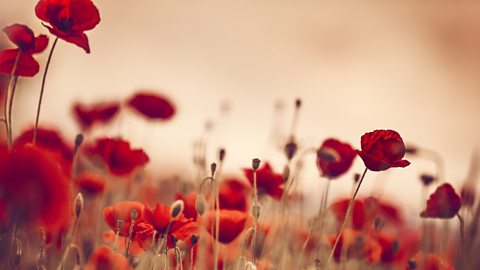
WW1: 'Poppies grew where people died'
Fiona Stafford, Professor of Literature, reflects on the wild, red poppy and WW1.
1. Poppies grow easily in poor soil and disturbed land.
2. As the battlefields were churned up, poppies grew back where people once had died.
3. While most people know poppies for their association with WW1 and WW2, the flower has long been linked with young men dying too soon, especially in poems reflecting on war. In The Iliad, Homer described the death of a young Trojan prince as being like a "full-blown poppy, overcharg'd with rain", sinking to the ground.
4. Commemorative poppies were a direct response to a poem - In Flanders Fields - published in the Christmas 1915 issue of Punch magazine by the Canadian doctor and soldier, John MacCrae.

5. In 2014 crowds flocked to the Tower of London to see 888,246 ceramic poppies planted in the Tower's moat, each poppy representing a British military fatality during the war. The art installation, by Paul Cummins, with setting by stage designer Tom Piper, was called Blood Swept Lands and Seas of Red - the first line of a poem by an unknown war poet.
6. The popularity of the name Poppy for baby girls grew exponentially and peaked every November in the 1920s. But only 44 baby girls received the name during World War 2.
7. One of the most powerful and poignant uses of poppy symbolism occurs every year at the Royal British Legion's Festival of Remembrance in the Royal Albert Hall: thousands of poppy petals flutter down from the roof of the hall to signal the two minutes' silence in memory of the fallen.

Photo: The Royal British Legion/Alison Baskerville 2015
Further Listening on Radio 3
![]()
The Meaning of Flowers
A second series of the popular flower essays written and presented by Fiona Stafford.
![]()
Download The Essay Podcast
Download all the episodes from the series and listen at your leisure.
![]()
Download the Slow Radio Podcast
An antidote to today’s frenzied world. Step back, let go, immerse yourself: it’s time to go slow.
![]()
Why the music we love as teens stays with us for life
How the reminiscence bump affects the music you love.