Why we love singing at football matches
As football fans gear up for the FA Cup Final, The Listening Service explores the roots of communal singing – from the church pew to the football stadium.
The sound of voices emanating from the terraces on a Saturday afternoon is so normal to us now that it's hard to believe that this kind of spontaneous group singing was ever frowned on. But believe it or not, communal singing was once a radical, revolutionary practice that brought religion and politics together with an almighty crash.
To understand why, we need to travel back in time. It was in 16th-century Germany that Martin Luther – composer, theologian, priest and a seminal figure in the Protestant Reformation – realised that singing together is about a lot more than just making music. When we sing, we’re expressing identity, spirituality and solidarity, whether it's in a church or the football stand.
You'll Never Walk Alone
Most people who sing in public with big groups of like-minded people aren't members of choirs – they're football fans. Football songs or chants have a long and illustrious pedigree in the UK, where there are records of chants dating back to the 1920s. But the origins of this form of expression can be dated to much earlier, with Luther, his songs and reforms.

It’s not as flippant as it seems to compare one of Luther’s hymns with "You’ll Never Walk Alone", the Rodgers and Hammerstein song from Carousel adopted by Liverpool FC fans. The ritual that Liverpool fans go through every time their team plays has turned that melody and those words into a something much more than a signature tune for a football club.
In the musical, "You’ll Never Walk Alone" acts as a bridge between heaven and earth after the suicide of one of the main characters. But the tune is about much, much more than that on the terraces. Since the early 1960s, when Liverpool adopted it as their sonic mascot, it has acquired more more memories and meanings with every rendition. As well as being a symbol of the fans' collective identity, it's a hymn to comrades lost in the 1989 Hillsborough tragedy.
Every time Liverpool fans sing "You'll Never Walk Alone", they perform their solidarity with each other as as fans and create a memorial bridge to lost friends and families. It also creates a sense of non-partisan fellowship that anyone in the stadium or watching at home can feel part of. It's an unconducted, uncoordinated force of nature that has real power.

You'll Never Walk Alone
Liverpool FC supporters singing on the Kop at Anfield
"You’ll Never Walk Alone" is simultaneously a sound of hope, a lament and a call for togetherness. It may be the closest that football songs get to spiritual experience. Every time it is sung, Liverpool fans enact the revolutionary values of active, engaged and transformational communal singing that Martin Luther mobilised as an essential part of the Reformation in Germany in the 16th century.
When did communal singing begin?
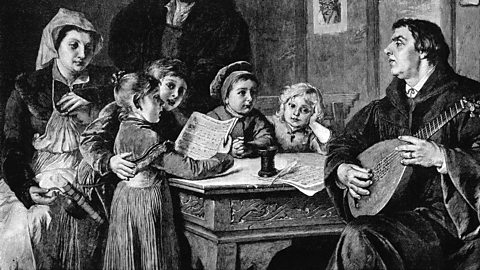
Among Luther's most revolutionary ideas was his use of music. For him, music was the most important way of communicating the words and deeds of God, and of making people better Christians. Luther's easy-to-learn tunes were mapped on to words that would reveal and inspire religious devotion and imitation.
Above all, these melodies were meant for everyone to sing – not least because they were based on folk tunes and farming work songs as well as Gregorian chant.
These songs could be sung to the accompaniment of a simple guitar, at home or in the pub (and there are pictures of Luther himself doing just that), or in church with an organ. The idea was that by singing these melodies with the rest of your community, you would be brought into the new church by the collective power and experience of song.
Links with the past
Martin Luther: Vom Himmel Hoch
Luther's words and music sung by the Von Trapp Family Singers
The music scholar, conductor and keyboardist John Butt says that all of our communal singing today is a remnant of the fire that Luther unleashed in the 16th century. Whenever we sing together, we’re animating a spiritual force and creating something bigger than our individual selves.
To sing together is to make the connections and relationships between us – usually invisible, inaudible – resound together.
Whether it makes us think about football, heaven, a lost loved one or a challenge ahead, Luther’s magic fire still burns with an essential truth: when we sing together, we’re not alone.
The Listening Service – Breaking Free: Martin Luther's Revolution – is available via the Radio 3 website.
![]()
Soul music: You'll never walk alone
How did this Rodgers and Hammerstein Broadwayt classic become a football anthem?
![]()
Breaking Free: Martin Luther's Revolution
Browse a host of fabulous concerts, documentaries and features exploring the Reformation.
![]()
Exporting football
Clare Balding explores how Britain spread a passion for football around the world.
![]()
Why does music move us so deeply?
This gorgeous animation shows how music sounds us out, reflects us and gives us the shivers.