What does technology mean for the future of music?

By Jack Needham, 12 November 2018
You're probably reading this on a glass screen, the glare of your own face reflecting back at you from your smartphone. Your own personal 'black mirror', a phrase that’s become synonymous with visions of the future thanks in no small part to Charlie Brooker, who joined Lauren Laverne in the 6 Music studio this week to discuss the new companion book to his hit TV show, Black Mirror.
Since first airing in 2011, Black Mirror has become a prophetic comment on modern times, showing how exciting technological innovations can also have serious downsides.
Technology has changed music for decades, from the introduction of the synthesiser to the pop innovation of Auto-Tune, and we’re now even witnessing virtual reality pop stars. But just how different will the future of music be? Get your tin foil hats ready, as we take a look at what could be in store...
New ways of listening
From gramophones to smartphones, our listening experience has come a long way - and audio technology is not only becoming more immersive, but personalised too. You only have to say the title of a song for your electronic assistant to blare music out of your wireless speakers.
Giving personalised control to the people makes them a part of that musical experienceNoah Kraft of Doppler Labs
There are also headphones on the market that tailor sound to your own hearing capabilities and instinctively adapt themselves to our listening habits. In-ear headphones devised by now-defunct San Francisco-based company Doppler Labs allow you to filter and alter noise from the outside world in real-time, which holds especially boundless potential in terms of live performances. "Every single live experience is going to be different. Nobody likes a show where it’s so loud you’re not enjoying it, so giving personalised control to the people makes them a part of that musical experience," the company’s co-founder Noah Kraft said last year. (Doppler has since ceased but a statement from the founders say they hope their innovation "lives on through other products and endeavours for years to come".)
But no matter how high tech headphones get, there’ll always be some people who lose them. One "body modification" expert, Rich Lee, thinks he’s found a solution though: by implanting sound-sensitive magnets inside his ears. Such surgical procedures shouldn’t be attempted at home, so the Versatile Extra-Sensory Transducer could be for you instead. Conceived as a hearing device for the deaf by neuroscientist David Eagleman, VEST is a tool that converts noise into vibration, allowing the wearer to ‘feel’ certain sounds or environments.
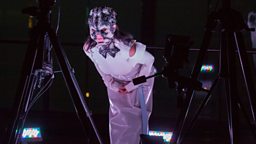
Leading musicians are pushing the boundaries of surround sound, too. Björk has always existed at the apex of music and tech, and one of her most recent experiments in the art of sound came with 2015’s Black Lake, a retrospective at New York’s Museum of Modern Art (MoMA). The exhibition incorporated 6,000 felt cones and 49 loudspeakers, mapping the music to a 3D environment, with individual sounds bounding across the room in real time.
"If you scan across the room from north to south, each inch corresponds to one second of the song," collaborator David Benjamin explained. "We created this effect by taking a spectral analysis of the song, projecting it onto the walls and the ceiling, and then using this map to dial in the size and location of each cone."
The future of physical
Despite the growth of digital music, listeners clearly still yearn for music they can touch, hold and proudly place on their shelves. Vinyl has seen a massive revival in recent years, with UK sales reaching a 25-year high in 2017. Cassettes are making a bit of a comeback too, while sales of the often unfashionable CD have increased as well. It’s great news for those who prefer their music with some crackle and character, but what does the future hold for the tangible music format? And how are physical releases being moved forward?
It's a response to a society which prioritises passive consumption over meaningful human connectionSpanish producer Plata
There’s a long history of artists pushing the boundaries of musical formats. Jack White has been busy reinventing what can be done with vinyl, stuffing his Lazaretto album in 2014 with hidden tracks and holograms, while The Flaming Lips have spent decades dreaming up progressively stranger things: from releasing 1997 album Zaireeka as four CDs meant to be played at once to more recently distributing records on blood-filled vinyl and as edible skulls.
Elsewhere, you can gather around an aluminium cube and enjoy the music of Nicolas Jaar, who sought to encourage collective listening via a rechargeable prism embedded with two headphone jacks and a copy of his 2012 compilation Don’t Break My Love.
Meanwhile, Massive Attack recently celebrated the 20th anniversary of their trip-hop masterpiece Mezzanine by releasing it on an entirely new format: sprayable DNA. Yes, the Bristol band encoded the album onto DNA fragments encased in microscopic glass beads, with one spray can containing about one million copies. So to play the record, all you have to do is spray it on your wall, scrape away the DNA paint, meticulously rebuild it in the correct order and just like that, you have your album.
Digital music is becoming a lot more tangible too. Take Plata’s Last Dayz EP on London-via-Berlin dance imprint Circadian Rhythms, for example, which came in its own format known as the '.plata', an encrypted digital file that only exists once the files are extracted using a USB that accompanies the release. "It's a response to a society which prioritises passive consumption over meaningful human connection," explained the Spanish-born producer in a press release.
Music with a mind
Technology is already impacting music creation. The dominance of streaming and changes in listening habits have seen studies suggesting that the great pop intro might be dying. We may also be saying farewell to fade outs and imaginative song titles for the very same reasons. But it’s even more interesting to consider how artificial intelligence is influencing the way music is produced.
I wanted music that would unfold differently all the timeBrian Eno
There have been studies looking at how AI has the ability to generate song lyrics, while AI is also being used to make completely unique music. Brian Eno's 2017 album Reflection came with an accompanying app that used algorithms to constantly change the record on every listen. Eno stressed his desire to "make endless music, music that would be there as long as you wanted it to be," adding: "I wanted also that this music would unfold differently all the time."
AI doesn’t just have the ability to achieve regenerative music, it can also mimic pretty convincingly. As The Beatles 'sing' on Daddy’s Car: "We took off that sunny day / packed our things and went away / me and friends in daddy’s car / to find out how summers are." Only, they didn’t. If you’re failing to recognise those lyrics, it’s because they come from a song that was composed by AI in the style of the Fab Four. It’s no Eleanor Rigby, but Daddy’s Car was a breakthrough for AI-generated pop.
There is still a human element that is key to AI-created music. For some musicians, AI is a tool that allows them to stretch what's humanly possible. For the video game No Man’s Sky, 65daysofstatic created an everlasting soundtrack that, thanks to its algorithmic makeup, could play for eternity. Bill Baird’s 2017 album Summer Is Gone, originally released through an interactive website, remixed itself using data of the time and location that you were playing it from: listening to the record at 4pm in London would produce a different album than 2am in Manchester.
Warning: Third Party video may contain adverts.
Holograms, drones and VR pop stars
Live music is where most musicians make a lot of their money these days. In fact, takings from live events accounted for almost 25% of all UK music revenue in 2016, bringing in £1 billion, which is over £300 million more than through physical sales and streaming combined. It makes sense, then, that artists have upped their game in the live setting, with today’s mega-stars using the latest tech to make their show a particular must-see.
A time machine that captures the essence of who we were. And are.ABBA's Benny Andersson
Artists like Four Tet focus on the visual aspect: on recent dates, producer Kieran Hebden has been performing amongst a breathtaking hanging garden of ceiling to floor lights. Designed by visual artist Squidsoup the lights are mapped to a 3D environment that dance and weave between the crowd. But for true absurdist fan interaction, look no further than Aphex Twin and his visual collaborator Weirdcore. Face-mapping technology captures the expressions of those in the audience in real time, superimposing them onto the faces of celebrities and beamed to the gargantuan screens onstage - a "psychological overload", as described by Weirdcore.
Muse, meanwhile, have been incorporating computer programming into their tour set-up. Frontman Matt Bellamy described the concept of his band’s 2015 album Drones as being informed by the idea that "the world is run by drones utilising drones to turn us all into drones," so it was only natural that the band incorporated them into the Drones World Tour, with 16 self-controlled drones hovering above the audience (although the experiments weren’t without incident). According to some, the future might even see drones bringing us food and beverages at festivals with pinpoint accuracy.
Despite the live music boom, concerts aren’t for everyone. But thanks to virtual reality headsets, the live experience is being brought to the comfort of your own home. Artists as wide-ranging as Chromeo and Slash have released interactive performances that can be viewed and explored through the use of VR headsets, with Slash’s version even allowing fans to wander backstage. "VR has the ability to deepen the fans relationship with the artist while providing access to fans around the world to experience the energy of live when they can’t physically be there," says Kevin Chernett, the Executive Vice President of Live Nation.
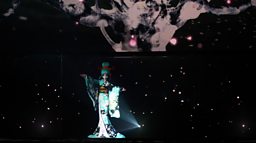
While the future may allow you to enjoy immersive live events without even being there, it might not even require the stars themselves to be physically present either. When 2-D, Murdoc, Noodle, and Russel emerged as Gorillaz in 1998, the idea of animated pop stars was still an alien one. Now, it’s becoming more commonplace. In Japan, names like Megurine Luka and Kaito are already reaching Beyoncé levels of fame despite being entirely animated. Hatsune Miku, a turquoise-haired teen sensation who began life as a vocaloid software, has become not only a virtual idol, but one of Japan’s biggest pop stars, drawing thousands of fans to stadiums in Japan as well as London’s Barbican last year.
It’s not just virtual reality acts though, there’s also been a controversial trend of posthumous live performances using the holographic likeness of deceased stars. In 2012 a holographic Tupac Shakur joined Snoop Dogg at Coachella. More recently, an Amy Winehouse hologram tour was announced to be in the works, with the late singer’s father saying in a statement: "Our daughter's music touched the lives of millions of people and it means everything that her legacy will continue."
We’re also starting to see living stars utilise holograms, too. Earlier this year, Elton John announced his farewell tour with a VR extravaganza that included a motion-captured Elton performing his greatest hits, digitally rolling back the years and personally guiding fans through his cosmos-traversing life story. Meanwhile, ABBA are set to sort-of reunite for what they’re calling an "avatar tour project", which Benny Andersson has teased as "a time machine that captures the essence of who we were. And are."
We are the robots?
Anybody dreading the prospect of an all-out apocalypse at the hands of sentient robots should take solace in ways that robot and human worlds are intersecting, as we see advances in biohacking through the emergence of things like wearable instruments.
I no longer need to compose music in the traditional sense, I can compose it by looking at things'Cyborg artist' Neil Harbisson
Imogen Heap has helped develop a pair of gloves that promise to "revolutionise the way we make music through movement". Teaming up with a group of scientists, the gloves match movements to musical functions and allow wearers to control live instruments and effects through hand gestures in thin air. They aim to show that "there is a better way to make music than with sliders and buttons – through the complex movement of the human body", and are already favoured by stars like Ariana Grande. They are even being used to help disabled musicians play again.
Then there’s something called The Spine, a protruding vertebrae designed by PhD researchers Joseph Malloch and Ian Hattwick, that works as a wearable effects unit, distorting and delaying sound as the performer bends and twists.
Biohacking isn’t contained to wearable upgrades though: some are taking things to far more extreme levels by installing sound devices into their bodies. Neil Harbisson, who has been described as "the world's first cyborg artist", has an antenna screwed into the back of his skull that hangs over the middle of his forehead and transmits colour from its built-in sensor, vibrating at certain frequencies, allowing him to "hear" different shades. "It’s not that I create music; my reality has become my music," Harbisson says. "I no longer need to compose music in the traditional sense, I can compose it by looking at things."
Follow us on Facebook, on Twitter @BBC6Music, or on Instagram @BBC6Music.