From the Black Power salute and beyond: political protests that inspired music
16 October 2018
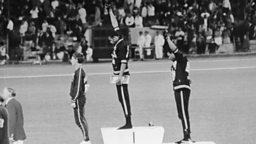
50 years ago, U.S. athletes Tommie Smith and John Carlos took a stand against racial injustice at the Olympics, bowing their heads and raising their fists - a gesture that would later become known as the "Black Power" salute. The protest may have resulted in the 200-metre sprinters being ejected from the 1968 Summer Games, but as the image ingrained itself in popular culture, the historic moment became a source of inspiration for countless people.
While Smith has said that the gesture was "human rights salute" rather than an exclusive "Black Power" statement, the silent protest against inequality and act of black unity nonetheless became an iconic moment in the civil rights history of the U.S. and sent shockwaves throughout the world. It was an act of defiance that many could relate to, even years later.
- There's another chance to listen to 6 Music's Black Power Soundscape with Don Letts, from Tuesday 2 June 2020, 12pm, as part of 6 Music's Blackout Tuesday coverage. There'll also be a special 1Xtra Talks, discussing the death of George Floyd, racism and recent events, available to hear from Tuesday 2 June 2020, 6pm.
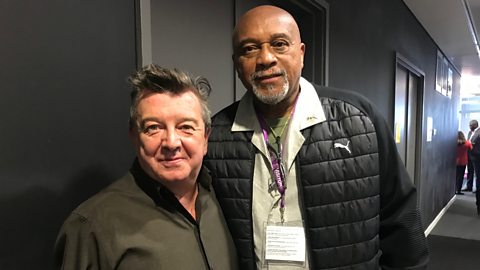
Tommie Smith on his ’68 Black Power Salute
Tommie Smith talks about how it felt to make the Black Power salute at the 1968 Olympics
The civil rights movement was heavily reflected in the music of the time; the likes of Nina Simone, Curtis Mayfield, Billie Holiday and Sam Cooke all producing politically conscious classics that illustrated the plight of African-Americans and underlined hope for change. But Smith and Carlos's protest has directly influenced musicians over the years too.
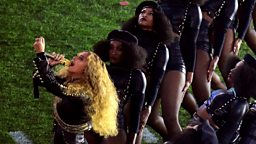
Decades on, photographs of the protest have appeared on artwork by Rage Against the Machine (Testify, 2000), Kendrick Lamar (HiiiPoWeR, 2011) and in music videos for The Story of OJ by JAY-Z, Fight the Power by Public Enemy and The Space Program by A Tribe Called Quest. Earl Sweatshirt’s Hoarse features the line "fists clenched, emulating '68 Olympics”, while Beyoncé's 2016 Super Bowl performance – the third most-watched television broadcast of all-time in the US – made reference to Black Lives Matter and the Black Panthers, and featured the star and her dancers with raised fists evocative of Smith and Carlos’s famous salute.
6 Music marks the 50th anniversary of the 1968 Olympics protest with the special programming produced alongside BBC 5 Live and BBC 1Xtra. The Black Power season, taking place this October (see highlights here), celebrates black achievement and excellence by exploring the music and stories associated with that time and its inheritors since.
As the aftermath of that historic moment continues to reverberate around the world, here are other political protests from the 50 years that have followed that have been reflected in the music of the time.
The anti-Vietnam War movement
Although the role of the U.S. military in the Vietnam War had been a polarising issue since the 1950s, it wasn’t until the mid and latter part of the 60s that opposition took the form of a fully galvanised movement. It’s hard to imagine how the issue could have failed to be reflected in the musical output of the era - and music played a massive role in the movement itself.
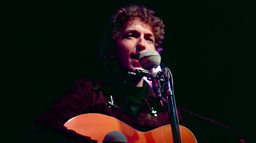
Bob Dylan never outright penned an anti-Vietnam War song (he told a Greenwich Village crowd in 1962: "This here ain’t no protest song or anything like that, ‘cause I don’t write no protest songs"), but the likes of The Times They Are a-Changin', Blowin' in the Wind and A Hard Rain's a-Gonna Fall became anthems for the youth protest that sprang up around it, as well as the civil rights movement.
Other songs that either echoed or became associated with the anti-Vietnam cause include Buffalo Springfield’s For What It’s Worth (1966), Creedence Clearwater Revival’s Fortunate Son (1969) and Edwin Starr’s War (1970). Meanwhile, Curtis Mayfield’s 1973 track Back in the World explored the difficulty for Vietnam veterans adjusting back to civilian life.
The AFN (American Forces Network) radio in Vietnam had its own protest songs too, adapted by soldiers for their own purposes, such as The Animals’ We Gotta Get Out of This Place and Country Joe and The Fish’s I-Feel-Like-I'm-Fixin'-to-Die Rag. (When the US forces eventually left Vietnam, the signal to evacuate was a song played on their network: Bing Crosby’s White Christmas.)
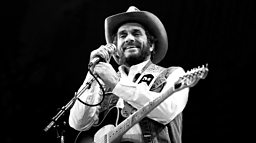
On the flipside, there were popular pro-Vietnam War songs too. The most famous being country star Merle Haggard's Okie From Muskogee, in which a semi-ironic character song from conservative Oklahoma outlines his stance in comparison to the young hippy-led protests: "We don't smoke marijuana in Muskogee/We don't take our trips on LSD/We don't burn our draft cards down on Main Street".
Explaining that he "wrote the song to support those soldiers," Haggard later described Okie from Muskogee as "a patriotic song that went to the top of the charts at a time when patriotism wasn’t really that popular." The song was such a success that it earned Haggard an invitation to the White House from President Nixon in 1973.
Staff Sgt. Barry Sadler took matters into his own hands, meanwhile, writing the patriotic Ballad of the Green Berets, which stayed at No. 1 in the U.S. for five weeks at the beginning of 1966.
As the impact of the Vietnam War was felt in American life and culture in the decades that followed the withdrawal of US forces in the early 70s, it also continued to inspire music that looked at the aftermath of the conflict. Television Personalities’ 1984 track Back to Vietnam evoked the horrors of PTSD, and in the same year, Bruce Springsteen’s Born in the USA explored the struggle of ex-servicemen and the feeling of the 'American Dream' being betrayed.
Calls for the fall of the Berlin Wall
As relations between the USSR and the western nations of NATO deteriorated, the second Cold War saw the loom of potential world warfare and fear of nuclear apocalypse occupy the minds of many. In early 1980, Kate Bush recorded Breathing; a sad, eerie song written from the point of view of a foetus in the womb, afraid of nuclear fallout from a blast. Four years later, Iron Maiden’s 2 Minutes to Midnight centred around the Doomsday Clock, the symbolic signifier assessing the threat of man-made global catastrophe.
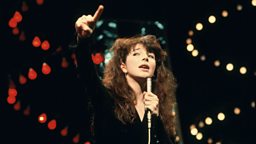
Also in 1984, Frankie Goes To Hollywood’s Two Tribes sent up the struggle between East and West, while its lyrics took potshots at President Reagan’s former modelling past, with its video depicting geopolitics as a macho wrestling match. Elsewhere, Pink Floyd’s Two Suns in the Sunset (1983) took the normally idyllic image of a simple sunset to imagine “premonitions of the holocaust to come”, the second sun being the fireball of a nuclear blast. The song ended with a dystopian weather report: “an expected high of 4000 degrees celsius”.
The division of Germany along the line of the Berlin Wall was a topic for songwriters for many decades too - and helped give a voice to the growing public unrest felt about the guarded concrete barrier. David Bowie’s Heroes, recorded in Hansa studios, close to the Wall itself, depicted lovers meeting in the barrier’s shadow. At first, Bowie told journalists he’d spotted two strangers kissing on a bench beneath a guard turret: later it emerged that the lovers of the lyrics were in fact his producer Tony Visconti and backing singer Antonia Maas, who were having an affair. Elton John’s Nikita similarly imagined a love divided by the Berlin Wall, while German pop singer Nena, whose 1983 single 99 Luftballons, re-released in English as 99 Balloons a year later, contrasted childish innocence with geopolitical madness in the idea of a conflict sparked in forces primed for war when they see the red balloons drifting by.
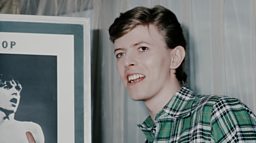
Thankfully the wasteland imagined in Nena’s song never came to pass, and in 1989, the Wall was opened, finally being demolished the following year, a moment commemorated Pink Floyd’s A Great Day for Freedom. The soundtrack to the event itself, though, was David Hasselhoff’s cover of the 1978 German song Looking For Freedom, which topped the German chart for eight weeks in 1989, and was performed by Hasselhoff by the Wall on New Year’s Eve 1989, shortly after dismantling began.
Opposition to the Iraq War
At the turn of the millennium, the global shock of the September 11 terrorist attacks in 2001 was felt throughout the music world. Sleater-Kinney’s Far Away (2002) was written by the band’s Corin Tucker about watching the events unfold from her home in Portland: “Turn on the TV / Watch the world explode in flames. Bruce Springsteen’s album The Rising responded to the climate of fear and anger that followed the attacks, while both its title track and song The Fire paying tribute to the firemen who went in to the burning towers trying to save lives. Beastie Boys’ Open Letter to NYC, meanwhile, offered words of hope and resilience: “Dear New York, I hope you're doing well I know a lot's happen and you've been through hell.”
The ensuing "War on Terror" sparked a period of increasingly politicised rock, especially in the U.S. Neil Young wrote his whole album Living With War in nine days, such was his ire at the war and George Bush, while Dixie Chicks braved the ire of their own country audience after speaking out against the war after Natalie Maines said at a London show: "We don't want this war, this violence, and we're ashamed that the President of the United States is from Texas". Their defiant song Not Ready To Make Nice is about the criticism they received for their perceived lack of patriotism.
In the UK, Faithless took aim with their 2004 single Mass Destruction, which turned the words of the British and American governments back on them, while Muse produced a song about the Iraq War that was “not really about the arguments for or against the war” but instead a song that sympathised with those in the military that were in the frontline of the conflict, evoking their experiences in Soldiers’ Poem from 2006 album Black Holes and Revelations. Bellamy said at the time that he "felt sympathy with all the soldiers fighting in the war, but who are never talked about in the media because war is such an anonymous monstrosity. People often forget that soldiers risk their lives and amidst all the political debates their lives come least."
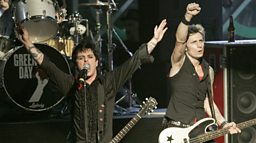
In 2004, the punk band NOFX launched the Rock Against Bush concert and compilation series, enlisting the likes of Foo Fighters, Sum 41, The Offspring and Green Day to oppose President Bush's (ultimately successful) re-election campaign and help boost the voter registration drive. "We want punks and other disenfranchised young people to vote as a block," NOFX’s Fat Mike said at the time. "I'm planning on losing a lot of money, but I don't care. This is something I really believe in."
As with the Vietnam War though, some songs from this period were explicitly pro-war. In 2003, pro-war (or "pro-American" as some of the musicians labelled themselves) tracks by the likes of Darryl Worley, Clint Black, Bo Diddley and Lynyrd Skynyrdclimbed the charts in the U.S..
A song that's left the most lasting impression from this time, though, arguably remains Green Day’s punk rock opera American Idiot. Largely inspired by the invasion of Iraq as well as the leadership of President Bush, it became an anthem against US interventionism. "We always wanted our music to be timeless. Even the political stuff that we’re doing now. I would never think of American Idiot as being about the Bush administration specifically. It’s about the confusion of where we’re at right now," frontman Billie Joe Armstrong said in 2004 about the song, which has since been used to show opposition to President Trump.
Occupy Wall Street
In September 2011, protesters began to gather in Zucotti Park in New York’s financial district to protest inequality and the lack of consequences for those who they felt had caused the 2008 economic crash. Music was an integral component of the Occupy movement, with impromptu performances that could be likened to the Peace movement of 1960s Woodstock. At first, protesters sang political classics: Blowin’ In The Wind and What’s Going On among them. But soon, musicians started to come down to the site.
Sean Lennon, Rufus Wainwright, David Crosby and Graham Nash all performed, as did Jeff Mangum (what was then a rare live outing from the the once-reclusive Neutral Milk Hotel singer), while Kanye West and Katy Perry also visited Occupy sites and JAY-Z was seen sporting pro-OWS t-shirts. Rage Against the Machine's Tom Morello, however, took things a step further, performing not just at Occupy Wall Street but at the sister demonstrations that sprang up in Los Angeles, San Francisco, Seattle, Vancouver, British Columbia, Nottingham and Newcastle.
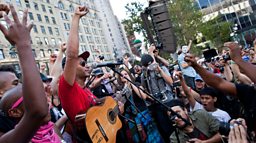
As the movement grew, everyone from Third Eye Blind (with If There Ever Was a Time) to Muse (with Uprising) and Ry Cooder (with No Banker Left Behind) were inspired to write about the new political energy. Perhaps one of the first original songs to be born from the Occupy sites, Talib Kweli freestyled a track - later released as Distraction - during a OWS visit. Although she didn’t pen a song about Occupy directly, Miley Cyrus included footage from the protests in the video for her song Liberty Walk, dedicating the clip to “the thousands of people who are standing up for what they believe in".
Despite the abundance of star power, the music of the Occupy movement remained a grassroots affair, with protesters regularly picking up an acoustic guitar to perform themselves. "The movement is not waiting for superstars to grace it with their presence," said Tom Morello, who often adopts the Olympics protest salute during his performances. "It’s not waiting for a Diane Warren-penned anthem featuring Rihanna and Drake."
The Black Lives Matter movement
Almost five decades on from the height of the civil rights movement, political unrest in U.S. cities like Ferguson in August 2014 followed high-profile deaths of black youths and sparked what would become known as the Black Lives Matter movement, with issues of race relations, systemic inequality and police brutality being tackled by the music of many major artists.
In 2015, Janelle Monáe and her Wondaland Records collective released the furious protest track Hell You Talmbout, listing names of victims of police brutality. "This song is a vessel," Monáe wrote on Instagram. "It carries the unbearable anguish of millions." Solange’s 2016 album A Seat at the Table was also informed by the history of black struggle, while sister Beyoncé offered her own stance on her visual album Lemonade, with the clip accompanying Kendrick Lamar collaborator Freedom featuring the mothers of Trayvon Martin, Eric Garner and Michael Brown all holding pictures of their late sons.
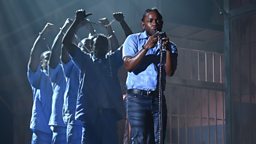
While D'Angelo’s 2014 instant-classic Black Messiah has been labelled as the "first major album directly linked to Black Lives Matter," Kendrick Lamar's own song Alright went on to became one of the anthems of the movement, with demonstrators regularly chanting its chorus (“We gon’ be alright! We gon’ be alright!”) at protests. Lamar's show-stopping 2016 Grammys performance, meanwhile, made allusions to America's prison-industrial complex, with the rapper performing his track The Blacker the Berry while shackled in chains.
"In this era of violent but often unacknowledged forms of white supremacy, D’Angelo, Lamar and Beyoncé are each using their repertoires to encourage us to congregate with each other, to wrestle with pleasure," Daphne A Brooks, professor of African American studies at Yale University, has written, going on to conjure an image of the 1968 Olympics protest: "To raise our hands in the air in postmodern contradiction – in ecstasy, abiding faith, as well as resistance."
#MeToo and Time's Up
The #MeToo and Time’s Up movements have shone a light on sexual abuse and gender inequality in Hollywood and beyond, with high-profile musicians among the leading advocates for change.
Janelle Monáe, Halsey and Kesha spoke at Women’s March events back in January. That month also saw Monáe deliver a stirring speech at the Grammy Awards. "To those who would dare try and silence us, we offer you two words: Time’s Up," Monáe said. "We say Time’s Up for pay inequality, discrimination or harassment of any kind, and the abuse of power. We come in peace, but we mean business."
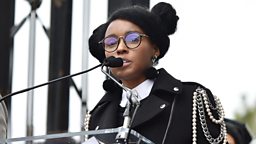
Meanwhile, the likes of Lauren Mayberry from CHVRCHES have expressed support for #MeToo and Time’s Up. Speaking to Pitchfork in February, Mayberry said that it was "great that people are speaking up", describing herself as hopeful that the movement "will change the way that people think in the future", while also underlining that there's more action to be done.
It may be slightly too early to see the bigger picture of how the movement has seeped into music itself, but musicians have been vocal participants in the cause so far.
Follow us on Facebook, on Twitter @BBC6Music, or on Instagram @BBC6Music.
Black Power Season on 6 Music
![]()
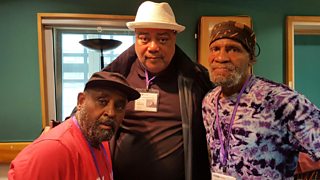
The Last Poets (19 October, 7pm)
50 years ago this year, the founding members of the Last Poets stood together in Harlem's Marcus Garvey Park and performed their first poems in public. The forefathers of hip hop present their Black Power Playlist on 6 Music.
![]()
Huey Morgan (20 October, 10am)
Huey explores Black Power in film and TV soundtracks and interviews Adrian Younge and A Tribe Called Quest’s Ali Shaheed Muhammad.
![]()
Cerys Matthews (21 October, 10am)
Cerys discusses new film Green Book, celebrating black culture by focusing on stars that became great role models.
![]()
6 Music Salutes Black Power (21 October, 1pm)
Don Letts presents an hour of black conscious music mixed with archive footage of the Olympic Games, featuring Smith and Carlos telling their story.
![]()
Revolutionary Black Power playlist (21 October, 2pm)
Neneh Cherry and 1Xtra's Jamz Supernova focus on female empowerment within the black community, with music from some of the biggest female artists in black music.
![]()
Now Playing (21 October, 6pm)
Tom Robinson curates the listening choices of the 6 Music listeners, with the theme of protest songs.
![]()
Stuart Maconie's Freak Zone (21 October, 8pm)
Radical black music from the last 50 years, including black and minority ethnic artists making the most exciting underground and experimental music today.
![]()
The Joy of 6: Yomi Adegoke and Elizabeth Uviebinené (22 October, 1am)
Authors of Slay In Your Lane, Yomi Adegoke and Elizabeth Uviebinené pick an hour of artists that have influenced them.
![]()
Blood Orange sits in for Iggy Pop (26 October, 7pm)
Dev Hynes (who says his album, Negro Swan, is "an honest look at the corners of black existence") sits in for Iggy Pop.
![]()
Gilles Peterson (27 October, 3pm)
Gilles presents a Shakedown Playlist themed around songs of protest.
![]()
Craig Charles: 6 Music Rewinds To 1968 (27 October, 6pm)
Craig explores the music of 1968, the year that the revolution was televised, with the Craig Charles Funk & Soul Show House Band, The History Teachers.
![]()
Spike Lee's Black Power playlist (available now)
American film director, producer, writer, and actor, Spike Lee (who directed the music video for Public Enemy's Fight the Power) presents his Black Power playlist.