'I left my high street fashion job to launch my own label'
In this episode of her podcast, Fresh Starts, award-winning documentary maker and podcaster Stacey Dooley met Eliza, a 27-year-old fashion designer from Leicester who left the high street behind to start her own sustainable fashion business.
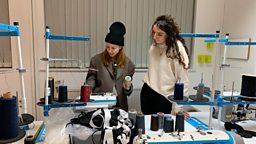
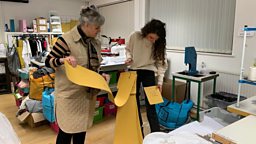
Stacey went behind the scenes at the factory where Eliza's designs are made and also chatted to owner Janie, who has helped Eliza realise her dream to make clothes that are kinder to the planet - and the people making them.

Listen to the podcast episode Eliza: Goodbye to Fast Fashion now on BBC Sounds!
Eliza’s race was run with fast fashion

After leaving college with a fashion degree, Eliza worked for about five years with big high street clothing brands. She remembers raising concerns about sustainability early on.
There were times when extra fabric was thrown straight into the bin"Eliza
“There were times when extra fabric was thrown straight into the bin,” explained Liza. “I’d ask questions about recycling the fabric, but they were dismissed.”
Waste was one issue, but then there was the disposable nature of the products themselves.
“With these fast fashion brands, it doesn't even matter what an item of clothing is made out of because it's only designed to be worn once,” said Eliza. “Why is it ending up in the bin before it's even had any sort of lease of life?”
There was a perfect storm of reasons for Eliza to quit her job.
“It got to the point where I was feeling exploited and doing ridiculous hours,” she says. “I thought, ‘if I feel exploited, how do the garment workers on the production line feel?’ It's not a nice industry to be in.”
Stacey helped Eliza try on something new
A colleague of Eliza’s told her about Stacey Dooley Investigates: Fashion’s Dirty Secrets, Stacey’s documentary about the environmental impact of cheap clothing.
If I don't do it now, I'm never going to"Eliza
“I remember being really quite shocked by it because I think where I was working was producing clothes in places similar to the ones you [Stacey's documentary crew] were in.”
Unconvinced by the high street brands claims of sustainability, Eliza set out to start her own business. “I had a bit of redundancy money behind me, and I thought, ‘if I don't do it now, I'm never going to.’”
Eliza went headlong into uncertainty, investing all her money in her new business without even knowing if she would get orders for her range.
Everything was up in the air, and there were other things going on in Eliza’s life around that time too – her dad suffered a seizure just before the pandemic, and then, as the pandemic took hold, her granddad died.
She also sold her house and left a long-term relationship. “For the business to have come out of all that feels like a silver lining,” said Eliza.
ADHD helps Eliza be a better businesswoman
Even before these life changes, Eliza found sleep a challenge. “When I worked for other people, I minded that, but I don't mind now. That's how my brain works. If I've got an idea, I need to roll with it, and I'm not going to stop if it’s the middle of the night.”
My brain works very differently, but I definitely take positives from it'Eliza
Eliza’s overactive brain was given an official explanation with a diagnosis of ADHD. The diagnosis took a while to happen because the condition is harder to diagnose in women.
It explained some of Eliza’s forthright behaviour at school, arguing back and standing up for someone else in trouble, and it underscores a lot of personality traits that she doesn’t want to lose.
“It makes me very impulsive. I can't switch off. I'm stressed a lot, but I also get stuff done,” Eliza said. “So, my brain works very differently, but I definitely take positives from it.
I've been offered medication for ADHD but I don't want it. I think it makes me a better businesswoman.”
To underline how she feels about staying true to herself, Eliza quotes a line from country singer Kacey Musgraves’ song Pageant Material: “I'd rather lose for what I am, than win for what I ain't.”
Being an eco-aware clothes shopper is an exercise in mindfulness
So what ways can we stay stylish, save money and save the planet?
I would never judge anyone for buying cheaper brands because they need to”Eliza
For Eliza, buying clothes to love for the long-term is a key factor. Her favourite jacket, which she has had for 10 years, inspired her to put “timeless” pieces in her collection.
Asked by Stacey about whether everyone could afford this though, Eliza replied: “I would never judge anyone for buying cheaper brands because they need to,” she says.
There are alternatives though. Charity shops and pre-loved clothes can be a great option - but also, it's about buying less altogether.
“If you’re going to buy something, really think about why you're buying it,” advised Janie, the owner of the factory where Eliza’s company is based. “Do you know how much you're going to wear it? What is it really going to do for you? Do you really need it?”