Famous child actor plays at Ledbury
A lucrative novelty, these young stars blazed for a short while then for the most part disappeared into obscurity as they grew up. Was such a brief moment in the limelight worth it or were these children the victims of a ruthless profession?
![]()
Much ado near me
Hear more Shakespeare stories on BBC Hereford & Worcester
![]()
Shakespeare Festival 2016
The BBC celebrates the genius of the bard

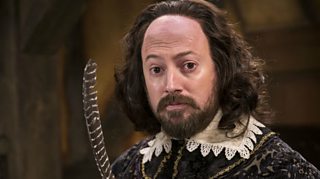
Was it talent or exploitation?
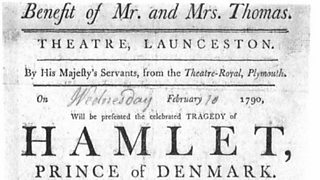
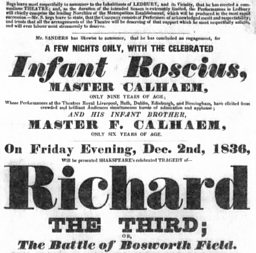
Master Calhaem and his infant brother were a pair of child actors, who amongst others, such as Master Betty and Clara Fisher, appear often in the British Library playbills collection.
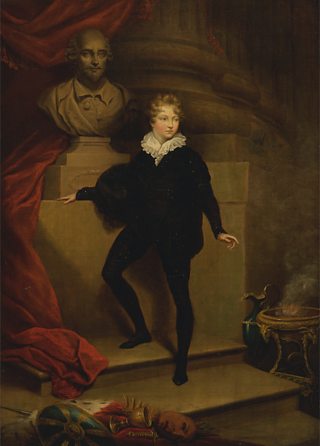
It is not uncommon for all the members of a family, even the smallest, to perform.
For audiences, the effect of seeing a youngster in one of Shakespeare’s most demanding roles was sensational - and lucrative for theatre managers.
Children tackled major roles such as Shylock for example.
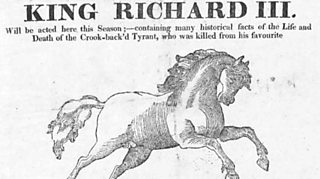
But in this playbill, the young Calhaem’s are the Princes in the Tower, murdered at the behest of the ruthless tyrant Richard.
As we can see from this particular production, the two brothers Calhaem are versatile and they can also sing and dance for their supper.
Although it was a demanding life, compared to the fate of others the same age who could be working in the mines or the factories, treading the boards was a far more pleasant option.
And yet for some it still amounted to a form of exploitation.
In the novel Nicholas Nickleby, published initially in serial-form just two years after this playbill, Charles Dickens satirises child actors, attacking those who saw their youth as a means to make money.
In the novel, Ninetta the daughter of the theatre manager Vincent Crummles, is known as ‘the infant phenomenon’.
She is supposedly ten years old and seemingly “the idol of every place we go into”.
The nobility and gentry of almost every town in England have written complimentary letters about her dramatic abilities as according to her father, her talent is not to be imagined.
Dickens writes; "The infant phenomenon, though of short stature, had a comparatively aged countenance, and had moreover been precisely the same age… for five good years. But she had been kept up late every night, and put upon an unlimited allowance of gin-and-water from infancy, to prevent her growing tall."
About Shakespeare on Tour
From the moment they were written through to the present day, Shakespeare’s plays have continued to enthral and inspire audiences. They’ve been performed in venues big and small – including inns, private houses and emerging provincial theatres.
BBC English Regions is building a digital picture which tracks some of the many iconic moments across the country as we follow the ‘explosion’ in the performance of The Bard’s plays, from his own lifetime to recent times.
Drawing on fascinating new research from Records of Early English Drama (REED), plus the British Library's extensive collection of playbills, as well as expertise from De Montfort University and the Arts and Humanities Research Council, Shakespeare on Tour is a unique timeline of iconic moments of those performances, starting with his own troupe of actors, to highlights from more recent times. Listen out for stories on Shakespeare’s legacy on your BBC Local Radio station from Monday 21 March, 2016.
You never know - you might find evidence of Shakespeare’s footsteps close to home…
Craig Henderson, BBC English Regions
![]()
Shakespeare Lives
The nation’s greatest performing arts institutions mark 400 years since the Bard's death

Related Links
Shakespeare on Tour: Around Hereford and Worcestershire
![]()
The fear of spreading disease is bad news for many travelling performers
Many towns and cities, including Worcester, laid down strict controls
![]()
A theatre fit for a Queen
Queen Victoria impressed by Shakespearean actor Stephen Kemble’s home town of Kington
![]()
A horse! A horse! My kingdom for a horse!
King Richard III's horse White Surrey is the star of the show
Shakespeare on Tour: Around the country
![]()
The 18th century impersonator who was 'the Jon Culshaw of his day'
The city gets its prestigious Theatre Royal
![]()
The Northampton Repertory Theatre
Pieces of history in Northampton
![]()
Drunken robbers threaten the leader of Shakespeare's players
As he collects admission money at the door!
![]()
Shakespeare's tragic heroes appear in Launceston
Size not everything as Shakespeare's tragic heroes appear in remote town of Launceston