Carte-de-visites: the development of the royal image
9 February 2018
In conjunction with the Modern Times episode in Andrew Graham-Dixon's Art, Passion & Power, Sophie Gordon, Head of Photographs at the Royal Collection Trust, introduces us to the first photographic portraits widely available to the public.

Left image - Queen Victoria and Princess Beatrice | Photograph of Queen Victoria seated, slightly to right, with Princess Beatrice seated on her lap | Read more at Royal Collection Trust's website
Right image - Princess Helena (1846-1923) | Photograph of a full length portrait of Princess Helena (1846-1923) | Read more at Royal Collection Trust's website
Although the first photograph of a member of the British royal family was taken as early as 1842, it was not until 1860 that the first photographic portraits of the royals were published and widely available to the public.
Instead of presenting the queen as sovereign, the photographs show the queen dressed quite modestly and she is shown as a wife and a mother.Sophie Gordon
By this time, Queen Victoria and Prince Albert had been photographed on many occasions and they would have seen how photographs could be manipulated to create a particular image, be it of a reigning monarch or of a wife and dutiful spouse.
Those first photographs that were released to the public in 1860 were presented in a particular format – the carte-de-visite – when a small photograph was pasted onto a card backing. Patented in 1854 by French photographer Alphonse Disdéri, within a few years the carte-de-visite had become popular across Europe as a way of creating relatively cheap family portraits.
At the same time, cartes of famous people, including royalty, politicians, writers, musicians and actors, were made available for sale through print-sellers. A collecting craze quickly developed, known as cartomania, which was fully embraced by Queen Victoria. Public demand for images of the British royal family also grew stronger.
In 1860, Queen Victoria gave photographer John Mayall (1813-1901) her permission to publish a set of portraits he had taken of her and other members of the royal family. This set of images was extremely popular, and another set of Mayall's portraits was released in 1861. Instead of presenting the queen as sovereign, the photographs show the queen dressed quite modestly, and she is also portrayed as a wife and a mother.
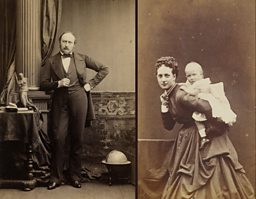
Left image - Prince Albert, Prince Consort (1819-61) | Photograph of Prince Albert, Prince Consort in a full-length portrait | Read more at Royal Collection Trust's website
Right image - Queen Alexandra when Princess of Wales (1844-1925) with her daughter Princess Louise (1867-1931) | An informal photograph of Queen Alexandra (1844-1925) when Princess of Wales, carrying her daughter Princess Louise (1867-1931) on her back | Read more at Royal Collection Trust's website
The carte-de-visite thus gave the royal family a way to communicate directly with the British public.Sophie Gordon
Cartes-de-visite of the queen sold in their tens of thousands, with events such as the death of Prince Albert in December 1861 triggering large sales of portraits.
It was later claimed though that the best-selling photograph of this period was the extremely unusual portrait, from 1867, of the Princess of Wales giving her daughter Princess Louise a piggy-back.
Issued as a carte-de-visite, it was designed to show the public that the young, modern Princess was well and full of life, following an illness and the birth of her child. The carte-de-visite thus gave the royal family a way to communicate directly with the British public.
The Curators
![]()
Hans Holbein and the court of Henry VIII
Curator insights into Holbein's portraits of court life.
![]()
George III's 'Buy British' drive
The family retreat at Buckingham House was filled with works by British artisans and artists.
![]()
Victoria and Albert's watercolours
These albums became precious mementos for Victoria after the untimely death of Albert in 1861.
![]()
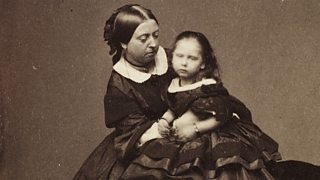
Cartes-de-visite: The royal image
Insights into early royal portrait photographs.
Royal Collection season highlights
![]()
The House of Fun
Welcome to the breathtaking Royal Pavilion in Brighton.
![]()
Victoria's children
One of Queen Victoria's more macabre commissions revealed.
![]()
King of the collectors
An exhibition reunites the treasures amassed by Charles I for the first time in 370 years.
![]()
Art as power tool
How Charles II, the 'Merry Monarch', overruled austerity to project power through art.
![]()
Sacred items
What the Coronation Regalia tell us about the country's history.
![]()
The Padshahnama
This extraordinary work of Mughal painting was acquired by George III.
![]()
Royal armour
An incredible suit of armour created for Henry, Prince of Wales.
![]()
A new light on Leonardo
Andrew Graham-Dixon views drawings by da Vinci that have been lost for centuries.


More from BBC Arts
![]()
Picasso’s ex-factor
Who are the six women who shaped his life and work?
![]()
Quiz: Picasso or pixel?
Can you separate the AI fakes from genuine paintings by Pablo Picasso?
![]()
Frida: Fiery, fierce and passionate
The extraordinary life of Mexican artist Frida Kahlo, in her own words
![]()
Proms 2023: The best bits
From Yuja Wang to Northern Soul, handpicked stand-out moments from this year's Proms