George III's 'Buy British' drive for the royal art collection
22 January 2018
Before George III succumbed permanently to the mental illness that had been a feature of his life, he and Queen Charlotte filled the family retreat at Buckingham House with works by British artisans and artists. Curator Sally Goodsir picks some highlights from the Royal Collection.
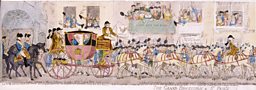
George III was the first Hanoverian monarch to be born and educated in England and to speak English as his first language. After his marriage, to Charlotte of Mecklenburg-Strelitz, the new king and queen consciously chose to patronise British artists and craftsmen, alongside championing British exploration, botany, science, architects and other arts. Many examples of their patronage survive in the Royal Collection today, including porcelain, furniture and clocks.
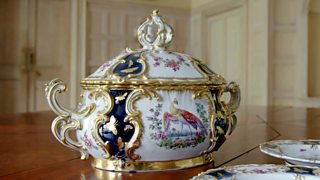
Queen Charlotte in particular supported the Worcester and Wedgwood porcelain factories, and her appreciation for the creamy colours of early Wedgwood led the factory to rename the type Queen's ware.
George and Charlotte would have fifteen children, the largest number of royal children born to any British monarch, and the king must have valued his purchase in 1761 of Buckingham House - the future Buckingham Palace. The new palace was furnished with the work of the leading English cabinetmakers of their day, including William Vile, who created a bookcase for the queen's bedroom, and John Bradburn, who made furniture for the royal children.
Clips: George III and Charlotte
![]()
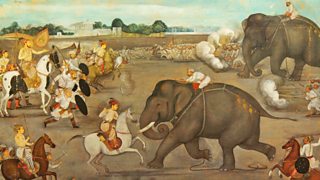
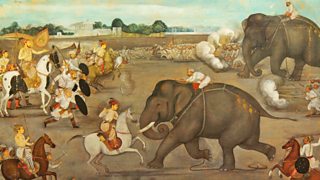
The Padshahnama
This extraordinary work of Mughal painting was acquired by George III.
![]()
The King's mug
A selection of porcelain including the king's very own mug.
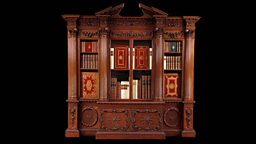
Bookcase, 1762-67, by William Vile (c. 1700–67), carved mahogany | Royal Collection Trust / © Her Majesty Queen Elizabeth II 2018 | Vile's bill:- ‘a very handsome Mohogany Bookcase... the whole very handsomely Carv’d... £107 4s’ - Read more at Royal Collection Trust's website
A complicated door lock by William Walls of Birmingham included two small pistols which would fire on an unfortunate intruder
The longevity of George III's reign, which spanned the Industrial Revolution, meant that new technologies were incorporated into their collecting. A complicated door lock by William Walls of Birmingham included two small pistols which would fire on an unfortunate intruder, although it is not known whether any were ever installed.
Advances in the production of metals by Matthew Boulton, also in Birmingham, introduced British-made ormolu, a rich gilt-bronze, into the Royal Collection in the form of an ornate candle and perfume vase.
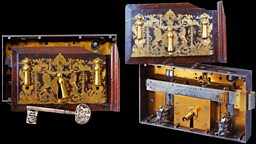
Door lock 1761, by William Walls (active 1761) | Royal Collection Trust / © Her Majesty Queen Elizabeth II 2018 | ‘honest inadvertent people might suffer by it, who not being always recollected, might forget the danger, tho’ apprized of it and suffer for their want of memory’, The Gentleman's Magazine, 1765 - Read more at Royal Collection Trust's website
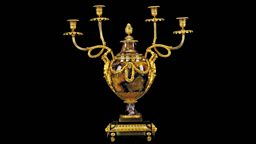
Candle and perfume vase, 1770-71, by Matthew Boulton (1728-1809) | Royal Collection Trust / © Her Majesty Queen Elizabeth II 2018 | Manufactured from Boulton’s ‘or moulu’ - rich gilt bronze of distinctive coppery colour - and from Derbyshire fluorspar (blue john), the luxuriously coloured crystalline stone which Boulton made his speciality - Read more at Royal Collection Trust's website
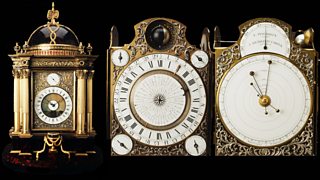
The king was particularly interested in horology and acquired several clocks which are masterpieces of their type. A table clock by Eardley Norton, originally installed in 1765 in the centre of his library at Buckingham Palace, uses its four dials to show the time, the date, the positions of the planets and the phases of the moon.
The Eardley Norton clock was installed under the supervision of the king's clockmaker Christopher Pinchbeck, who three years later created his own version of a four-sided astronomical clock, apparently with input from the king and the architect William Chambers.
Sally Goodsir is Assistant Curator of Decorative Arts at Royal Collection Trust.
Related Links
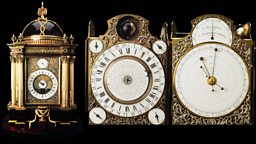
Astronomical clock, 1768, by Christopher Pinchbeck II (1710-83), tortoiseshell, oak, gilt bronze, silver, brass, steel and enamel | Royal Collection Trust / © Her Majesty Queen Elizabeth II 2018 | 'In George III’s time the clock was kept in the Passage Room, which probably lay at the centre of his apartment at Buckingham House' - Read more at Royal Collection Trust's website
The Curators
![]()
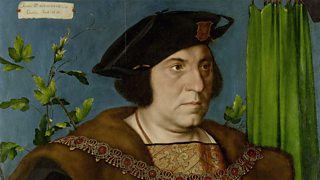
Hans Holbein and the court of Henry VIII
Curator insights into Holbein's portraits of court life.
![]()
George III's 'Buy British' drive
The family retreat at Buckingham House was filled with works by British artisans and artists.
![]()
Victoria and Albert's watercolours
These albums became precious mementos for Victoria after the untimely death of Albert in 1861.
![]()
Cartes-de-visite: The royal image
Insights into early royal portrait photographs.
Royal Collection season highlights
![]()
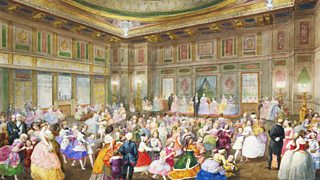
The House of Fun
Welcome to the breathtaking Royal Pavilion in Brighton.
![]()
Victoria's children
One of Queen Victoria's more macabre commissions revealed.
![]()
King of the collectors
An exhibition reunites the treasures amassed by Charles I for the first time in 370 years.
![]()
Art as power tool
How Charles II, the 'Merry Monarch', overruled austerity to project power through art.
![]()
Sacred items
What the Coronation Regalia tell us about the country's history.
![]()
The Padshahnama
This extraordinary work of Mughal painting was acquired by George III.
![]()
Royal armour
An incredible suit of armour created for Henry, Prince of Wales.
![]()
A new light on Leonardo
Andrew Graham-Dixon views drawings by da Vinci that have been lost for centuries.


More from BBC Arts
![]()
Picasso’s ex-factor
Who are the six women who shaped his life and work?
![]()
Quiz: Picasso or pixel?
Can you separate the AI fakes from genuine paintings by Pablo Picasso?
![]()
Frida: Fiery, fierce and passionate
The extraordinary life of Mexican artist Frida Kahlo, in her own words
![]()
Proms 2023: The best bits
From Yuja Wang to Northern Soul, handpicked stand-out moments from this year's Proms