

Wednesday 24 Sep 2014
Programme Information
Network TV BBC Week 32: Wednesday 11 August 2010
BBC ONE Wednesday 11 August 2010
www.bbc.co.uk/bbcone
Matt Allwright sends a British family undercover to a four-star, all-inclusive hotel in Tunisia to find out if bad reports from some tourists are really true, as BBC One's consumer series continues. The Secret Tourists are less than impressed with the poor standard of their room and the general cleanliness of the hotel. The family is also concerned with the health and safety of the pool area and the discovery that five out of seven smoke detectors they see are out of order.
The series' environmental health expert, Dr Lisa Ackerley, joins the family at the hotel to collect some samples for testing. Testing the bedside table for microbes, Dr Lisa finds it dirtier than the toilet, the testing machine showing the highest reading she has ever seen. She also reports that the fire safety measures are unacceptable and could lead to serious potential dangers, even death, in the event of a fire.
Reporter Carole Machin meets a British tourist whose six-year-old son drowned at a hotel swimming pool abroad. Following a report that estimates there are nearly 650 swimming pool accidents a day in the European Union, Carol travels to Lanzarote to look into hotel pool safety over there. During the course of the investigation, The Secret Tourist finds evidence of widespread safety breaches including the fact that half of the swimming pools in the survey do not have lifeguards, 70 per cent of the hotels visited lack adequate buoyancy aids and half the hotels checked out have broken tiles and sharp edges surrounding the pool.
Matt reveals more tricks and cons that tourists can be exposed to while on holiday and this week shows how unsuspecting tourists can be scammed in taxis that charge more or rig meters for scenic detours. The Secret Tourist also recreates a hire company con, revealing how some hirers claim their mopeds, boats and pedalos have been damaged and threaten to keep tourists' passports until they give them compensation.
The Secret Tourist team researches the holidays from hell, so viewers don't have to.
KA
BBC TWO Wednesday 11 August 2010
www.bbc.co.uk/bbctwo
Reporter Lucy Ash travels to Chechnya to investigate the practice of bride stealing. Young women are being kidnapped from the street and, within days, married to men they may never have met. Although officially disapproved of, this centuries-old tradition is flourishing.
From the moment a young woman is snatched, to her wedding one week later, Lucy follows the twists and turns as two families struggle to negotiate a compromise.
Lucy is also with the mullah whose job it is to arbitrate between the two families and prevent the incident spilling into bloodshed. After a week of tense negotiations she finally attends the colourful wedding celebrations where it seems there are as many guns as guests.
All this is played out in a country still recovering from its brutal war with Russia where political disappearances and murders are commonplace.
Chechnya’s President, Ramzan Kadyrov, is an ally of Moscow and governs the Republic with a firm hand. In an interview he explains he is promoting his own particular Chechen interpretation of Islam. Lucy then joins a state-sponsored patrol on the streets of Grozny – its job is to persuade women to wear headscarves and dress appropriately. Lucy also meets human rights campaigners to learn how dangerous it can be to oppose the authorities.
Lucy also visits the new Islamic Medical Centre where thousands of troubled and disturbed women have been sent for treatment, many the victims of bride stealing. There, Lucy witnesses a harrowing exorcism performed on a woman in an effort to cure her unhappy marriage.
What emerges is a picture of a country and its people struggling to balance the often contradictory forces of Russian law, Islamic Sharia law and ancient Chechen tradition.
Six weeks later, Lucy makes a further trip, this time to Kazakhstan, to meet up again with the newlyweds to find out how they are adapting to married life and how the bride is getting on with a husband she barely knew on her wedding day.
FS
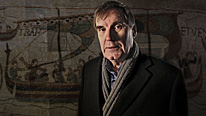
Professor Robert Bartlett continues his journey tracing the extraordinary expansion and unchecked ambition of the Normans. Drawing on Anglo-Saxon chronicles, medieval manuscripts and some of the most powerful examples of Norman architecture, he reveals how their impact is still felt in our culture and politics to this day.
Bartlett explores the impact of the Norman Conquest of Britain and Ireland in this second episode. He shows how William the Conqueror savagely cut down any opposition and built scores of castles and cathedrals to intimidate and control. He imposed a new aristocracy and commissioned the Domesday Book, the greatest survey of England that had ever been attempted. This gave him an efficient instrument of control and a useful means of raising revenue.
England adapted to her new masters. Intermarriage between the Normans and the English was common, giving rise to a transformation of the language and culture of the land. Bartlett argues that the political and cultural landscapes of Scotland, Wales and Ireland were also forged by the Normans. In Scotland, the Normans were invited in, while they faced opposition in Wales and never managed to take the whole country. In Ireland, Bartlett shows how the Normans created a division between the English and the Irish that still exists to this day, laying the blueprint for colonialism in the modern world.
The Normans is part of a season of Norman programmes on the BBC, including Domesday, Dan Snow's Norman Walks, Treasures Of The Anglo-Saxons and The Making Of King Arthur.
Working in partnership with more than 20 heritage and history organisations, BBC Learning's Hands On History offers a range of events and activities as part of the Norman Season, including Norman walks. See bbc.co.uk/history for details.
CD3
BBC FOUR Wednesday 11 August 2010
www.bbc.co.uk/bbcfour
The Great Outdoors Ep 3/3

There's fury on the footpaths this week as the walking club splits in two, as BBC Four's comedy following the hikes, heartaches, friendships and rivalries of a misfit rambling club, written by Andy Riley and Kevin Cecil, concludes.
Bob's life is collapsing on all fronts: redundancy looms, and Christine is ready to revolt and replace him as walk leader. Even his best friend Tom is slipping away from him, drawn irresistibly toward the hi-tech-fibre-clad charms of Christine. When Bob and Christine realise they can't share the same path any more, Tom must choose between them. Bob finally snaps under the strain and goes missing, and they've all got to work together to find him.
Meanwhile, Sophie confronts Joe about his ruinous overspending, Tom hopes to discover Roman treasure with his metal detector "just like that bloke on the news who was on the sick", and teenage Hazel's big secret is out. She's been spotted rambling with her Dad's club by her cooler mates, when she said she was doing work experience at a major fashion house. How will she face her friends now? And will she finally kiss Victor?
Christine's past is revealed; there's a fight with a giant ice cream; Tom steals a bike – in its third episode, the adventure in sensible footwear reaches its thrilling climax.
Bob is played by Mark Heap, Christine by Ruth Jones, Tom by Steve Edge, Sophie by Katherine Parkinson, Joe by Steve Wight, Hazel by Gwyneth Keyworth and Victor by Joe Tracini. The Great Outdoors is written by Kevin Cecil and Andy Riley.
The Great Outdoors is simulcast on the BBC HD channel – the BBC's High Definition channel, available through Freesat 108, Freeview 50, Sky 143 and Virgin 108.
KS3
CBBC Wednesday 11 August 2010
www.bbc.co.uk/cbbc
Richard Hammond concocts another set of scientific experiments from his secret laboratory, using chemical reactions and carbon emissions as his theme for this week's edition of the scientific game show.
In the mini science test Nanny Returns, the Red Team boys face the Random Radicals in this Egyptian-themed game. The teams have to use various solutions and light sources to reveal the hidden code inscribed in invisible ink on some scrolls. The team which finds the correct code first can then unlock the golden Cleopatra Ninja Nan trapped inside a glass case.
At Richard's top-secret testing centre, a Secret Agent Drag Race sees the unusual combination of a helicopter, Aston Martin and a Segway compete against each other over a quarter-of-a-mile course. The studio audience then has to work out which vehicle released the least carbon dioxide per second.
VT
Programme information
Network TV
Network TV – Days
Key

- New

- Live event/outside broadcast

- Interactive programme
- High Definition programme
BBC iD
BBC iDBBC navigation
BBC links

BBC © 2014The BBC is not responsible for the content of external sites. Read more.
This page is best viewed in an up-to-date web browser with style sheets (CSS) enabled. While you will be able to view the content of this page in your current browser, you will not be able to get the full visual experience. Please consider upgrading your browser software or enabling style sheets (CSS) if you are able to do so.
