

Thursday 27 Nov 2014
Programme Information
Network TV BBC Week 32: Unplaced
BBC TWO Unplaced
www.bbc.co.uk/bbctwo
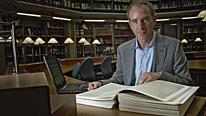
Medieval historian Dr Stephen Baxter uncovers the dramas and mysteries that surround England's earliest surviving public record, in this special programme on the Domesday Book.
Domesday is the first great national survey of England, a record of who owned every piece of land and property in the kingdom. Historians have never been able to agree exactly why it was commissioned by William the Conqueror in 1085. Most think that it was used to raise taxes – but Baxter has his own theory.
The making of the Domesday Book was a huge logistical exercise. Commissioners set out across the country to attend intimidating local inquests. These established who owned what, both in 1066, before the Norman Conquest, and in 1086, after 20 years of Norman rule. The results of these inquests were then collected, edited and written up by one scribe. It was given the name Domesday Book by Anglo-Saxons who felt that its authority was as final as the Day of Judgement.
Domesday records the trauma of the Norman Conquest – the greatest social and political upheaval in England's history. It confirmed that land once owned by the English was now legally in the hands of the Normans. This was a revolution in land ownership. Baxter tells the human and political story of this drama of dispossession. He also finds out the true purpose of the Domesday survey. Proving that it couldn't have been used to collect taxes, he argues that the Domesday Book is about something far more important than money – its real purpose was to confer revolutionary new powers on the monarchy in Norman England.
Domesday is part of a season of Norman programmes on the BBC, including Professor Robert Bartlett's three-part series The Normans, Dan Snow's Norman Walks, Treasures Of The Anglo-Saxons and The Making Of King Arthur.
Working in partnership with more than 20 heritage and history organisations, BBC Learning's Hands On History offers a range of events and activities as part of the Norman Season, including Norman walks. See bbc.co.uk/history for details.
CD4
Programme information
Network TV
Network TV – Days
Key

- New

- Live event/outside broadcast

- Interactive programme

- High Definition programme
BBC iD
BBC iDBBC navigation
BBC links

BBC © 2014The BBC is not responsible for the content of external sites. Read more.
This page is best viewed in an up-to-date web browser with style sheets (CSS) enabled. While you will be able to view the content of this page in your current browser, you will not be able to get the full visual experience. Please consider upgrading your browser software or enabling style sheets (CSS) if you are able to do so.
