How India moon lander Vikram make historic lunar south pole landing

India Chandrayaan-3 don become di first space mission to land near di south pole of di Moon.
For inside di lander na di six-wheeled Pragyaan rover, wey go roam di lunar surface to gather images and data, if all plans go well.
Prime Minister Narendra Modi bin announce say “India don dey Moon now”, immediately afta di Vikram lander touch down on di lunar surface.
Sabi for science matter bin believe say craters wey dey permanently in shadow on di dark side of di moon go don hold water.
Dis attempt by India come afta Russia bin launch dia own spacecraft but e crash into di moon.
One of di major goals of di mission na to hunt for water-based ice, wey ogbonge science pipo tok say go support human habitation on di moon for future.
Wit di success of Chandrayaan-3, India go be di only fourth kontri for di world wey go don achieve soft landing for di moon.
Dis success by India dey come just days wey Russia Luna-25 bin crash as e dey try touch down for di same region.



End of Di one wey oda users dey read well well
Di south pole of di moon hold special promise in di search for water ice. Di surface area wey remain in permanent shadow, na wetin ogbonge science pipo tok say possibility dey for water to exist for diz areas.
Di US, di former Soviet Union and China don already achieve a soft landing near di moon equator- but none don lead successful missions to di south pole.
Bifor, attempt by India to land dia Chandrayaan-2 mission near di south pole in 2019 dey unsuccessful- e crash into di lunar surface.
So all eyes don dey on top Chandrayaan-3- wey be di third mission to di little-explored moon. Di spacecraft wey get orbiter, lander and a rover comot for ground on 14 july from di Sriharikota space centre for south india.
Di lander wey dem dey call Vikram afta Indian Space Research Organisation (Isro) founder Vikram Sarabhai – bin carry a 26kg rover dem name Pragyaan for im belle, wey be Sanskrit word meaning wisdom.
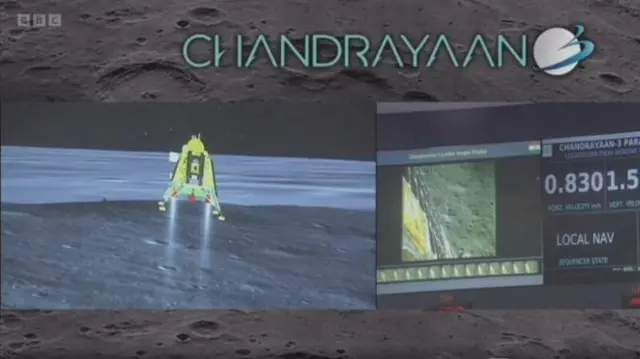
Di lander make successful attempt to touch down at 18:04 time (12:34 GMT) on Wednesday, wey di return start at 17:45 India time from di current height of 25km (15 miles), Isro bin tok.
Ogbonge science pipo say di area wia dem make di touchdown dey full of craters.
As di descent bin start, di landers bin reduce dia speed from 1.68km per second to almost zero by di time e dey reach 800m, Isro's Nilesh M Desai tell ANI news agency.
Di rover wheel get di Isro logo and emblem for body wey go make dem leave imprints on di lunar soil during di Moon walk, one official tell di BBC.
How di moon lander bin prepare
Chandrayaan-3 journey go Moon don generate jollie moment for India, as plenti pray say make di mission success dey pour across di country.
Isro don announce bifor say dem go do live telecast of di landing as dem dey expect millions of pipo, including schoolchildren, make dem tune in.
For Tuesday, Isro chief Sreedhara Panicker Somanath tell di Hindustan Times say dem dey "extremely confident of a successful landing" becos dem don get "back-ups of di back-up plans".
E tok say dem don carefully study di data from di Chandrayaan-2 crash and carry out simulation exercises to fix di glitches.
In di past few days, di Vikram lander camera don dey map di lunar surface while attempting to locate a safe landing spot.
For dia Tuesday update, Isro tok say di mission "dey on schedule, systems dey undergo regular checks and smooth sailing dey continue".
Oga Somanath tok say Chandrayaan-3 go work to build on di success of India earlier Moon missions and help make some "very substantial" scientific discovery.
Chandrayaan-1, di kontri first Moon mission for 2008, discover di presence of water molecules on di parched lunar surface and establish say di Moon get atmosphere during daytime.
Despite failing di soft landing, Chandrayaan-2 no be write-off - di orbiter kontinu to circle di Moon even on Wednesday and go help di Vikram lander send images and data to Earth for analysis.
Di lander and di rover carry five scientific instruments wey help to discover "di physical characteristics of di surface of di Moon, di atmosphere close to di surface and di tectonic activity to study wetin go on below di surface".
Dem carefully select di landing date to coincide wit di start of a lunar day.
A day on di Moon equal 28 days on Earth and dis go mean say dis lander and rover go get 14 days of sunlight to charge dia batteries. Once night come, dem go discharge and stop working.
E no dey clear bifor whether dem go come back to life wen di next lunar day start.
India no be di only kontri wey get eye for di Moon - global interest dey inside am, wit many oda missions wey don plan to go di lunar surface in di near future. And ogbnge science pipo say many tins still dey to understand about di Moon, wey dey often described as a gateway to deep space.
Now wey Chandrayaan-3 don dey successful, ogbonge pipo tok say, e go take us a step closer.