History of Rowing
All of the major ancient civilisations used rowing to advance their cultures, both in war and peace-time. The victors of many a sea battle were those that could out-manoeuvre their opponents on the water. The Athenians frequently won because ancient war ships, such as the Trireme, were used to ram enemy ships at great speed powered by 170 oarsmen. Competitive rowing is one of the oldest and most traditional of sports. Races between oared galleys were held in ancient Egypt and Rome. Although rowing was always popular with fishermen and sailors, it was not until the 1700's that the sport became popular with ordinary citizens, when watermen would race in long barges on the Thames. The Thames is the setting for three of the most celebrated rowing events in the world: Doggett's Coat and Badge Race, the oldest rowing contest in the world, held annually since 1715; the annual boat race between the universities of Oxford and Cambridge; and the Henley Royal Regatta. 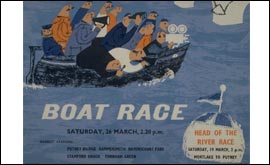 | | The Boat Race by NG Crayford courtesy of the London's Transport Museum |
Competitive rowing became an event at the first modern Olympic Games in Athens, Greece, in 1896. The sport of rowing as we know it today began in 1829 with the first Oxford-Cambridge race and the Henley Royal Regatta which started in 1839. The River & Rowing Museum preserves rowing's significant artefacts, building a library and archive about the activity, which started with the Egyptians and Phoeniecians and continues today with University Blues and Olympians. The Museum is a home for rowing's heritage in the domain of Henley Royal Regatta and the world-famous Leander Club. Interactive displays on the art of rowing and the search for speed will enable visitors to learn more about the sport. Exhibits already include the boat used by Steve Redgrave and Matthew Pinsent who won Britain's only Gold Medals in the Atlanta Olympic Games as well as the world's oldest-known competitive rowing boat. History of Henley
Henley's history is intrinsically linked to the river. Displays and exhibits trace the history of the town's development through the ages, highlighting the influence of the River Thames. In the Middle Ages poor navigation above Henley made the town a centre for transfer of goods between land and water transport. The present stone bridge, depicted in Sibrecht's painting at the museum, replaced the wooden one in 1786. Henley-on-Thames is a small Thames-side town with a world-class reputation. It is known throughout the world that rowing means Henley and that Henley means rowing. Henley hosted the first University Boat Race in 1829, established the Royal Regatta in 1839 and hosted Olympic regattas in 1908 and 1948. Henley is the home of rowing history in Britain, and the Museum is a temporal home which fosters this spirit. Once pivotal to trade between Oxford and London, Henley is now a centre of recreation on the river. The opening of Henley's own branch line on the Great Western Railway in 1857, meant ever-larger crowds came to the regatta for rowing and revelling. Once a market town dependent on river trading and trade, Henley-on-Thames developed a diversity of industries in the course of its history from glass making, brick making, breweries, engineering, more recently motor, financial and software companies. |