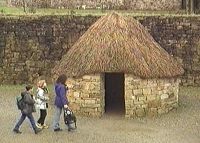
The word monk comes from the Greek word "monachos", which means "alone". It was first used by early Christians to describe men who felt the need to go away by themselves to some lonely place to contemplate God and pray. The first monks, also called hermits, lived in caves or rough shelters. They ate little and went without all the things that ordinary people of the time wanted or needed.
The first monasteries grew up around these hermits because men who also felt the call to a religious life came to find the hermits in their lonely shelters, wanting to learn from them and to copy their way of life. One of the first hermits was a man called Benedict who at first lived in a cave. However, he realised that it might be better to start a community of like-minded men who loved each other like brothers rather than to struggle alone.
Saint Benedict, as he became later, founded the Benedictine religious order. He wrote down the things that he believed every monk should do and these became a blueprint for the many different orders that were to follow him.
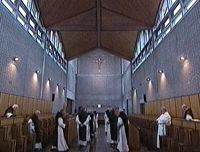
It has never been easy to become a monk. A man wishing to enter an abbey must give away all that he owns and from the moment the door shuts behind him he must share everything with the community. A monk's life has always been hard and not everyone is suited to it.
He must first become a "novice" or beginner, under the tutelage of a senior monk. After two years, during which the novice is free to leave the order at any time, the other monks in the community vote on whether he will be allowed to take his vows, or promises to God, and become a monk.
Monastic life today has changed little from its earliest beginnings. Monks still live in sparse cells and devote their lives to the service of God. Printing and literature still play a large role in their lives. Early monks used to copy and decorate beautiful religious books by hand. Today they use a printing press or computerised desktop publishing.




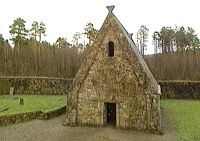 Mahee Island is the largest island in Strangford Lough and lies close to its western shore. The monastic site of Nendrum was founded by Mochaoi after whom Mahee Island was named. Mochaoi was said to have been converted by Patrick himself and died at the end of the 5th century. From the 7th century to the 9th century, the Annals of Ulster record a succession of bishops and abbots.
 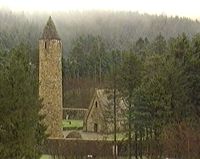 They consisted of tiny huts made of either stone or wood and wattle. The most important building was the small church which was built at the centre. This was because the worship of God was central to people’s lives. In other huts were the kitchen, a dining room called the refectory and sometimes a library. The monks lived in individual cells usually called bee-hives because of their shape.