 | The programmes all feature specific locations in Northern Ireland and they also provide scope for work on a variety of themes e.g. the environment, where people live, what people do. The aim is to provide material which is relevant to pupils' experiences and which is illustrative of life in Northern Ireland. | |
|  | Programme 4 - Textile Industry
Monday, 2 November 1999
ARCHIVE - SELB programme code :TK 1161 This episode is now part of our archive. This programme is still available to schools to borrow or purchase from the Audio Visual Recording service at the SELB. Please quote the SELB programme code in your correspondence. See our ordering page for more information.
| This programme compares the manufacture of two very different fibres, linen and lycra. One is a natural fibre and the other synthetic or man-made. Northern Ireland has been associated with the textile industry for many years. The North-West in particular has strong links through its supply of materials and fabrics to multi-national clothing companies. This area also plays host to the manufacture of both natural and man-made fabrics through Herdmans Mill in Sion Mills and Dupont at Maydown.
In the programme two children are guided through the different processes used in the manufacture of these two fabrics and the histories of the two fabrics are compared.
Natural Fibre - Linen Linen has been used as a fabric for over ten thousand years. From the time of the early lake dwellers in Europe through the age of the Pharaohs to modern times, linen has played an important role. It has both made history and preserved it. It is not surprising to learn that linen comes from the flax plant, "linum usitatissimum" or "most useful linen". It is unlikely that any other fibre has given us such a varied vocabulary. We still speak of a "flaxen-haired" girl for someone with blond hair; an unmarried woman was called a spinster because traditionally only unmarried women were allowed to spin flax; and lingerie got its name because at one time underwear was made only from linen. 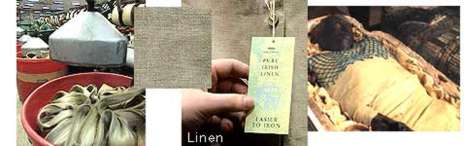 Although the bible makes reference to linen, historically it is the link with ancient Egypt that most people are aware of. Mummies were wrapped in shrouds of fine linen and over forty different designs of loin cloths have been discovered. With a material of such versatility it is not surprising to realise that the spread of the printed word owes much to the existence of linen, both for making paper and for the linseed oil that was used in the making of printing ink. While linen has a glorious past, it is the future upon which the linen industry needs to concentrate. There can be no doubt that linen plays an important role in the world of clothing and household textiles. Despite the advances in technology the basic process of manufacturing linen has remained the same. The need to compete with younger, newer fabrics in a world-wide market is a constant challenge and one to which traditional manufacturers must rise in order to survive. The Natural Process - from Flax to Linen... - Flax is no longer grown commercially in Ireland. It is now grown in Belgium or Northern France, where the climate is more suitable, and is then imported. It is a three month crop, sown in the spring and harvested in summer. When it was grown in Ireland St Patrick's Day marked the start of the process and the 12th of July the end.
- After harvesting, the flax goes through a process called scutching which extracts the valuable flax fibres. They are then graded for quality and then baled.
- The scutched flax is delivered to the spinning mill where it is hackled (or combed) and then spun into yarn.
- This yarn is woven on looms into linen.
- The linen is exported all over the world.
Synthetic Fibre - Lycra Lycra is a man-made fibre developed and produced by Dupont. Unlike linen, lycra has been around for only thirty years. It grew out of Dupont's continuing research into man-made fibres. Dr W. Carothers, the inventor of Nylon and Neoprene, had worked in their experimental research centre. 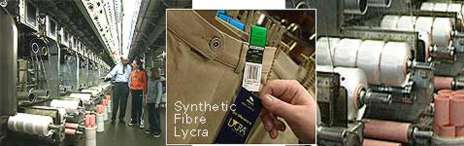 Lycra is stronger and more durable than elastic fibres. It can be stretched four to seven times its original length yet when released it will instantly recover its original length. Unlike most fibres it is resistant to degradation by sunlight, sea water, chlorine and many other common oxidants. Lycra was first produced at Maydown in 1969 and has become one of the most important fabrics in use today, particularly in the fashion industry. The Man-Made Process - from Chemical to Lycra - The raw chemical materials are imported and stored in large tanks.
- The chemicals are mixed together in vats.
- This substance goes through a process called polymerisation where it becomes like sticky treacle.
- This treacly substance is forced at very high temperatures through spinnerets which contain very small holes rather like shower heads. It emerges into spinning cells as fine streams.
- The streams are dried and the moisture evaporated.
- The streams are wound onto "cakes" of Lycra.
- The Lycra is exported all over the world.
|  | - Discuss the meaning of the following keywords:
TEXTILE, FABRIC, FIBRE, SEW, HARVEST, NATURAL, FLAX, MILL, SPINNING, EVAPORATE, SCUTCHING, YARN, LOOM, ECONOMY, LINEN, IMPORT, EXPORT.
|  | - Take an item of clothing made from lycra and stretch it. Do the same with linen. Compare the effects of this stretching on the two materials.
- Experiment with the effect of water on linen and lycra - what happens to the materials when they are wet and what is the difference between them when they dry?
- Visit the Ulster Museum and explore the Egyptology Department and the Local History Department.
- The class could do a project on factories in their area. They could visit them and find out what exactly they produce, how it is made and what happens to it when it leaves the factory.
- Explore the differences between import and export.
Group Work:- Explore the differences between man-made and natural e.g. food, clothing
- What other natural and man-made substances occur in everyday life.
Individual Work:- The children could go through their clothes at home and make a list of what they think is man-made and what they think is natural.
|  | |
|
|  |
| |  | Programme 1: Canals: |  |  | Programme 2: Quarries | | | Programme 3: Strangford Lough | | | Programme 4: Textile Industry | | | Programme 5: Traffic Survey | |
| | |  | Can't find your subject? Visit our archive section where you can find programmes supporting other curricular subjects, including: Geography, History, Citizenship and English. Visit the archive. |
| |
| |


