 |  | Programme - 3 Strangford Lough
Monday, 26 October 1999
ARCHIVE - SELB programme code :TI 1518 This episode is now part of our archive. This programme is still available to schools to borrow or purchase from the Audio Visual Recording service at the SELB. Please quote the SELB programme code in your correspondence. See our ordering page for more information.
| The programme examines Strangford Lough as a protected environment showing the exceptional variety and abundance of wildlife below the waves and on its shores, including the large numbers of birds that migrate to it from other parts of the world every year. The marine life of the lough is illustrated by underwater photography and is contrasted with the man-made environment at Exploris, the aquarium at Portaferry. The programme also explores issues arising from human use of the lough and its resources for both commercial reasons and leisure pursuits. 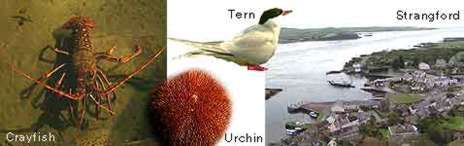 The programme is presented by Donna Traynor. Donna is accompanied on her journey round the lough by two pupils from schools in Downpatrick. These Primary 7 pupils have been studying the lough and its wildlife as part of their classwork. With their help Donna introduces the programme's three main areas of study. These are: - the diversity of wildlife in and around the lough.
- how Exploris shows the richness of marine life in the lough.
- the delicate balance between human use of the lough's resources and the needs of the huge variety of species that live there.
Strangford Lough
The programme Strangford Lough is the largest sea lough in the British Isles and one of the most important marine sites in Europe. It covers 150 square kilometres from Angus Rock at its mouth to the vast sandflats at its northern end, 30 kilometres away. It has about 240 kilometres of twisting coastline and has 120 islands and countless tidal rocky outcrops or pladdies. It is almost totally landlocked apart from its connection to the Irish Sea through the Strangford Narrows, a fast-running tidal channel 8 kilometres long which closes to a width of just 500 metres. The strong currents that flow here reach a speed of 8 knots or 18 kilometres making them some of the fastest sea currents in north-west Europe. This possibly inspired the Viking invaders to name the Lough the Strangfjorthr, meaning the strong fjord.
Marine Life
A huge amount of water, 350 million cubic metres, flows in and out of the lough twice a day with the tides. The turbulence of the currents rushing through the Narrows mixes up the different layers of water, churning it like a gigantic washing machine. This mixes the nutrients on which microscopic plants and animals called plankton thrive and which in turn are consumed by most of the animals and plants in the lough. It also creates even temperatures throughout the lough, which helps the food-chain thrive.
The lough offers an astonishing variety of species. Over 2000 marine animals and plants have been found including 72% of all the species recorded from around the Northern Ireland coast. Of these 28 are found only in the lough.
The main reason why the lough can support such exceptionally dense populations of marine species is the enormous quantity of plankton under the waves. Billions of tiny plants and animals (phytoplankton and zooplankton) are swept into and out of the Narrows on every tide. They have practically no independent means of movement or propulsion and are carried into the Irish Sea from the North Atlantic and then into the lough. Most of the zooplankton are tiny but some, such as the jellyfish, are enormous with a number of species growing to well over two feet in diameter.
The waters of the lough, particularly in summer, are like a soup containing the larvae of shrimps, crabs, worms, starfish and molluscs. These larvae support exceptionally dense populations of bottom-dwelling animals including flatfish, herring fry and sand eels which are eaten by mackerel and cod.
The varying strength of the current in different parts of the lough helps create different habitats in which many kinds of animals thrive. Under the waves in the Narrows grow filter feeding animals such as sea-anemones, sea-squirts and soft corals, as well as dense forests of kelp seaweed.
Further north in the lough the waters slow and coarse submarine sand dunes are inhabited by a type of sea-cucumber and dog cockles. Predators such as the curled octopus and sunstars are also numerous.
The richest seabed community in the lough is based on the horse mussel. It lives in the mid-lough water troughs which can be up to 60 metres deep. These are the largest species of mussel in the British Isles. Unfortunately they are inedible. These horse mussels grow on shells buried in fine mud providing a bed for up to 100 different organisms. In the mud between the mussels, worms, sea-cucumbers and the highly sought after queen scallops are found. In the early 90s overfishing by boats from outside the lough damaged the mussel beds. Trawling is now limited to certain areas and is strictly monitored.
The lough once supported a large herring industry with over 300 boats but nowadays only a few boats fish occasionally for marine life such as crab, lobster and shellfish. Commercial fin fishing has almost disappeared. The only major commercial fishery operating on the lough is Cuan Fisheries off Sketrick Island. It sells three and a half million oysters a year largely to European and Far Eastern markets. There are plans to reintroduce the native Comber White Oyster to the lough.
The flow of the tides in and out of the lough creates a rich environment for animals of all kinds on the shores. Winkles, cockles, shellfish, worms and sponges thrive. Soft mud and muddy sands form vast areas in the northern end of the lough where many species grow including shrimp, shellfish and millions of lugworms.
Beneath the lough's surface a foreign, fast-growing seaweed called japweed or sargassum is thriving and invading native habitats. It could potentially pose problems for both mariculture and boating. However, while it can obstruct boats, it can also provide a rich habitat for a range of species from sea-anemones to small fish.
Birds Eel-grass or zostera grows on the inter-tidal shore and is the staple diet for many birds. It is this rich food source, along with a wide variety of fin fish including coley, butterfish, sea trout, angler-fish and enormous numbers of eels, which attracts vast numbers of wildfowl including waders, gulls and auks. For many birds the lough is a kind of motorway café as they stop to feed and rest en route from Canada, Iceland or Russia to more temperate zones. Around 70,000 birds are present each winter around the lough. 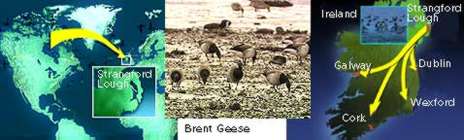 Undoubtedly the star attraction on the lough is the brent-goose. Up to 15,000 pale-bellied brent-geese make the 3,000 kilometre journey from Polar Bear Pass in north-east Canada each autumn to feed on the succulent eel-grass. Some stay on the lough while others move to feeding grounds in Dublin, Wexford, Cork and the west of Ireland. Thousands of knot, dunlin, curlew, redshank and oystercatcher also arrive during the winter and feed between the tides. Plover, godwits and knots perform spectacular aerobatics with thousands of birds forming twisting, swirling "clouds" when they are in flight. Herbivorous wildfowl such as ducks from Eastern Europe also winter on the lough. There has been a dramatic decline in the numbers of wigeon from a peak of about 25,000 in the early 1970s to just over 1000 today. The reason for their diminishing numbers is not clear although the drop is at least partly due to competition with other birds for eel-grass which is not as plentiful as it once was. Teal still visit as do about 100 whooper swans from Iceland. Breeding Birds
Each spring upwards of 4000 terns, a third of Ireland's total, arrive from Africa en route from the Antarctic to breed on the lough's islands. They share the lough's nesting places with black-headed gulls and a small number of breeding wildfowl and waders including eider, mallard, merganser, Canada geese, oystercatcher and ringed plover. A population of 200 pairs of cormorants also breed on the lough.
Common and Grey Seals Strangford Lough is one of the most important breeding sites in Ireland for the common seal. In recent years however there has been a decline in common seal numbers. Before 1988 the population could be as high as 800 but it has now dropped to under 300. The exact reasons are unclear but it is believed that human disturbance and insufficient food are mostly to blame. A small number of grey seals are also present. They are best viewed on rocky haul-outs particularly at Cloghy Rocks or Granard Bay in the Narrows. 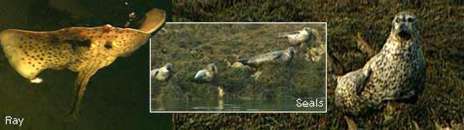 Seals are powerful swimmers and good fish catchers. They normally dive for five to ten minutes but they are capable of staying down for up to half an hour and can reach depths of 50 metres. Although fishermen can resent their consumption of salmon, sea trout and other commercial species, they also eat bottom-dwelling fish, crabs, shellfish, eels and octopus. It is thought that they hunt following vibrations caused by fish movement in the water and using their long whiskers as antennae! Porpoises are regularly seen in the lough and occasionally whales and basking sharks. There are also large numbers of foxes, badgers, otters and other animals around the lough shores, particularly in areas of low human population, and a wide variety of wild flowers and plants. Exploris Aquarium
Hundreds of different marine animals taken from the lough can be seen at Exploris, Northern Ireland's largest public aquarium which was opened in 1994. It is an Ards Borough Council facility and was established with funding from the European Regional Development Fund with assistance from the Northern Ireland Tourist Board.
Seawater is pumped constantly from the lough into its many tanks to keep all of the marine specimens healthy. In the touch tank rays will allow visitors to pet them - even though they are members of the feared shark family! Nobody knows for sure why they appear to be so friendly and allow contact. They have many sensory organs and may be checking out what is happening at the water's surface.
Every year more than 120,000 visitors come to see what Exploris has to offer. In the summer of 1999 a new seal sanctuary opened where young or abandoned seals are to be cared for.
A Delicate Balance: Human Involvement with the Lough The lough is internationally recognised for its wildlife. No comparable area of Europe has such a range of habitats supporting such an array of wildlife. It has a number of important designations, most significantly as a Marine Nature Reserve, an Area of Outstanding Natural Beauty (AONB), an Area of Special Scientific Interest (ASSI), and a Special Area of Conservation (SAC), The lough contains several Nature Reserves and National Nature Reserves. 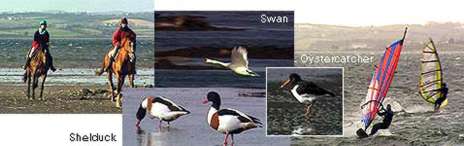 Despite these many designations conservationists are concerned that existing legislation is inadequate to deal with unregulated exploitation of shellfish, such as cockles and winkles, on the lough shore. Some commercial operations have already harmed mussel communities and zoning has been brought in to protect the lough floor. Farming is also having its own effect on the lough. Silage effluent and the use of fertiliser for crops can damage water quality and affect the nutrient balance of the lough. Around 60,000 people live close to the lough shores and over one million live less than an hour's drive away. The increasing demand for water-based recreation like power-boating, jet-skiing and windsurfing could lead to high levels of disturbance for bird and marine life, to the damaging of some vulnerable habitats and to pollution of the waters. More people are using the shore for walking, horse-riding, bird-watching and food collection and other activities such as micro-lighting are also on the increase. The area immediately surrounding the lough is also becoming more popular as a place to live because of its short commuting distance from Belfast. This will put increasing pressure on sewage facilities in particular. Treated sewage can affect the vital eel-grass on which the brent-geese depend and in some parts relatively untreated sewage enters the waters. We do not yet know in any great detail what effect these developments are having on the lough as a whole. The lough's beauty, accessibility and wildlife are big attractions. The balance between human use and environmental risk is a delicate one. If we want future generations to enjoy the same excitement and pleasure we derive from Strangford Lough then we need to carefully manage this beautiful natural resource. |  | - Discuss the meaning of the following keywords:
CONSERVATION, MIGRATE, RESOURCES, PROTECTED ENVIRONMENT, PLANKTON, FOOD CHAIN, OVERFISHING, INTERTIDAL, COMMERCE, LEISURE, POLLUTION.
|  | - Find Polar Bear Pass on a map of Canada and on a map of Northern Ireland locate Strangford Lough. From a world map calculate the distance between the two locations.
- Why do pale-bellied brent-geese make their way to Ireland each year?
- What special food do the geese find at Strangford Lough?
- Common seal numbers have declined in the lough in recent years. What are believed to be the two main causes of this decline?
Group Work:- Find out from your school or local library as much as you can about the breeding cycle of the pale-bellied brent-goose. Build up a group fact file on the brent-goose.
- Find out from your school or local library as much as you can about the breeding cycle of the common seal. Build up a group fact file on the common seal.
- From the information given in the programme complete the following table:
Question | Answer | What hobbies do people engage in around and on Strangford Lough? | | Place these hobbies in order from the one that you believe could cause most disturbance to wildlife to the one that you believe would cause least disturbance. | | If there was one hobby which you could ban from Strangford Lough what would it be and why would you ban it? | | What do you think would be the positive effects of limiting the fishing areas within the Lough? | | What do you think would be the negative effects of limiting the fishing areas within the Lough? | | How do we humans benefit the wildlife that lives in and around Strangford Lough? | |
|  | Exploris Aquarium: Tel: 028 4272 8062 Wildfowl & Wetlands Trust, Castle Espie: Tel: 028 9187 4146. Email: castleespie@wwt.org.ukNational Trust, Strangford Lough Wildfowl Centre: Tel: 028 4488 1411. |
|
|  |
| |  | Programme 1: Canals: |  |  | Programme 2: Quarries | | | Programme 3: Strangford Lough | | | Programme 4: Textile Industry | | | Programme 5: Traffic Survey | |
| | |  | Can't find your subject? Visit our archive section where you can find programmes supporting other curricular subjects, including: Geography, History, Citizenship and English. Visit the archive. |
| |
| |


