GO NUTS FOR THE NATIVE NUTKIN - RED SQUIRREL WEEK
Go to Red Squirrel facts >>>
Report your sightings here cedar.info@magni.org.uk
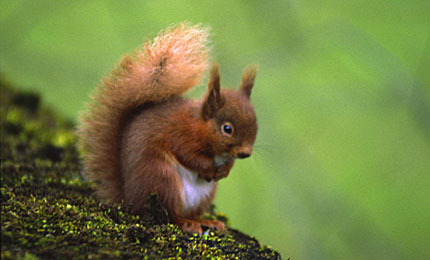
They’re agile, cute and furry, and we’re nuts about them! With their distinctive russet fur, tufted ears and twitching tail, a red squirrel is always a captivating sight. Yet these flashes of red are becoming more infrequent.
That’s why the Ulster Wildlife Trust is encouraging everyone to help protect them - by getting out and about, and reporting sightings during Red Squirrel Week (4 - 12 October 2008). A series of family events and activities are being held across the province to promote awareness of this much-loved native species and to encourage everyone to look for signs or sights in woodlands, along roadsides and in gardens too.
The Ulster Wildlife Trust hopes the events to celebrate Red Squirrel Week will help people understand more about the red’s habitat and behaviour, why they’re in danger from factors such as competition from greys, disease, and loss of woodland, and get involved in efforts to protect them.
Maeve Rafferty, Biodiversity Manager with the Ulster Wildlife Trust said: “During Red Squirrel Week, we want people to get out there, have some fun and get acquainted with one of our best loved mammals. These are challenging times for our native squirrel and conservation efforts will rely on public support, co-operation between landowners and volunteer time.
“One of the simplest ways to help our native nutkin is to report your sightings of both red and grey squirrels to the Centre for Environmental Data and Recording by visiting www.habitas.org.uk/cedar and you can find out how and what to look out for, or get along to one of our red squirrel events.”
For further information, contact the Ulster Wildlife Trust on tel: 028 4483 0282,
email: events@ulsterwildlifetrust.org or
visit www.ulsterwildlifetrust.org.
RED SQUIRREL FACTS
The plight of the Red Squirrel is now recognised in local, regional, national and international conservation policies – it is featured in the Bern Convention, it is a priority species in the UK and NI Biodiversity Action Plan (BAP) and the Red Squirrel is afforded the highest level of protection under UK law, the Wildlife and Countryside Act.
Red squirrels are not always red. They can be brown, almost black, or even quite grey, and can become blonde due to bleaching by the summer sunlight. In winter, they have noticeable ear tufts.
Red squirrels are able to live in any type of woodland but in the UK they are now mostly confined to conifer forests where they have a competitive advantage over the larger greys.
They do not hibernate. They bury nuts to help provide food in the winter to supplement the year round supply of conifer seeds in mixed broadleaf and coniferous woodland.
Red squirrels build nests, called dreys, from sticks and moss placed high in the branches, where they produce two litters of three to four kittens a year. The drey is often the first evidence of the presence of red squirrels in a wood.
Red squirrels can live for up to six years.
What's On in Northern Ireland...»
|