|  |  |  |  |  |
 |  |  |  |
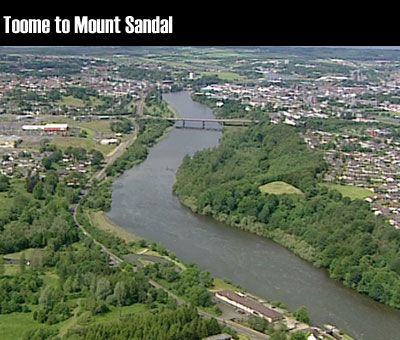  | 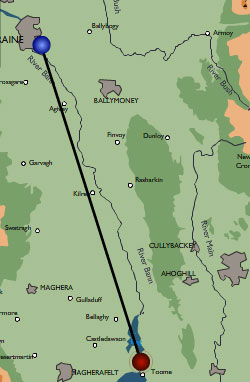 |
Fasten your seatbelt for a trip along Northern Ireland's longest river. The River Bann rises in the Mourne Mountains and reaches the Atlantic Ocean on the north coast 80 miles, or 129 kilometres, later. The lower part of the river, after it leaves Lough Neagh, has five locks to allow boats to navigate its 38-mile course. Nowadays, the vessels are mostly leisure craft. The Bann is rich in both underwater life and history. Every fisherman knows about its salmon stocks, and there are also the famous eel fisheries at Toome. Excavations along the river have found evidence of civilisations dating back to the Mesolithic and Neolithic eras. A discovery at Toome in 2003 provided one of the earliest pieces of evidence of human settlement in Ireland, going back 9,000 years. Ironically, it was uncovered during an effort to cope with the increasing demands of modern life - the construction of the Toome bypass to handle the growing volume of traffic crossing the Bann. In earlier times, the river played an important role in the industrialisation of the northern part of the island, and was a key factor in the development of the linen industry. Just before the river reaches the ocean, we come to Coleraine, a town that owes its existence to the companies of the City of London, who colonised much of this area in the 17th century plantation of Ulster. Nestling in trees on the east bank, we see Mount Sandel, which is said to be the earliest inhabited place in Ireland. During the 1970s, archaeologists discovered one of the most important historical sites on the island, with artefacts from between nine and a half and ten thousand years ago. The excavations showed that the people who lived here had a rich diet of salmon, pig, duck and pigeon. More recently, the Norman leader John de Courcy had a fort here in the 12th century. | The River Bann rises in the Mourne Mountains and reaches the Atlantic Ocean on the north coast, 80 miles (129 km) later. Excavations along the Bann have found evidence of civilisations dating back to the Mesolithic and Neolithic eras. Coleraine owes its existence to the companies of the City of London who colonised much of this area in the 17th century Plantation of Ulster. Mount Sandel is said to be the earliest inhabited place in Ireland. |