
Huge new crested dinosaur species discovered in Sahara Desert

- Published
Experts have discovered a huge new species of fish-eating dinosaur.
It has been named Spinosaurus mirabilis and scientists say it lived nearly 100 million years ago.
The fossil was found in the Sahara Desert in the western African country of Niger.
Researchers say that the species is the first new spinosaurid identified in more than one hundred years.
More dino news
Skull of veggie-eating animal from 307 million years ago found
- Published11 February
Scientists discover 125-million-year-old 'spiny dragon' dinosaur fossil
- Published10 February
The AI playing 'dinosaur detective'
- Published2 February
What did experts find out about the new dinosaur?

The new species was found in the Sahara Desert in the African country of Niger
The discovery was made by an international team of scientists led by the University of Chicago in the United States.
The new fossil area was discovered in northern Niger in West Africa, around 620 miles from the nearest marine shoreline.
From this, experts believe the animals lived inland in a forested habitat where plenty of rivers flowed.
Researchers think that the new species strode into the water to catch fish, in a similar way to modern-day birds, such as herons.
Professor Paul Sereno, from the University of Chicago, explained that the new species "had no problem wading on its sturdy legs into two metres of water," however it "probably spent most of its time stalking shallower traps for the many large fish of the day."
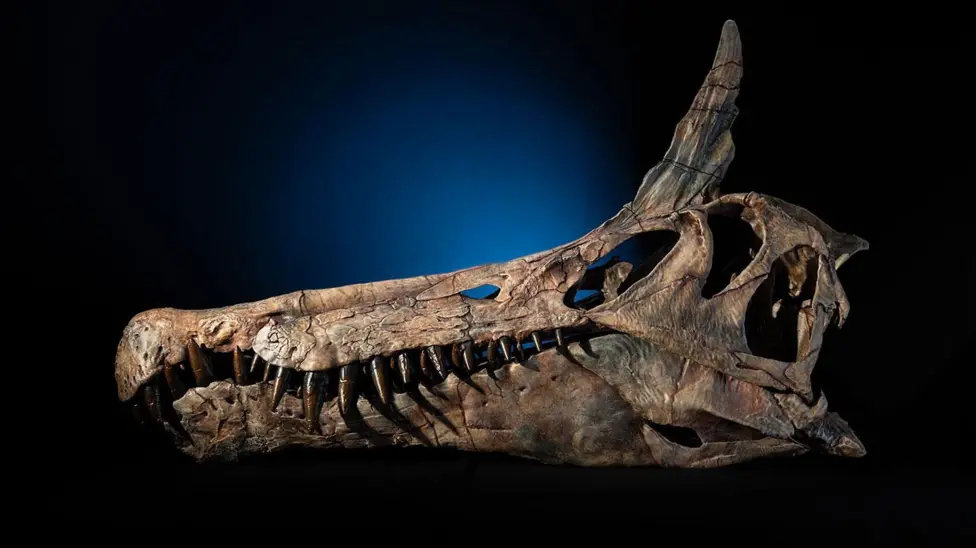
A cast of the skull of Spinosaurus mirabilis
Experts say that Spinosaurus mirabilis was among the biggest of the meat-eating dinosaurs - around the length of a bus (12 metres long) and weighing between 5-7 tonnes, about the same as a large African elephant.
It had a large head crest, which is believed to have been brightly coloured and curved toward the sky.
The team also discovered that the new dino had interlocking teeth, with its lower jaw sticking outwards, to help it catch slippery fish.
This feature is commonly seen among ancient fish-eaters, such as some types of ichthyosaurs, pterosaurs and semi-aquatic crocodiles.
The researchers unearthed fossils of multiple Spinosaurus mirabilis individuals, as well as the remains of various other dinosaurs from around 95 million years ago.
"This find was so sudden and amazing, it was really emotional for our team," Professor Sereno added.
