
Scientists discover 125-million-year-old 'spiny dragon' dinosaur fossil

- Published
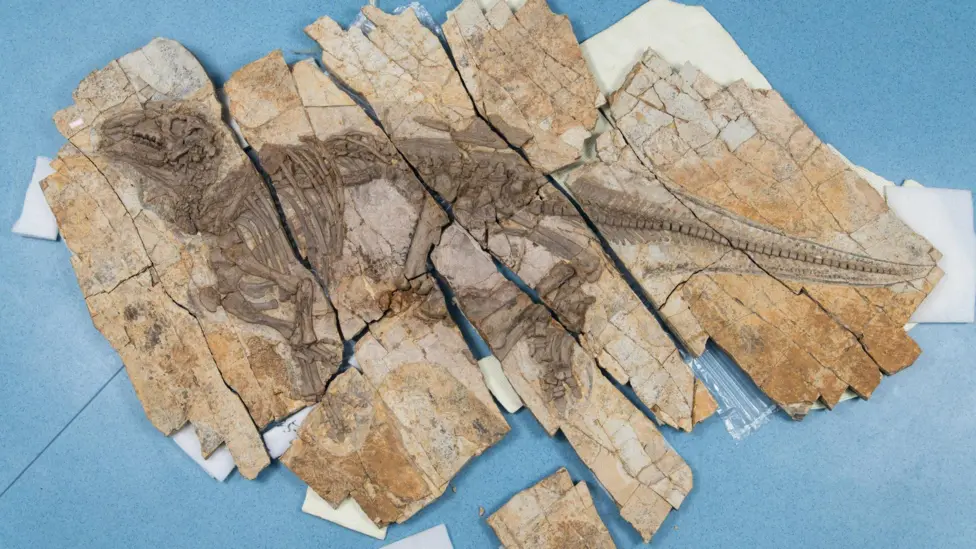
Scientists have uncovered a well-preserved 125-million-year-old dinosaur fossil in China.
Experts say it's in such good condition, that it has allowed them to see what the dinosaurs' skin really looked like.
The newly identified species has been named Haolong dongi, and belongs to the iguanodontian family.
Nicknamed the "spiny dragon", the newly-discovered dinosaur had both longer and shorter spikes across its body - a bit like a porcupine.
More like this
Chicken-sized dinosaur species discovered in Spain
- Published4 February
The AI playing 'dinosaur detective'
- Published2 February
Bones from 'longest dinosaur' found in US car park
- Published19 January
What did experts discover?
The discovery was made by an international team of scientists led by China's Anhui Geological Museum and the Institute of Natural Sciences in Belgium.
They found the new iguanodontian dinosaur in the north-east of China.
Experts say the dinosaur was a herbivore - meaning it only ate plants.
It had large overlapping scales along its tail, but its body was also covered in spikes of different sizes - structures never before seen in dinosaurs.
They think the spikes likely served as a way of protecting Haolong dongi against predators, making the it harder to swallow for the numerous other species that roamed the same ecosystem.
Other theories include the fact the spikes might have played a role in the dinosaur controlling its body temperature or helping it to sense the world around it.
In addition, the fossil also contained large areas of skin, which surprised the team.
Huang Jiandong, from Anhui Geological Museum, explained: "The complexity of dinosaur skin is far greater than we imagined."
Pascal Godefroit, palaeontologist at the Institute of Natural Sciences, added: "Finding skin preserved at the cellular level in a dinosaur is extraordinary.
"It gives us a window into the biology of these animals at a level that we never thought possible."
