
Jealous of a sibling? Baboons are too...

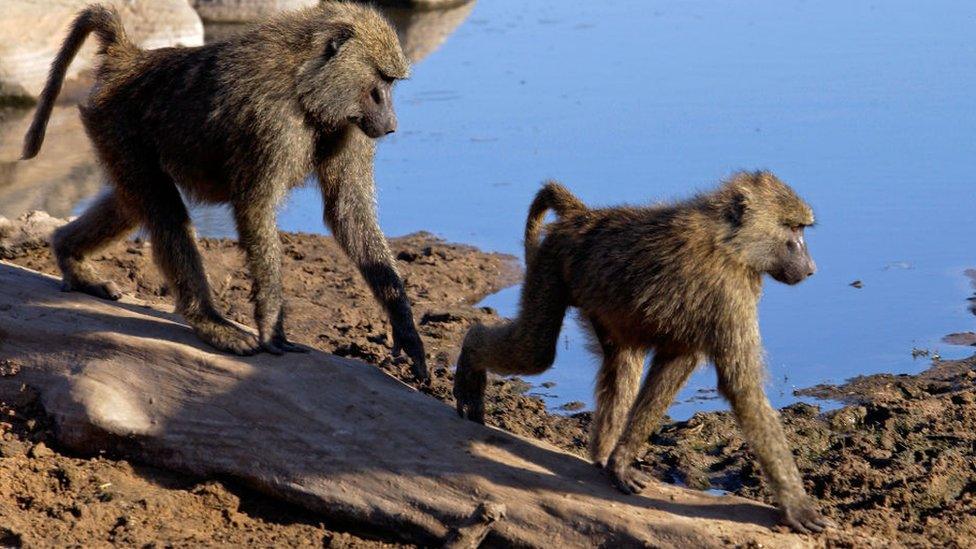
Chacma baboons spend a lot of time forming strong bonds with their mothers
- Published
If you've ever fallen out with your brother or sister, you're not alone.
Sibling rivalry is a real thing - and now the science proves that it's not just something that affects humans.
A new study of young baboon siblings has found they also compete for their mother's attention, and that some mothers even have favourites.
Some youngsters would shove their way between the mother and sibling, some would throw tantrums - some even bit and slapped their way in.
Scientist Axelle Delaunay, who led the study in Namibia said jealousy is "very complicated to measure" but there are "striking" similarities between the behaviour of jealous baboons, and children.

A mother baboon spends some quality time with a well-behaved baby
For the study, a team of researchers from Finland's University of Turku observed two troops of wild chacma baboons in central Namibia, Africa, between August and December 2021.
There were 16 families living in the troops, with a total of 49 young siblings.
Baboons live in groups ruled by the females, so the scientists spent lots of time watching baboon mothers resting and grooming their young.
Grooming involves removing bugs and dirt from fur and gently stroking it.
The scientists paid close attention to when the grooming was interrupted by a jealous sibling - often by biting, slapping, crying or more gently asking for affection.
What they found was "strikingly mirrors patterns of sibling jealousy reported in humans".
The young baboons were more likely to interrupt their mother when she was grooming one of their siblings than when she was just resting.
The study also found that the older baboons were less likely to interrupt a sibling's alone time with their mother.
But it turns out the mother baboons chose to groom some baby baboons more than others.
Bad news though - while your squabble with a sibling might be scientifically justified, Delaunay says that the displays of sibling jealousy did not appear to offer "many immediate benefits".
Baboon mothers only stopped grooming one of their children, after an outburst from another baby, about 20 percent of the time, the scientists found.
And she only then started grooming the jealous child nine percent of the time.
- Published4 July 2023


- Published23 January 2023

- Published9 April 2019
