Nasa's Artemis II rocket rolls back to launch pad ahead of second launch attempt

Nasa says the Artemis II launch could take place in early April
- Published
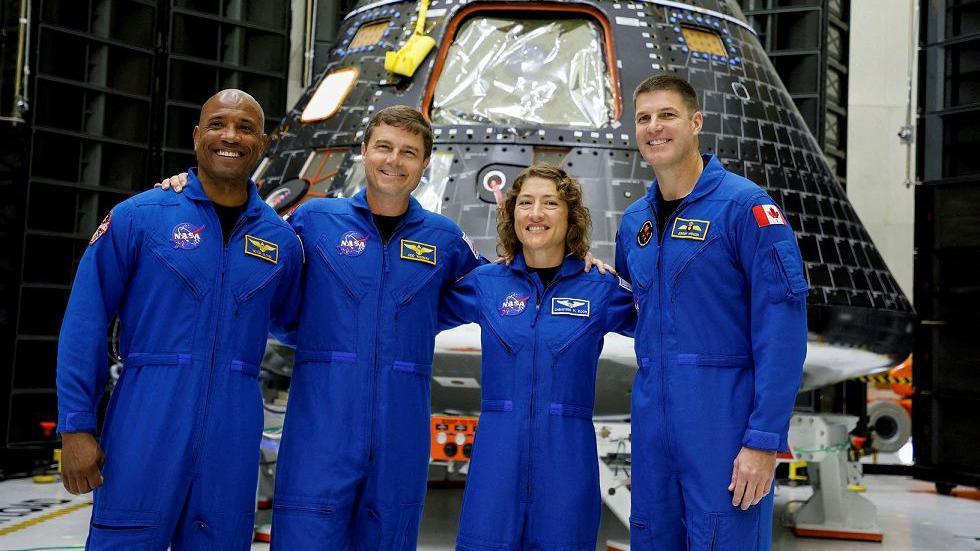
Nasa's giant Artemis II rocket, which will launch four astronauts into space for a test-flight around the Moon, is back at the launch pad for the second time.
The Space Launch System (SLS) and the Orion spacecraft have slowly and carefully been moved from the Vehicle Assembly Building (VAB) to Pad 39B at the Kennedy Space Center in Florida.
The rocket made its first journey to the launch pad on 17 January, but a problem with its helium systen meant it had to be sent for repairs, forcing Nasa to delay the launch of the mission.
But now, engineers say they've fixed the issue and that the Artemis II launch could take place in early April.

The rocket was carried by a special vehicle called the Crawler-Transporter 2
The distance between the Vehicle Assembly Building and the launch pad is only four miles, but it can take up to 12 hours for the rocket to complete its journey between the two points.
Together with its launch platform, the rocket is nearly 100m tall and weighs around 5,000 tonnes.
They were carried to the launch pad by a special Nasa vehicle called the Crawler-Transporter 2, which can only travel at a top speed of one mile per hour.

The rocket and its launch platform are about the same height as Big Ben's clock tower
Engineers at Nasa will now carry out lots of tests to make sure that the repairs on the rocket have worked.
They'll also check the rocket for any damage caused on its journey back to the launch pad.
Controllers will rehearse parts of the countdown, sending commands through the same computers and networks that will be used on launch day, but without filling the tanks with fuel.
Afterwards, the team of people that manages Nasa's missions will meet up to decide if the launch will go ahead, with the earliest opportunity being 1 April.
- Published28 February
- Published25 September 2025