New £50 note featuring Alan Turing enters circulation
- Published
- comments

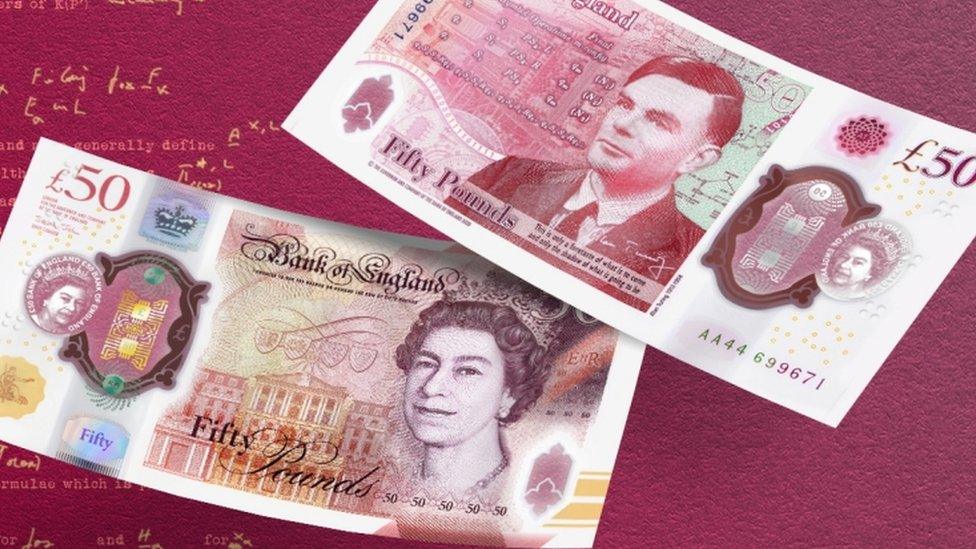
The Bank of England's newly-designed £50 note featuring the portrait of scientist Alan Turing has entered circulation.
The release date matches up with what would have been the computer pioneer and wartime codebreaker's birthday.
It means the Bank's entire collection of current banknotes is made of plastic for the first time.
Paper £50 and £20 notes will no longer be accepted in shops from October next year, although post offices will still swap them.

New £50 banknotes in production
The Bank of England's own counter can also swap any old notes for their face value.
Despite cash use falling for purchases, particularly during the pandemic, there is still a growing demand for banknotes. Population growth and storing money at home are among the reasons for the rising need for notes.
Who was Alan Turing?

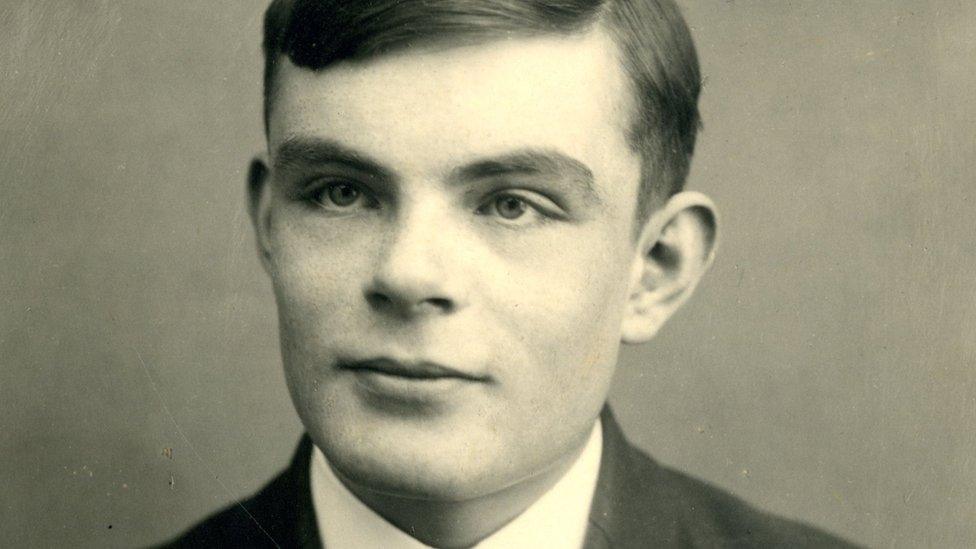
Alan Turing as a schoolboy
The note features and celebrates the work of Alan Turing, a mathematician who cracked secret German military codes during World War Two. It is thought that Turing and his fellow codebreakers shortened the war by several years, saving lives.
He was also played a key part in the development of early computers, first at the National Physical Laboratory and later at the University of Manchester.
During his life, he worked almost entirely in secret and it wasn't until long after his death that the legacy of his life and work came to light. His war-time efforts had a huge influence on the development of computer science and artificial intelligence.
He was also a victim of mid-20th Century attitudes to homosexuality and in 1952 was arrested because being homosexual was illegal in Britain at this time. Turing died on 7 June 1954.
The choice to place him on the note is also designed to promote diversity.
In keeping with his work, the new note includes security features, similar to other notes, such as holograms, see-through windows - based partly on images of the wartime codebreaking centre at Bletchley Park - and foil patches.
Why are the notes being changed to plastic?

The new design has a series of security features
The old, paper £50 banknotes are no longer being made, and will be withdrawn by the end of September next year.
Paper £20 notes, featuring the portrait of economist Adam Smith, will also be withdrawn at the same time. The replacement polymer plastic version, which shows artist JMW Turner, went into circulation in February last year.
The polymer versions should last two-and-a-half times longer than the old paper notes, are harder to copy illegally, and should also survive a spin in the washing machine.
But there have been some concerns raised about plastic banknotes, including the traces of animal products used in their production.
- Published25 March 2021
- Published6 June 2021

- Published31 January 2017