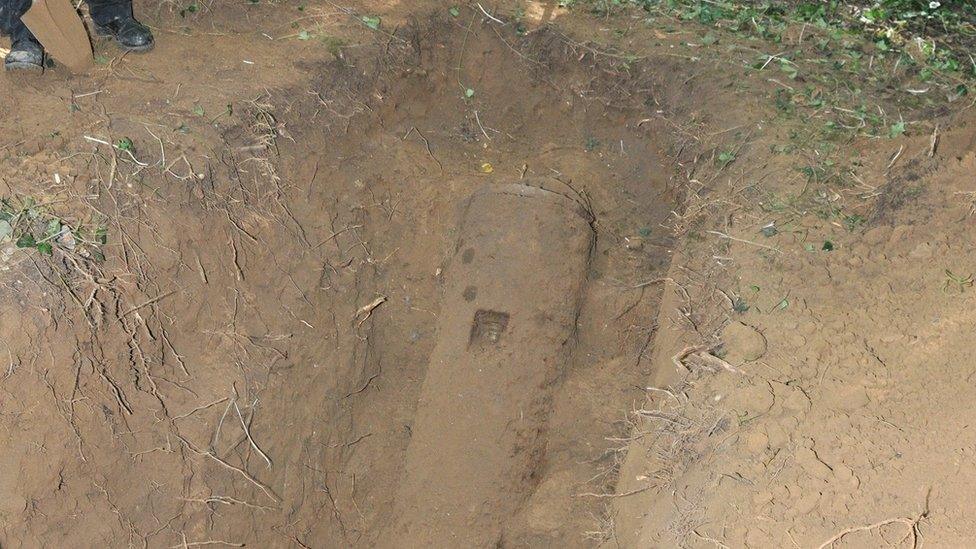
The majority of those on the memorial are Americans who served on bombers - each of which usually carried a crew of 10
The sacrifice of Allied airmen during World War Two is being marked by the islands that lived under the Nazi regime.
The Channel Islands were occupied for five years by German forces.
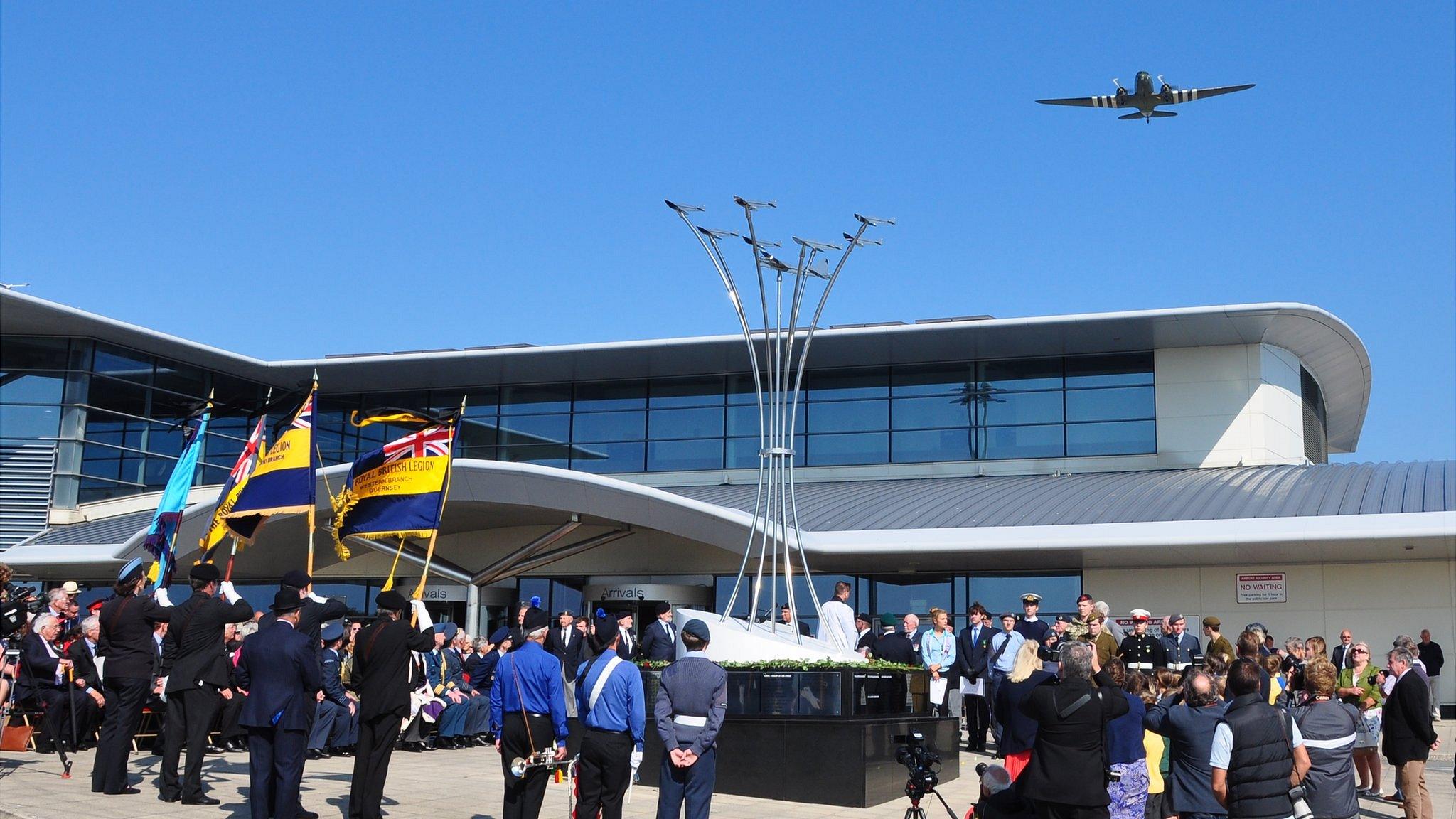
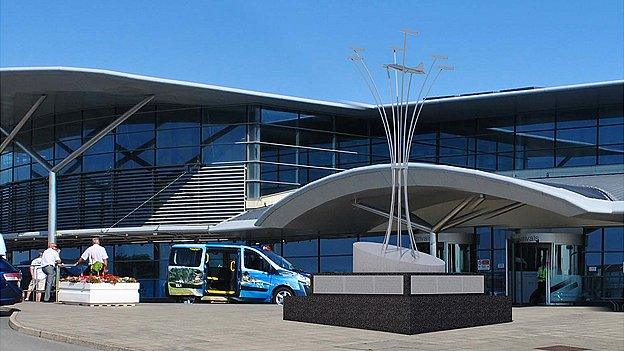
A memorial at Guernsey Airport featuring the names of 153 airmen known to have died in Bailiwick of Guernsey waters is being dedicated on Wednesday.
The work to uncover the names was led by John Goodwin, who has researched the subject for more than 50 years.
He was inspired by a line in a book that said the German garrison in Guernsey had only shot down one plane during the war - and it was one of their own.
"It's true they shot down one of their own - in August 1943 they shot down a Focke-Wulf 190 and he crashed on the back of Herm... as I got into it and realised the amount of anti-aircraft guns they had in the island I thought either they weren't trying or were damn bad shots," he said.

Allied Airmen Memorial
The 153 airmen have an average age of 24
They were from the US, Canada, Australia, New Zealand and Czechoslovakia
Some were shot down while carrying out missions over the German occupied Channel Islands, while others were returning from missions elsewhere in Europe
More airmen are known to have died in Bailiwick waters and research to uncover their names continues with room left on the memorial to represent those whose names are unknown
Most of those who died have no known graves, but of those who have been laid to rest two remain in Guernsey - both were laid to rest in the German Military Cemetery, at Fort George, by the occupying forces.
Sgt William Beach, a flight engineer with the Royal Air Force, was in the tail section of a Lancaster from 61 Squadron, which had been hit by anti-aircraft fire while over Germany on a bombing run of Berlin.

Billy Beach was 21 when he died along with two other members of the crew of his Lancaster and was laid to rest after his body washed ashore in occupied Guernsey
The badly damaged plane ran out of fuel to the north west of Guernsey on 28 January 1944 where it ditched in "horrendous seas" snapping the plane in two.
The four crew in the front section were able to get in a dinghy and after nearly two days in the water they were picked up by an air-sea rescue launch.
Sgt Beach and gunners Sgt Terence Bowden and Sgt Cyril Arthur Acombe-Hill were in the tail section, which started to sink on impact, and Sgt Beach's body later washed ashore on Guernsey.
Mr Goodwin said: "His sister Milly Wilson, who is still alive... [was] thrilled to hear Billy's name would be on the memorial."
Canadian 22-year-old Flt Sgt Conrad Peter Vivian Biddlecombe was part of the crew of a Mitchell, a twin-engined bomber, that launched an attack on a target in Normandy on 18 June 1944.
The plane was last seen over the English Channel at 02:15 on 19 June.

After the war the body was exhumed and identified as Flt Sgt Biddlecombe and he was reburied with a Commonwealth War Graves Commission headstone
Mr Goodwin said it ditched close to Guernsey's north coast and all four crew died.
He said Flt Sgt Baggery is recorded as buried at sea so was presumably picked up by a British naval vessel, Flt Sgt Ahearn's body is buried at Bayeux having been washed ashore in France, while Flt Sgt Ulens was never found.
Flt Sgt Biddlecombe's body was washed ashore in Guernsey on 27 July, although Mr Hamon said there was a disparity in the records as to where he was found on the coast.
He said a post-war exhumation and examination revealed the Flt Sgt's identity and he was reinterred with a headstone.
The majority of those remembered on the memorial are Americans as they were serving on bombers, which usually had a crew of 10 including pilots, engineer, navigator, radio operator, bombardier and gunners.

The crew of Piccadilly Commando, including a photographer, survived the crash, but only two of the crew of Speedball lived after they spent a winter's night on a reef
Among the incidents recorded in the diaries of Guernsey residents is seeing formations of Allied bombers and fighters heading towards France on New Year's Eve 1943.
Two of the B17 Flying Fortresses - named Piccadilly Commando and Speedball - were veterans of the conflict.
Piccadilly Commando suffered heavy damage shortly after dropping its bombs, which saw the plane drop behind the formation on the return to England where it became a target of the German fighters picking off the stragglers.
Although the crew fought off the attack and shot down two fighters the bomber had insufficient fuel to cross the Channel.
It came down off the coast of Guernsey and - although shot by the onshore batteries and only one life raft operating - the 11-man crew all made it safely to shore, where they were imprisoned by the German authorities.
The crew of Speedball was involved in the same raid, but were less fortunate. The plane was heavily damaged by fighters and came down 12 miles north of Guernsey.
The nine crew that survived spent the cold winter's night huddled on a reef 300m (1,000ft) offshore with all but two of them succumbing to the weather or the tides.

Items recovered from the wreck of Piccadilly Commando include a machine gun, oxygen tanks, parts of the cockpit instruments panel and some bomb shackles
More Allied airmen were known to be lost in Bailiwick waters, but their names remain unknown.
Simon Hamon, from the Channel Islands Occupation Society, said: "Research is only as good as the information available.
"Taking one day in September 1944, there are four or five diary accounts of a B17 hugging the coast and two fighters based at the airport engaging it.
"That day there were 1,500 aircraft on bomber runs that morning and 36 B17s were lost.
"We've been able to whittle it down to 16 possible aircraft which we know must have come down mid-channel and would have passed potentially close to the Channel Islands.
"There's no doubt in our minds that that incident happened, we cannot whittle it down beyond the 16 and therefore we have to leave those names off."
- Published9 September 2015
- Published8 May 2015
- Published3 October 2014
- Published11 May 2014
- Published4 November 2013
- Published9 September 2013
- Published30 October 2013
- Published20 August 2013