
The US Declaration of Independence, printed by an expatriate from Strabane, has gone on display
As millions of Americans celebrate Independence Day, a rare copy of the Declaration of Independence has gone on display at the Ulster American Folk Park near Omagh.
The document has unexpected connections to County Tyrone.
"Life, liberty and the pursuit of happiness" - the words of the US Declaration of Independence were read in the 13 colonies which regarded themselves as independent from the British state in July 1776.
On the night of what became Independence Day, a young man from Strabane was typesetting and checking those words before the document was sent out.
John Dunlap left his home in 1757 at the age of ten for Philadelphia to serve an apprenticeship with his uncle, a printer and bookseller.
By 1776, he had already made a name for himself, publishing a popular weekly newspaper.
That year, he secured a contract for printing with the Second Continental Congress and on the 4th July, 1776, the congressional president, John Hancock, ordered Dunlap to print the newly agreed Declaration of Independence.
The 200 copies printed by the Tyrone man became known as the Dunlap Broadsides.
One of the few remaining copies is now on display in the Ulster American Folk Park, after it was discovered in the National Archives some years ago.
Dr Phil Mowat, head of emigration for the National Museums of Northern Ireland and curator of the Folk Park, said the idea behind the document was to spread the word about independence through the 13 colonies.
"Quite a significant proportion of the estimated three million people in the colonies at the time weren't convinced that independence was the thing to have, as there was a certain security in being part of a British empire," he said.
"But it obviously worked. The Dunlap Broadside convinced everybody that they should be independent, and they fought for their independence."
Rally
While Independence Day is celebrated on 4th July, the declaration was not actually read out in all the colonies that night.
"It was a significantly large area and obviously, distribution was by horseback," said Dr Mowat.
"So it took a couple of months to get to the furthest-flung reaches, like Georgia. But nevertheless, they succeeded in doing it."
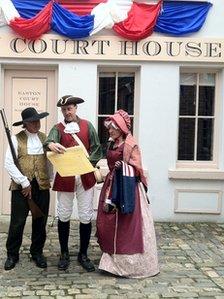
Actors at the folk park recreate how it was read in public spaces
The first three places to hear the Declaration read publicly were Easton in Northampton city, Trenton in New Jersey and Philadelphia, on 8th July 1776.
The Dunlap Broadsides bearing the wording were read aloud in squares and outside banks and courthouses, to rally people to the cause.
Just 26 copies remain of the Dunlap Broadsides, regarded as the most contemporary version of the declaration written that night by the Second Continental Congress.
Another local man, Maghera native Charles Thomson, is also named on the original document.
He was the secretary of the Continental Congress and created the Great Seal, still used by the Office of the President to this day.
With so many local links to the Broadside, Dr Mowat says there is a sense of the Declaration coming home.
"It's a wonderful document. You could summarise it by saying that this is a copy of America's birth certificate," he says.
The Dunlap Broadside is on display at the Ulster American Folk Park until September.
- Published4 July 2012
- Published29 December 2011
