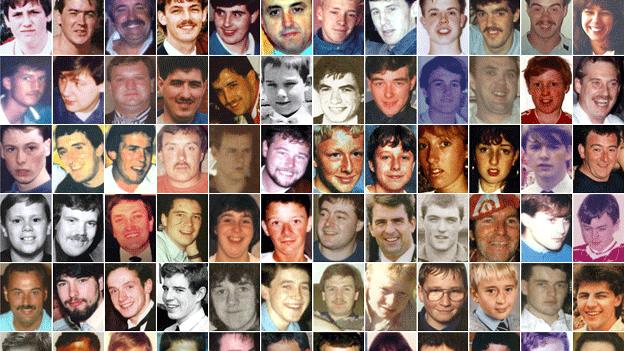
Andrew Brookes was among the 96 people who died in the Hillsborough disaster
Initial efforts to save one of the 96 victims of the Hillsborough disaster lasted for about a minute and 10 seconds, a jury has heard.
The new inquests into the 1989 tragedy focussed on the final movements of Liverpool supporter Andrew Brookes.
Former ambulance officer Leslie Worrall - who gave initial treatment to the 26-year-old - agreed it was "not very long" but said he had not felt a pulse.
A fan said he felt a faint pulse, saw his chest moving and eyes "flickering".
Brian Johnston said he also swore at a doctor who told him "he's gone" after assessing Mr Brookes for a "matter of seconds".
Mr Brookes, a car worker from Bromsgrove, Worcestershire, travelled with friends to the Sheffield stadium for his team's FA Cup semi-final against Nottingham Forest on 15 April 1989.
The jury saw pictures of Mr Brookes inside a fenced enclosure on the Leppings Lane terraces between 15:01 BST and 15:08 BST, just after kick-off.

Fatal crushing broke out at the Leppings Lane end of Hillsborough stadium on 15 April 1989
Video footage showed police carrying Mr Brookes out of the terraces at 15:28 BST.
A police officer, believed to be PC Christopher Plumridge, was seen giving Mr Brookes "vigorous" chest compressions, the court heard, while Mr Worrall gave artificial ventilation with a bag and mask.
Michael Mansfield QC, representing Mr Brookes' sister Louise, said that the resuscitation attempt lasted "about one minute and 10 seconds".
He said: "He comes out of the gate, he is put down. Nothing happens. Then he is picked up and moved a little bit further forward.
"So, it's the second time he is put down - from that point to the moment the hoarding arrives, when he is, as it were, carted off down the pitch, is about one minute and 10 seconds."
"That's not very long, is it?" he asked Mr Worrall, who replied: "It's not very long, no."
Mr Mansfield said that was "not a criticism" of Mr Worrall, who was working in a "fairly chaotic situation".
'Faint pulse'
The QC added: "In those circumstances, it's quite difficult to perhaps detect signs of life that are very faint?"
Mr Worrall replied: "It's difficult, but obviously you feel for the pulse.
"If there was a faint pulse, I would have felt a faint pulse, but there was not one."
Mr Worrall also said he had no specific recollection of treating Mr Brookes on the pitch.
Mr Mansfield asked whether the ambulance man suggested "at any time" that Mr Brookes should be put in the recovery position when he was loaded on to a makeshift stretcher.
Mr Worrall said he could not "recollect" doing so.
'Moving chest'
Mr Johnston was one of the Liverpool fans who helped carry Mr Brookes on a stretcher along the pitch. He said he saw Mr Brookes' chest "rising and falling".
He then helped try to resuscitate Mr Brookes at the Spion Kop end of the pitch.
Asked if there was any response to their first aid, Mr Johnston said: "Not when I first - we first started it - there was not, no.
"Well, I believe a bit later on that I, we did see - or I personally did see Andrew's chest move. So I thought we had got him back and I checked and I'm sure that there was a faint pulse there, which made me continue to do CPR."
When a doctor who assessed Mr Brookes for a "matter of seconds" told him "he's gone", Mr Johnson said: "I remember swearing at him and telling him not to be stupid."
The inquests, sitting in Warrington, Cheshire, are due to resume on Monday.

Who were the 96 victims?

BBC News: Profiles of all those who died
- Published23 September 2015
- Published22 September 2015
- Published24 September 2015
- Published16 September 2015
- Published9 September 2015
- Published7 September 2015
- Published26 April 2016