Summary

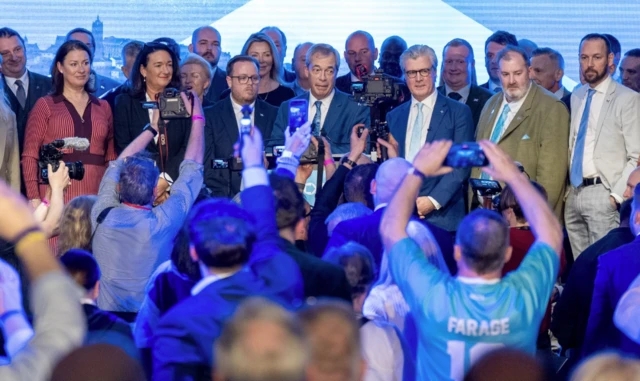
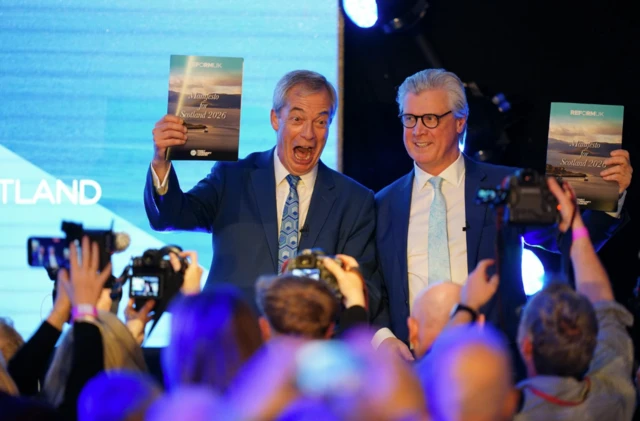
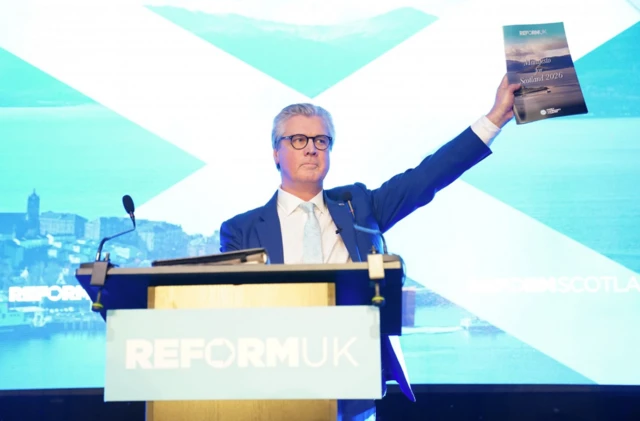
  • Reform UK Scotland's leader Malcolm Offord delivered his keynote speech at his party's manifesto launch in Bishopton, Renfrewshire

  • He promised that if his party won the Holyrood election in May, the "first thing" to do would be to "cut income tax"

  • The party said it would take 10 years - the equivalent of two parliamentary terms - to implement manifesto pledges designed to "turbocharge the economy in Scotland"

  • Voters north of the border will go to the polls on 7 May to elect 129 members of the Scottish Parliament

Media caption,

Reform will cut tax in Scotland, says Offord

  1. Reform UK Scotland manifesto launch: The Headlinespublished at 17:02 GMT
    farage launchImage source, PA Media

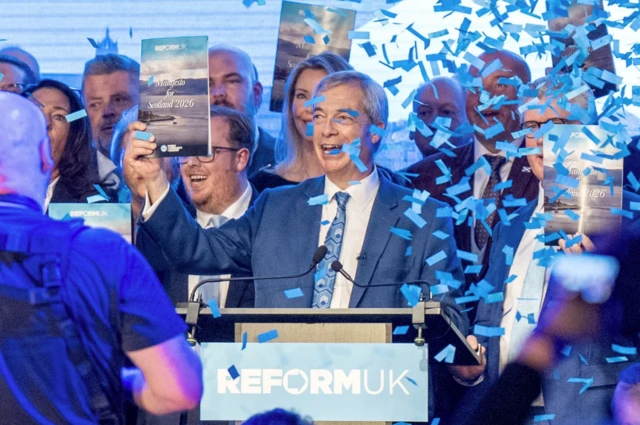
    That's all from our live coverage of the Reform UK Scotland manifesto launch. Here's a reminder of the key lines that emerged this afternoon:

    • Reform UK has vowed to cut Scottish income tax below rates in England as Nigel Farage's party launched its manifesto for the Holyrood election
    • Malcolm Offord, the party's leader in Scotland, said the tax system north of the border would be brought into line with the rest of the UK's before being cut
    • Offord, a former Conservative peer, also pledged to reform the NHS, cut "unsustainable" welfare spending and "rehabilitate" the North Sea oil and gas industry.
    • The manifesto was launched at Reform's first Scottish conference, with the party unveiling its constituency candidates for the election
    • Farage, who also spoke at the conference, said his party stood "with our people, not those who come to Britain illegally"
    • He also predicted Reform would become Holyrood's second largest party, though he said the party could "surprise" some people

    Thank you for joining us.

  2. Analysis

    Manifesto promises 'consequences' for bad behaviour in schoolspublished at 16:57 GMT

    Katy McCloskey
    Senior producer, Scotland education

    The Reform manifesto says the policy of inclusion in school has been an ‘illusion’ and that headteachers are discouraged from excluding disruptive pupils. It is true that schools have moved away from a punishment approach into a ‘nurture’ approach in response to behavioural issues in recent years.

    It is the case that exclusions – both permanent and temporary – have fallen in Scotland, by around 75% in 20 years. In 24/25 there were around 10,000 cases of exclusion across the country and they were more likely to be amongst pupils from deprived backgrounds. They are also more likely to be boys and have additional support needs.

    The Scottish government recently provided guidance to teachers on the use of consequences in the classroom and yesterday delivered an update on a three-year plan on improving relationships and behaviour in schools.

    The manifesto pledges to provide ‘advanced support’ to school heads aiming to maintain discipline by ‘using exclusion as an essential tool’ in a move to teach pupils that there ‘are consequences for disruptive activity’.

  3. What are other parties saying about the Reform manifesto?published at 16:37 GMT

    reform crowd at conferenceImage source, PA Media

    There's been reaction to the speeches already from four parties in Scotland.

    Scottish Conservative leader Russell Findlay says “Reform is the gift that keeps on giving …to John Swinney" and that Lord Offord is providing a "roadmap to another referendum".

    But SNP Depute Leader, Keith Brown MSP says Farage and "his band of mercenaries couldn’t care less about Scotland", saying they would sell off the NHS "in a heartbeat".

    For Scottish Labour, Jackie Baillie says "reform simply is not in this race" and “this manifesto has been scribbled on the back of a cigarette packet and the sums don’t add up.

    Scottish Greens MSP Patrick Harvie says Reform UK risks taking Scotland backwards and their manifesto would benefit the wealthy and stoke division.

    Scottish Lib Dem MSP Jamie Greene MSP asks why Reform and the Toies don't "just merge into one big toxic right-wing entity".

  4. Analysis

    There are familiar themes in Reform's health policiespublished at 16:30 GMT

    Claire McAllister
    BBC Scotland health reporter

    Fixing the NHS is front and centre of Reform's manifesto but plans on how to do that are vague. Reform UK say it would immediately establish an independent, expert review of healthcare.

    It would look at plans to train more NHS staff, expand services in the community and in GP surgeries and come up with creative solutions for delayed discharge.

    These are familiar themes and already part of Scottish Government and health board’s plans such as controversial walk-in GP clinics.

    A core pledge is to “cut waiting lists” as one in nine Scots are waiting for specialist NHS treatment. This ambition is mentioned in the opening and final pages but with no further information.

    Undoubtedly the NHS faces enormous strain with waiting lists and with unfilled vacancies but bold promises to make Scotland a world leader again will require significantly more detail.

  5. Analysis

    Different tones from Malcolm Offord and Nigel Farage speechespublished at 16:23 GMT

    David Wallace Lockhart
    Political correspondent

    FarageImage source, PA Media

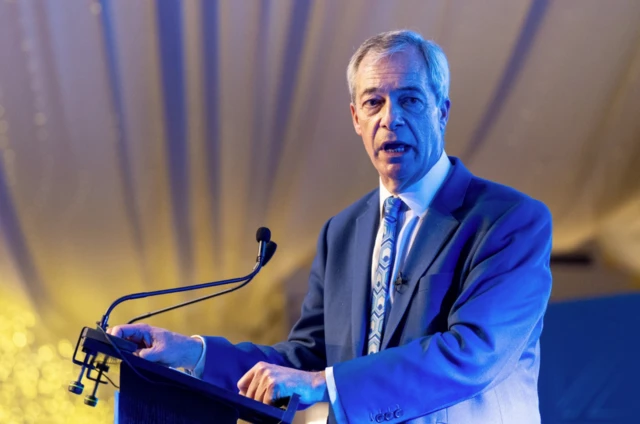
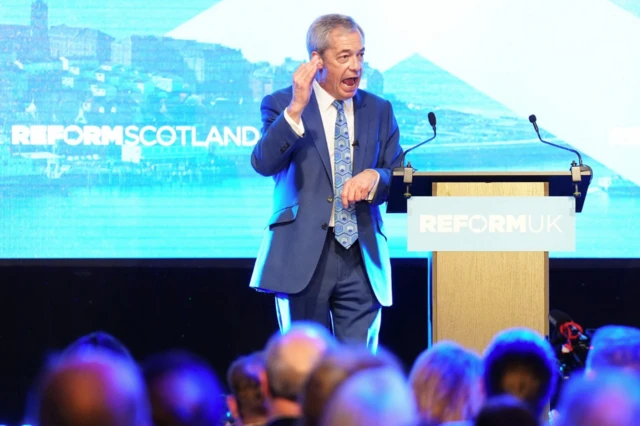
    There was a definite tone shift in the speeches from Malcolm Offord and Nigel Farage.

    Lord Offord - Reform’s leader in Scotland - focussed quite heavily on devolved issues and policies, with an eye on the looming Scottish election.

    Though he did touch on immigration and cultural cohesion.

    Nigel Farage spent quite a bit of his speech focusing on “mass public praying” by Muslims in London. He insisted this was an issue that would soon come to Scotland.

    Both speeches went down well with party members, but it definitely felt like Farage was more willing to stray into controversial territory.

  6. Analysis

    What would the role of councils be under Reform?published at 16:14 GMT

    Jamie McIvor
    BBC Scotland News Correspondent

    There has been discussion in recent years over what the precise role of local authorities should be.

    Do they deliver what are essentially national services controlled by the Scottish government - like education - but tailor them to local requirements? Or do they exist to provide the local services that local people say they want?

    Most council funding currently comes from the Scottish government. If local authorities were to "raise their own revenue" what would this mean in practice? Some would fear that councils would either be much smaller in their scope or would need to levy a wide range of charges.

    Reform's manifesto doesn't say what statutory obligations could potentially be lifted from local government. The devil would be in the detail. Some statutory obligations are vague.

    For instance, councils need to have a library service but there are no decrees over how many libraries there should be, when they should be open or how much should be spent on them.

    Proposals to phase out Land and Buildings Transaction Tax and business rates and replace them with an annual property tax are an interesting contribution to the funding debate. But there is no mention of replacing the council tax.

    The question of city mayors in Scotland has already been the subject of some debate. Some have argued they could have a part to play - especially in the Glasgow conurbation and in nearby towns which is split between a number of councils.

  7. Malcolm Offord pledges Reform tax cuts for Scotlandpublished at 16:08 GMT

  8. BBC Verify

    How would Reform change Scotland's tax system?published at 16:02 GMT

    Phil Sim, Scotland Political Correspondent

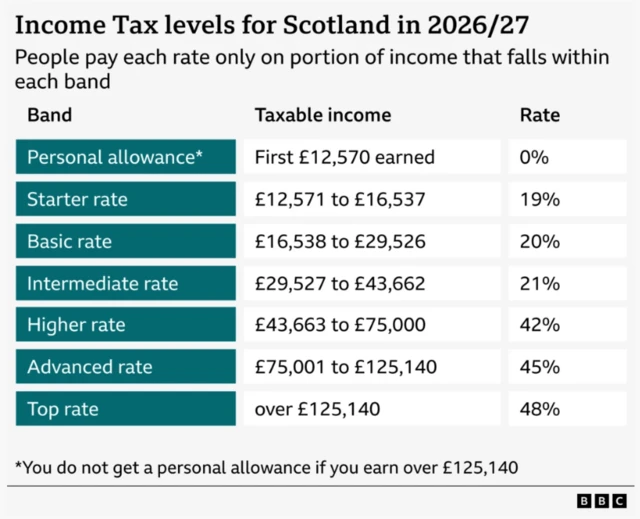
    Reform’s headline plan is to get rid of Scotland’s devolved six-band income tax system, bringing it back into line with the three-band system used in England.

    Each of the three bands would then be cut to 1p below the rate used in England, with the goal of going further by the end of parliament - saying this would ultimately pay off by boosting economic growth.

    So there would be a 19p basic rate, a 39p higher rate and a 44p additional rate.

    graph

    The Institute for Fiscal Studies says the party’s costing for that initial cut, at £2bn, is a “reasonable estimate” in the short term, although costs would increase over time.

    As to where that money comes from, Reform says it could find £1bn by cutting “ideological Net Zero projects”.

    For context, the Scottish government has said £5bn of spending will go towards climate-friendly initiatives in the coming year. But this is a broad definition including the £3bn budget for public transport (from nationalised rail services to ferries) and the £925m budget for affordable housing - both of which Reform agree with investing in.

    The entire allocation for the “climate action and energy” portfolio is £446m - which includes the running costs of bodies like Scottish Water, and already reflects a 17.2% cut from the previous year.

    Reform also talks about clawing back £6.5bn of funding from “unaccountable quangos” - arm’s length government bodies.

    However by far the biggest spenders among these bodies are things like the Scottish Funding Council - which underwrites Scotland’s colleges and universities to the tune of £2bn a year - where cuts also may not prove straightforward.

  9. Analysis

    Reform would reinstate the 'local connection' rule in relation to homelessnesspublished at 15:59 GMT

    Chris Clements
    Social Affairs Correspondent

    Amid rising homelessness figures and council housing stock under pressure, the Scottish government declared a national “housing emergency” in 2024. In response, Reform wishes to reinstate the “local connection” rule that was scrapped more than three years ago.

    Previously, a housing applicant needed to have a connection to the local authority – such as living in the council area for six months or more. This was changed and councils must now provide temporary accommodation to those who present as homeless, regardless of point of origin.

    The Scottish government and some charities had said this was to give homeless people more “choice and control about where they live”. But Reform argues this has led to “breaking point” and links the issue to the asylum system, particularly in Glasgow.

    Using figures obtained by the Scottish Conservatives, Reform says 76% of applications with no connection to the city came from outside Scotland, referring to Glasgow as “the asylum capital of the UK”.

    While the manifesto links this to the abolishing of local connection rules, the city council said this was due to changes in the way asylum applications were processed by the Home Office when declaring its own emergency in 2023.

    Elsewhere, Reform says it will commit to building 15,000 homes a year by changes to the planning system.

  10. Here are some other policies in the manifesto:published at 15:47 GMT

    • Reduce the number of constituency seats in the Scottish Parliament from 73 to 57
    • Form a department of government efficiency to "cut waste and duplication"
    • Shut down all quangos - public bodies operating at arms-length from the government.
    • Reviewing the number of civil servants and limiting opportunities to work from home
    • Ending lengthy public inquiries "which transfer taxpayers' money to lawyer"
    • Reforming planning laws for businesses
    • Prevent the construction of large solar and battery farms
    • End the phase out of oil boilers from rural homes
    • Abolish low-emission zones

  11. Analysis

    'Tax cuts, welfare reform, firmer justice measures'published at 15:43 GMT

    David Wallace Lockhart
    Political correspondent

    farage and offordImage source, PA Media

    Tax cuts, welfare reform, firmer justice measures. Much of Reform’s Scottish manifesto could be described as being within the mainstream centre right.

    There isn’t much that could be described as hugely radical - many Conservatives would agree with most, if not all, of it.

    And that’s deliberate. This party may criticise the political mainstream, but they’re hoping to join it by returning a big chunk of MSPs in May.

    And therefore they’ve gone for policies that aren’t too "out there" politically.

  12. Reform's manifesto points on immigrationpublished at 15:39 GMT

    The party claims that "strangers" are being "prioritised ahead of Scots" under the current SNP administration.

    It says that immigrants who adopts Scottish "values" - which the manifesto describes as being "generous, kind, amusing, hard-working, law-abiding and fair-minded" - is to be welcomed.

    But it pledges to "promote cohesion and delivery for Scottish communities" by restoring a housing rule, external that meant local authorities could refer homeless applicants to other council areas if they were deemed not to have a connection to the area.

    Reform says it would scrap Glasgow's status as Scotland's main dispersal city for successful asylum seekers.

  13. Here's what Reform says on Justicepublished at 15:35 GMT

    Reform also says it will impose harsher jail sentences for repeat offenders, increase prison capacity and end early release programmes designed to cut the inmate population.

    The party has also pledged to tackle the "shoplifting epidemic" in Scotland and scrap hate crime legislation introduced in 2024.

  14. What about Reform UK's Net-Zero policies?published at 15:31 GMT

    We're continuing to bring you summaries of the policies in the Reform UK Scotland manifesto, this time focusing on the party's approach to net-zero.

    It has pledged to scrap all net-zero subsidies - which can come in the form of grants and interest-free loans - to homeowners, businesses and communities for projects such as energy efficiency and decarbonisation.

    The party also says it would scrap targets to cut fossil fuel emissions and arms-length public bodies involved in net-zero policy.

    The manifesto sets out ambitions to "rehabilitate" the North Sea oil and gas industry to make it Scotland's "primary energy system", as well as ending government opposition to new nuclear power stations in Scotland.

    It claims "using our own natural resources again will reduce household bills immediately".

  15. Social Security in Reform manifestopublished at 15:26 GMT

    Reform claims the SNP has created a "welfare economy which punishes aspiration and success".

    The gap between what the Scottish government spends on social security and what it receives from the UK Treasury as a result of equivalent spending south of the border is forecast to be £1.1bn in 2026-27, rising to £1.2bn by 2030-31. The overall social security bill is forecast to rise to £9.2bn by then.

    Reform describes this spending is unsustainable and says it will reduce the outlay on welfare. The manifesto also vows to impose "rigorous face-to-face assessments of claimants".

  16. Analysis

    Media met with mixed response at conferencepublished at 15:22 GMT

    David Wallace Lockhart
    Political correspondent

    farageImage source, PA Media

    As the conference continues we’re on to questions from the press. GB News are up first and get a big cheer from the audience.

    But the BBC are up next, and there’s a lot of booing from the crowd, which Nigel Farage intervenes to stop. There’s then more booing for STV.

  17. Here are the party's thoughts on Scottish independencepublished at 15:19 GMT

    The Reform manifesto pledges to "make Scotland the most successful part of the UK".

    It also says arguments for independence are "pie-in-the-sky", claiming there is "no appetite" for another referendum "any time soon".

  18. What does Reform say about Health?published at 15:17 GMT

    The party has committed that the NHS would remain free at the point of need and fully funded by general taxation. It pledges to establish a Scottish Healthcare Reform Commission within the first six months of taking office.

    This expert body is to examine options including "creative" solutions to tackled delayed discharge from hospitals, social care reform, improved prevention strategies, expanded community healthcare and the adoption of the NHS England app in Scotland.

  19. Let's look at Reform UK Scotland's tax plans...published at 15:12 GMT

    The Scottish government has used its devolved powers to set up a distinct income tax system, with six bands to the UK's three.

    Reform is proposing to scrap Scotland's extra bands and align the remaining bands with rates in England. Thereafter the party aims to cut the rates by 1p - creating a 19p basic rate, a 39p higher rate and a 44p additional rate.

    The manifesto sets out plans to cut each band by up to 3p lower than in England by the end of the parliamentary term

  20. Reform UK Scotland's five core pledgespublished at 15:08 GMT

    malcolm offordImage source, PA Media

    Reform Scotland UK's 5 Core Pledges

    1. Fix NHS and cut waiting lists
    2. Cut taxes and make work pay
    3. Lower your energy bills
    4. Prioritise local people and restore law and order
    5. Build Scotland for the future